

Mid-Week Market Reversal: Consumer Data Impact
Wednesday, August 19, 2026
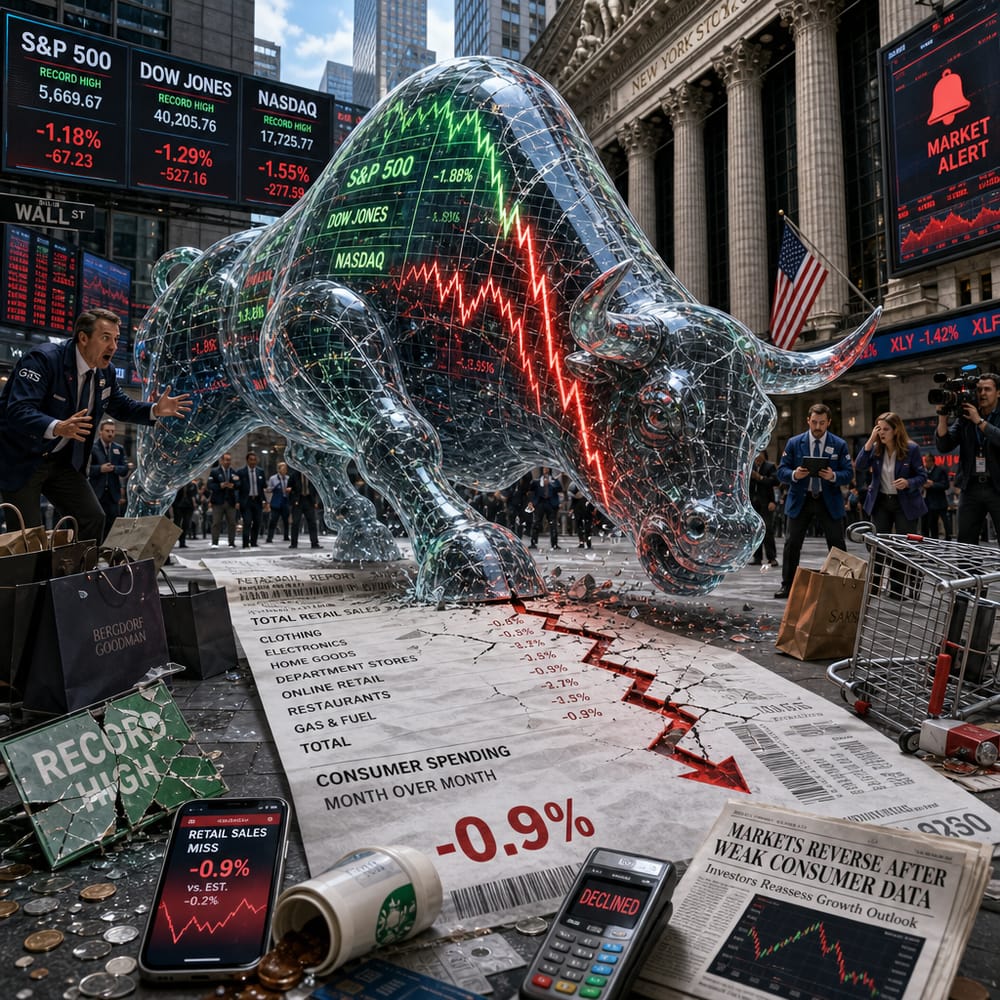
MID-WEEK MARKET REVERSAL: CONSUMER DATA IMPACT
Don’t blink or you might miss it: The S&P 500 teetered on the edge of new heights this week before doing a dramatic U-turn, like a tightrope walker who suddenly finds the rope a little too wobbly. The culprit? Weak retail spending data that had investors reconsidering their optimism faster than a shopper re-thinking that impulse buy at the register.
Riding high midweek, the S&P 500 was strutting with all the confidence of a high school prom king. But by the end of the week, it felt more like it had just been dumped on prom night. What gives? It turns out consumers have been gripping their wallets a little too tightly, and that’s enough to spook even the bravest bull.
THE DATA THAT DID THE DAMAGE
Let’s break it down: Recent retail spending reports showed a slowdown, which threw cold water on the idea that consumers were ready to spend like there was no tomorrow. Normally, consumer spending is the engine that keeps the economic train chugging along—accounting for roughly 70% of the U.S. economy. So when Americans start pinching pennies, alarms start ringing on Wall Street.
The weak retail data suggests that consumers are feeling the heat from high prices at the pump, especially in places like California where diesel has reached stratospheric levels at $7 a gallon, thanks to international turmoil. It’s no wonder folks are hesitating before splurging on that new set of patio furniture.
IMPLICATIONS FOR THE FED
So, what does this market roller coaster mean for the Federal Reserve’s policy decisions? The Fed has been navigating its own tightrope act between controlling inflation and avoiding a recession. This shaky consumer data could make the Fed more cautious about raising interest rates again. The Fed has been on a rate-tightening spree to tame inflation, but if consumers start pulling back, they might decide to tap the brakes.
The big question on everyone’s mind: Is this a temporary blip or a sign of more economic turbulence ahead? If consumers continue to shy away from spending, the Fed might just keep its finger off the rate hike trigger to avoid pushing the economy into a recessionary spiral.
RIPPLE EFFECTS ON MARKET STABILITY
The sudden shift in market sentiment underscores just how sensitive the markets are to consumer behavior. It’s like watching a cat walk across a piano, waiting to see which key it’s going to step on next. If consumer spending doesn’t pick up, it could spell trouble for market stability, as investors like a predictable tune.
This weariness among consumers isn’t just a problem for retail stocks; it’s a wave that could wash over broader sectors. Let’s not forget, a skittish consumer can ripple out to impact everything from tech stocks to industrial giants. After all, if people aren’t buying, companies aren’t making money, and that’s bad news for everyone with a stake in the market.
MOVING FORWARD
As we move forward, investors will be keeping a hawk-eye on consumer trends. Retailers like Lowe's have already signaled that shoppers are cautious, with spending on home improvements under pressure. If this trend continues, it could mean more volatility ahead.
But let’s not descend into doom and gloom just yet. Markets are nothing if not resilient, and savvy investors know there’s often opportunity amid uncertainty. Perhaps it’s time to dig into those market bones and look for assets that thrive even when consumer sentiment dips. Tech and healthcare have shown they can hold their own, even in a downturn.
In the end, the market’s reaction to consumer data is a stark reminder: In the game of investing, the only certainty is uncertainty. Keep your eyes peeled, and you might just spot the next opportunity before it zooms by.
This article is for informational purposes only and is not investment advice. Always do your own research or consult a licensed financial professional before making investment decisions.
© Copyright 2024. All Rights Reserved.
© Copyright 2024. All Rights Reserved.