

MGM Resorts (MGM) – Takeover Offer Withdrawn, Sharp Stock Drop
Thursday, September 24, 2026
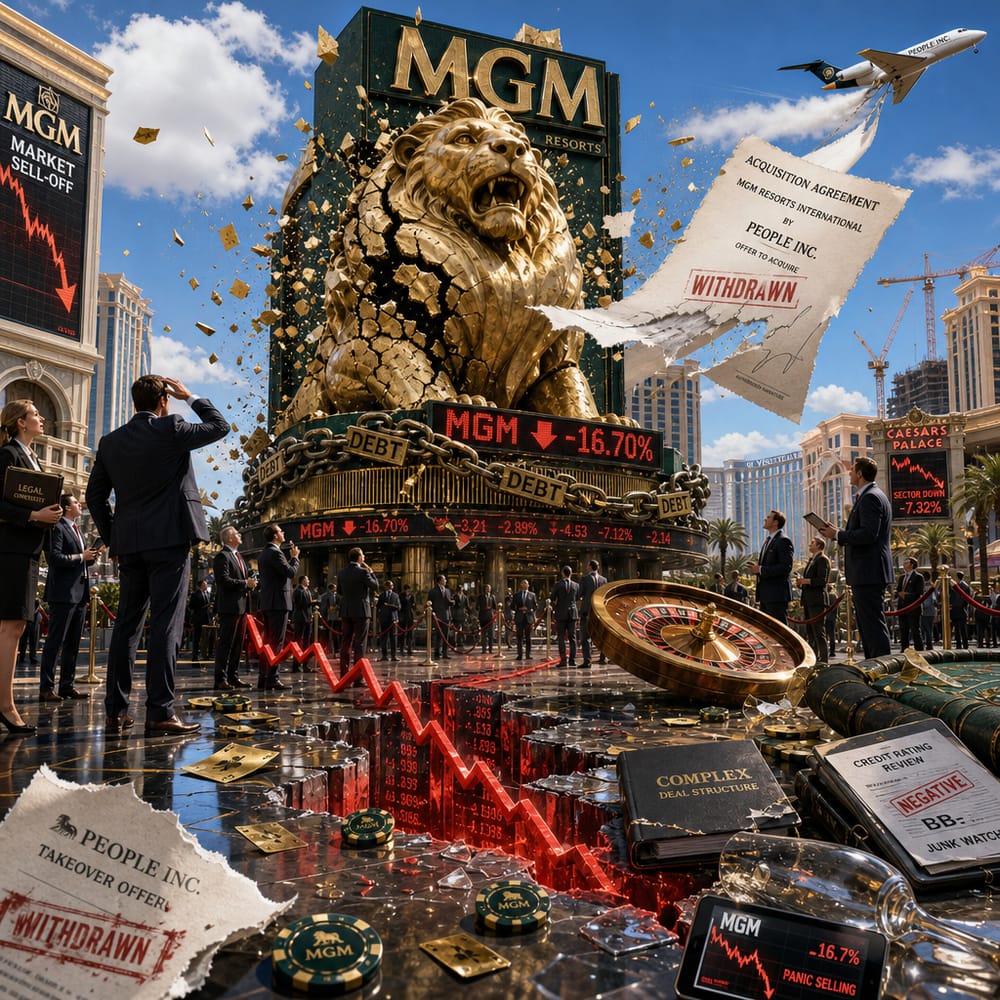
MGM Resorts Learns the Hard Way: The Gamble of a Failed Takeover
Picture a high-stakes poker game in a dimly lit Las Vegas casino. The chips are stacked, players are tense, and then—bam! The chip leader folds unexpectedly. That’s pretty much what happened to MGM Resorts this week, as People Inc. suddenly pulled out of a takeover deal that was supposed to be a jackpot. Instead, MGM’s stock felt the sting, dropping like a plunging roulette ball, down 9%. So, why exactly did People Inc. take its chips off the table, and what does this mean for MGM and the broader casino industry?
To start, let’s talk about what went down. Barry Diller, the head honcho over at People Inc., initially made eyes at MGM with a tantalizing offer—$48.30 per share. A pretty sweet deal, right? Especially considering People Inc. already held a chunky 26.1% of MGM’s stock. But just like a magician’s disappearing act, the deal vanished. Diller cited "deal complexity" and "debt concerns" as his reasons for backing out. Translation? The arithmetic just didn't work out, leaving MGM at the altar.
What’s love—or in this case, a merger—got to do with it? Well, apparently not much when you peek under the hood. Diller’s team likely crunched the numbers and realized that saddling People Inc. with MGM’s debt would’ve been akin to a Python swallowing a beach ball. People Inc. didn't want to add a financial weight that could pull them under. So, they bailed.
This unexpected exit has MGM stockholders feeling as jittery as a cat in a dog park. Investor sentiment took a nosedive, and who could blame them? The news yanked MGM's valuation downwards faster than a blackjack dealer can say "busted." For a company that relies on a steady stream of tourists and gamblers, this kind of volatility is anything but reassuring.
But hey, MGM isn’t the only player in town. The broader casino industry should also be taking notes. M&A—or mergers and acquisitions for the uninitiated—is the name of the game in today's fast-moving market. But as this episode shows, making a marriage work between giant corporations isn't easy, especially when debt is the unwelcome third wheel. The casino sector, already bogged down by the pandemic and shifting consumer behaviors, now has to contend with this fresh uncertainty.
One eyebrow-raising question remains though: could People Inc. circle back to MGM, say, after Hollywood’s next superhero flick? Diller hinted that they might be open to revisiting the deal at some point. But that’s a big if—like waiting for a unicorn to come strutting down the Las Vegas Strip.
In the meantime, MGM has some soul-searching to do. They must reassess their strategies to woo investors back and perhaps even make themselves more palatable to future suitors. A few tweaks to the balance sheet, maybe some creative restructuring, and MGM could be back in the game. Until then, they’ll need to rely on their ace in the hole: the timeless allure of Sin City itself.
So, what does this mean for you, the savvy retail investor? Well, if you’ve got your chips in MGM or are thinking about joining the table, keep an eye on their next moves. The casino sector is still a wild ride, loaded with risks and potential payoffs. Just remember, this isn’t the slot machine where you press a button and cross your fingers. In this high-stakes game, staying informed is your best bet.
In conclusion, MGM's recent brush with a takeover shows just how dicey corporate courtships can be. It serves as a wake-up call for investors and companies alike to look before they leap—or in this case, before they ante up. As they say in Vegas, always know when to hold 'em and when to fold 'em. MGM is holding—for now. How they play their hand next will be a show worth watching.
This article is for informational purposes only and is not investment advice. Always do your own research or consult a licensed financial professional before making investment decisions.
© Copyright 2024. All Rights Reserved.
© Copyright 2024. All Rights Reserved.