

Memory-Price Surge Spurs AI Infrastructure Cost Reassessment
Sunday, November 15, 2026
MEMORY-PRICE SURGE SPURS AI INFRASTRUCTURE COST REASSESSMENT
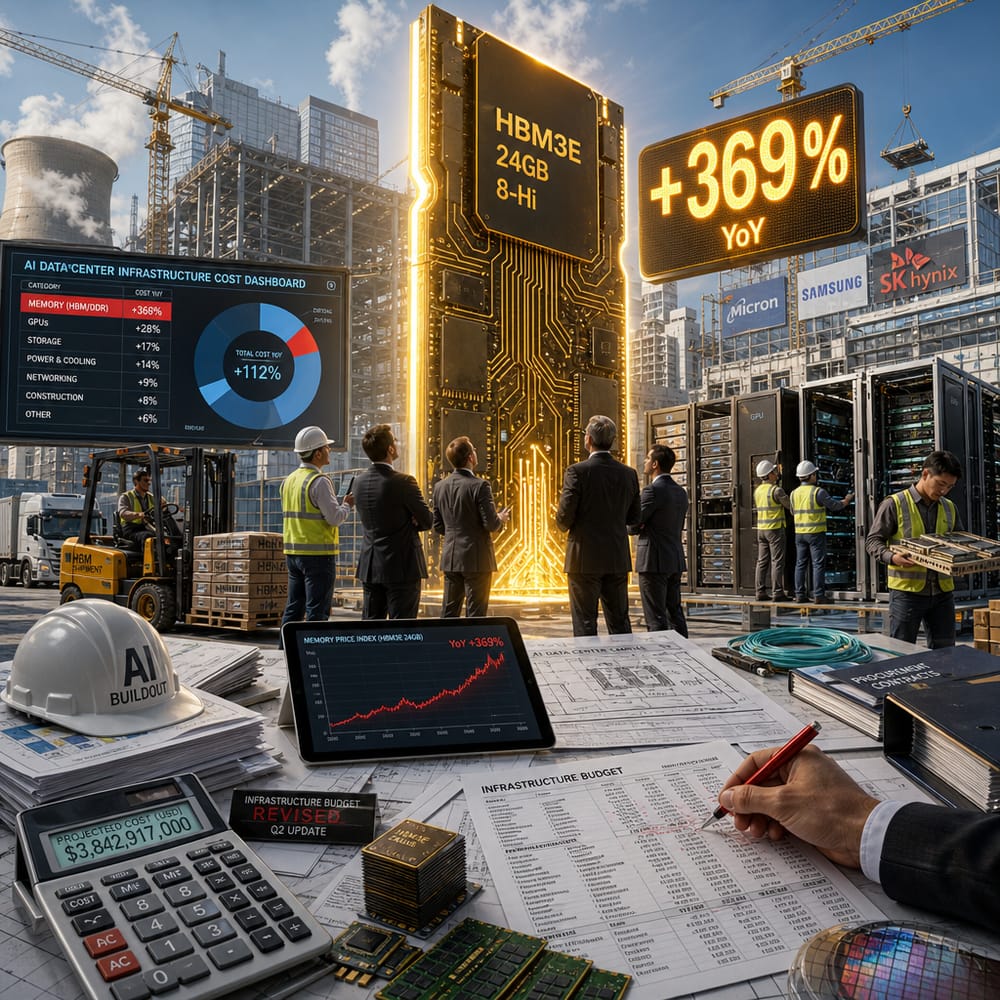
Ready for a mind-bending stat? Memory chip prices have skyrocketed a staggering 369% over the past year. No, that's not a typo. It's a surge more volcanic than Mount Vesuvius, and it's being fueled by insatiable demand from AI data centers. These aren’t your average neighborhood server farms; they’re the digital brains behind every language model chat, high-def video stream, and creepy accurate recommendation you receive. But the question looms: What does this explosive price hike mean for cloud service providers and the semiconductor sector?
PLUMPED-UP PRICES
Let’s start with the question on everyone’s lips: why the sudden price surge? Put simply, it's a matter of demand outpacing supply. AI applications require massive amounts of data storage and processing power, which chew through memory like a kid in a candy store. But here's the kicker: it’s not about more chips being sold. It’s all about the price tags getting heftier.
For cloud service providers, who rent out server space like digital landlords, this spells a potential margin squeeze. With costs rising faster than a Tesla in ludicrous mode, they might have to reassess their pricing strategies. We're talking about tech giants like Amazon Web Services, Microsoft Azure, and Google Cloud. They’re possibly facing an unpalatable choice: swallow the increased costs or pass them on to customers. It’s a real Sophie’s Choice of the digital age.
HARDWARE HARDSHIPS
So, how does this affect the semiconductor stocks? Well, companies behind these memory chips, like Micron Technology, Samsung Electronics, and SK Hynix, are suddenly the belle of the ball. Investors are watching with hawk-like precision, ready to pounce on opportunities. The semiconductor sector has become the darling of Wall Street, thanks to the AI boom. But here's the rub: the party could get a bit too wild if prices scare off buyers or if the economic conditions shift.
Chipmakers are in a bit of a dance-off, trying to balance cutting-edge innovation with cost management. They need to ramp up production without cratering margins. It's a tightrope walk that would make a circus performer sweat. And investors, take note: how these companies navigate these choppy waters will likely dictate their stock performance.
STRATEGIES IN THE AI ARMS RACE
Now, let’s talk defense strategies. How are companies coping with these price pressures? Well, for starters, cloud service providers are turning to edge computing—moving processing closer to the data source—as a tactic to cut down on high bandwidth costs. By distributing data processing closer to the edge, companies can reduce the load on data centers and potentially the amount of memory required.
In the semiconductor arena, firms are investing heavily in research and development to create more efficient chips. The goal is to deliver more bang for your buck—higher performance without a proportionate increase in cost. It's the smart chip equivalent of squeezing a fifth gear out of a four-speed engine.
Additionally, some companies are exploring partnerships and long-term supply agreements to secure better pricing. This isn’t just a stopgap but a strategic maneuver to ensure stability in a volatile market.
THE INVESTOR'S CALCULUS
For investors eyeing the semiconductor sector, this is a high-stakes game. One misstep, and the chips might not fall in your favor. But if you've got the nerve and the foresight, the rewards could be substantial. Keep an eye on how these companies innovate and adapt in the face of price pressures. Those who can effectively manage costs and continue pushing the innovation envelope are likely to stand out as leaders.
The memory chip conundrum is far from a trivial issue—it’s reshaping the very economics of data centers and AI infrastructure. For retail investors peering through the looking glass, the focus should be on the companies that are not just surviving this storm, but thriving because of it.
As AI continues to weave itself into the fabric of everyday life, the memory-price rollercoaster isn’t just a headline—it’s a signpost pointing to where digital gold might be mined. Fasten your seatbelts, folks. It's going to be a thrilling ride.
This article is for informational purposes only and is not investment advice. Always do your own research or consult a licensed financial professional before making investment decisions.
© Copyright 2024. All Rights Reserved.
© Copyright 2024. All Rights Reserved.