

Markets Trim Odds of October Rate Hike After Cooling Jobs and Dovish Fed Voices
Sunday, October 11, 2026
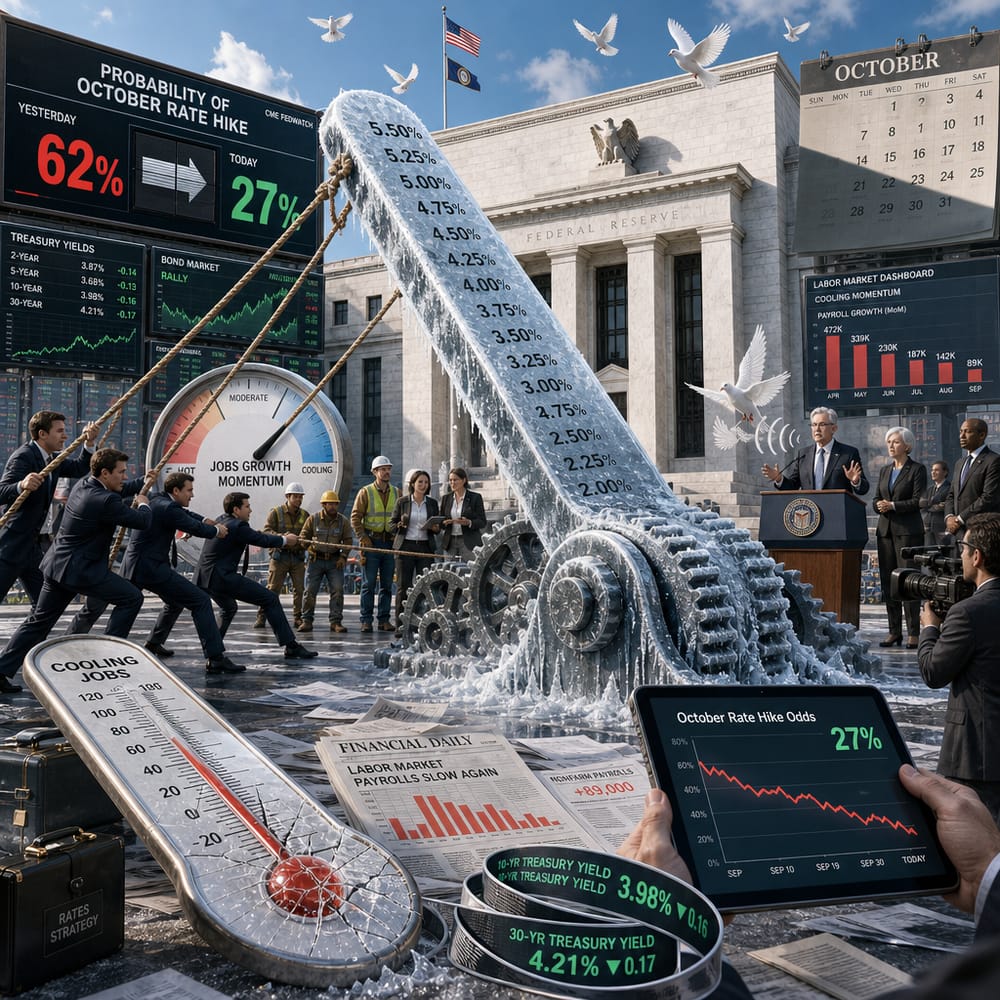
A slight change in the wind is enough to send markets fluttering like a bird in a storm. And recently, it seems the Federal Reserve has been dropping hints like breadcrumbs, leaving investors to speculate and recalibrate their strategies. With labor market growth hitting the brakes and some Federal Reserve officials suddenly sounding like doves in a cooing contest, the odds of an October rate hike are shrinking faster than an ice cube in July.
Let’s back up a bit. Not long ago, the possibility of an interest rate hike was the financial world’s worst-kept secret. It was practically a done deal. But a deceleration in job growth has thrown cautious optimism into the mix. Investors now find themselves dusting off their crystal balls, trying to predict the next move from the Fed's enigmatic chessboard.
First, let's talk job numbers. Recent data suggests the labor market is not the roaring lion it once was. September's job reports show hiring is veering towards the pedestrian, rather than the sprint we’ve been used to seeing. This slowdown in job creation has been music to the ears of those who dread rate hikes, as it signals a cooling economy, which could prompt the Fed to keep rates steady.
Moreover, several Fed officials have recently adopted a softer tone, suggesting they might not be in a rush to increase rates. This shift towards dovish territory — where interest rate hikes are avoided to encourage borrowing and investment — has investors scrambling to adjust their sails.
So, how are investors reacting to this monetary magic show? For starters, the bond market is doing a delicate dance. With fewer rate hikes on the horizon, bond yields have taken a dip. Lower bond yields make equities more appealing, causing stocks to gain some ground. This seesaw effect is classic market behavior, as investors hunt for the best returns.
On the equities front, we might witness a rotation into growth stocks, which tend to perform better when interest rates are low. Tech shares, in particular, which were once the darlings of the market, could see a resurgence as they usually benefit from cheaper borrowing costs.
Investors are also likely to reassess their strategies around financial stocks. Banks and other financial institutions often benefit from higher interest rates, which can lead to better margins on loans and mortgages. With the likelihood of a rate hike waning, there may be a cooling effect on these stocks.
Beyond Wall Street, the economic impacts of holding interest rates steady could be far-reaching. For one, it could provide a breather for the housing market, which has been under pressure from rising borrowing costs. With mortgages potentially remaining affordable, potential homeowners might find some relief.
On a broader scale, a delayed rate hike could serve as a lifeline to developing countries grappling with high debt levels. The UN recently warned that rising borrowing costs, coupled with energy crises and climate challenges, are a triple threat to these nations. A stable interest rate environment might just offer them a smidgen of much-needed support.
But before we pop the champagne, it's worth noting that the Fed’s decision-making process is as complex as the plot of a telenovela. While the current indicators suggest a pause, this could all change if inflation rears its head again or if global economic conditions take a turn.
Investors, ever the opportunists, will continue to hang on every word from the Fed, ready to shift gears at a moment’s notice. In the meantime, like a cunning chess player, the Fed will keep its next move a mystery.
In this game of financial musical chairs, one thing is clear — the market is always in flux, driven by a thousand moving parts and an equal number of predictions. For now, it seems like the music has slowed, but keep your ears open. In the world of finance, the tempo can change in an instant.
This article is for informational purposes only and is not investment advice. Always do your own research or consult a licensed financial professional before making investment decisions.
© Copyright 2024. All Rights Reserved.
© Copyright 2024. All Rights Reserved.