

Markets Dial Back Rate-Hike Odds After Weak Jobs Print
Monday, August 10, 2026
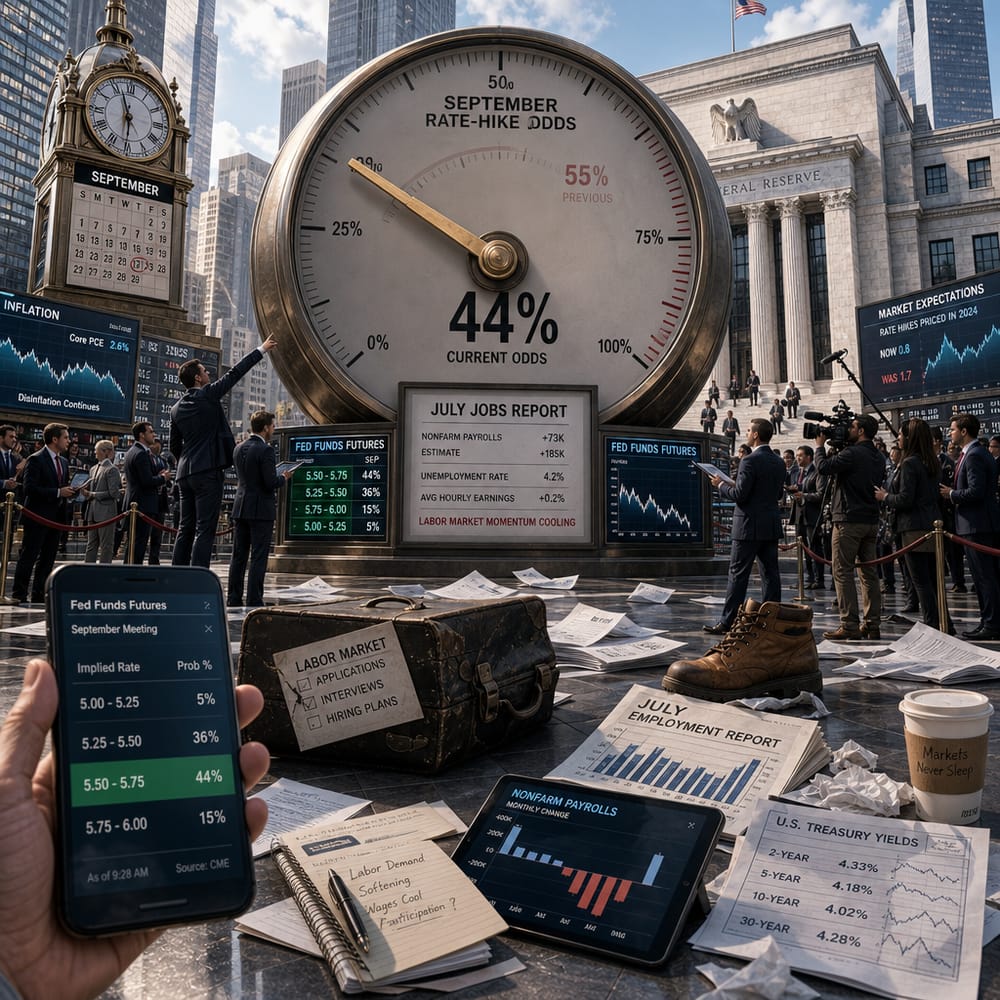
MARKETS HIT THE PAUSE BUTTON: JOBS REPORT SHAKES UP RATE-HIKE EXPECTATIONS
Just when you thought it was safe to assume the Fed might keep the rate-hike train chugging along, the latest jobs report slammed on the brakes. In the world of finance, a weak jobs report is like a bad first date—awkward, full of unmet expectations, and a definite game-changer.
On the back of a July jobs report that left more to be desired than a soggy sandwich, investors are recalibrating their rate-hike expectations faster than you can say "inflation." Just a day before, the likelihood of a September rate hike stood at 55%. Overnight, it slipped to 44%, like your enthusiasm after reading the word "meh-conomy."
UNDERSTANDING MARKET REACTIONS
So, how are markets reacting to this less-than-stellar jobs data? Well, it's like watching a juggler drop one too many balls—there's a lot of scrambling. Fed funds futures, which are essentially bets on the direction of Fed policy, are now less confident in a rate hike. Think of them like your friend in Vegas who decides after losing $20 that maybe blackjack isn't their thing after all.
With fewer new jobs than a retail store on a Monday morning, the economy just signaled it might be shifting from "hot" to "cozy." This puts the Federal Reserve in a tight spot akin to walking a tightrope between "taming inflation" and "not squashing growth."
THE INFLATION PUZZLE
Inflation remains the elephant in the room. And, like any elephant worth its salt, it's hard to ignore. The Fed's rate decisions are like trying to balance that elephant on a seesaw—tricky, to say the least. Inflation data is crucial because it tells the Fed whether it needs to cool down an overheating economy or stoke the fires a little more.
But here's the kicker: even with a weaker jobs report, inflation hasn't run off to hibernate. It's still very much active, like the stubborn fireplace that keeps crackling away no matter how much water you throw on it. The Fed has to weigh these inflation numbers heavily before making its next move.
INVESTOR STRATEGIES IN AN UNCERTAIN FED ERA
So, what should you, the savvy retail investor, do as the Fed plays a game of wait-and-see? First, don't panic. Remember, investing is a marathon, not a sprint. In times of uncertainty, it's crucial to ensure your portfolio remains as diversified as a buffet at an international food festival. Diversification is your financial safety net.
Consider keeping an eye on sectors that might demonstrate resilience regardless of rate hikes—think technology, which is less reliant on borrowing, or consumer staples that people buy regardless of economic jitters. Companies like Nvidia, which continue to innovate in tech, might be worth a look as they march on with ambitious plans despite market wobbles.
Additionally, stay nimble. With inflation still a key player, opportunities might arise in inflation-protected securities. It's like carrying an umbrella on a cloudy day—you might not need it, but if you do, you'll be glad you brought it.
THE BIGGER PICTURE
In the grand scheme of things, remember this: The Fed’s decision-making process is about as straightforward as a riddle wrapped in an enigma. Investors need to be agile, ready to pivot, and always keep an ear to the ground for the latest economic data.
While the jobs report threw a curveball, it's not the end of the game. The Fed's decisions will continue to sway the market, and being informed and prepared is your best bet in this ever-evolving landscape. So, keep your eyes peeled, your portfolio diversified, and your expectations calibrated.
In other words, stay sharp, stay curious, and ready for the next twist in the economic tale. After all, in the world of finance, the only constant is change.
This article is for informational purposes only and is not investment advice. Always do your own research or consult a licensed financial professional before making investment decisions.
© Copyright 2024. All Rights Reserved.
© Copyright 2024. All Rights Reserved.