

Market Volatility Amid AI Swings and Russell 2000 Anomaly
Monday, July 27, 2026
MARKET VOLATILITY AMID AI SWINGS AND RUSSELL 2000 ANOMALY
Step aside, Hollywood blockbusters; the real drama's unfolding on Wall Street, where the plot twists are thrilling even the most seasoned investors. Just when you think you've got a grip on the market, indices throw curveballs like a Russell 2000 anomaly and AI volatility that make your average roller coaster look like a kiddie ride. Buckle up, because this financial thriller is far from over.
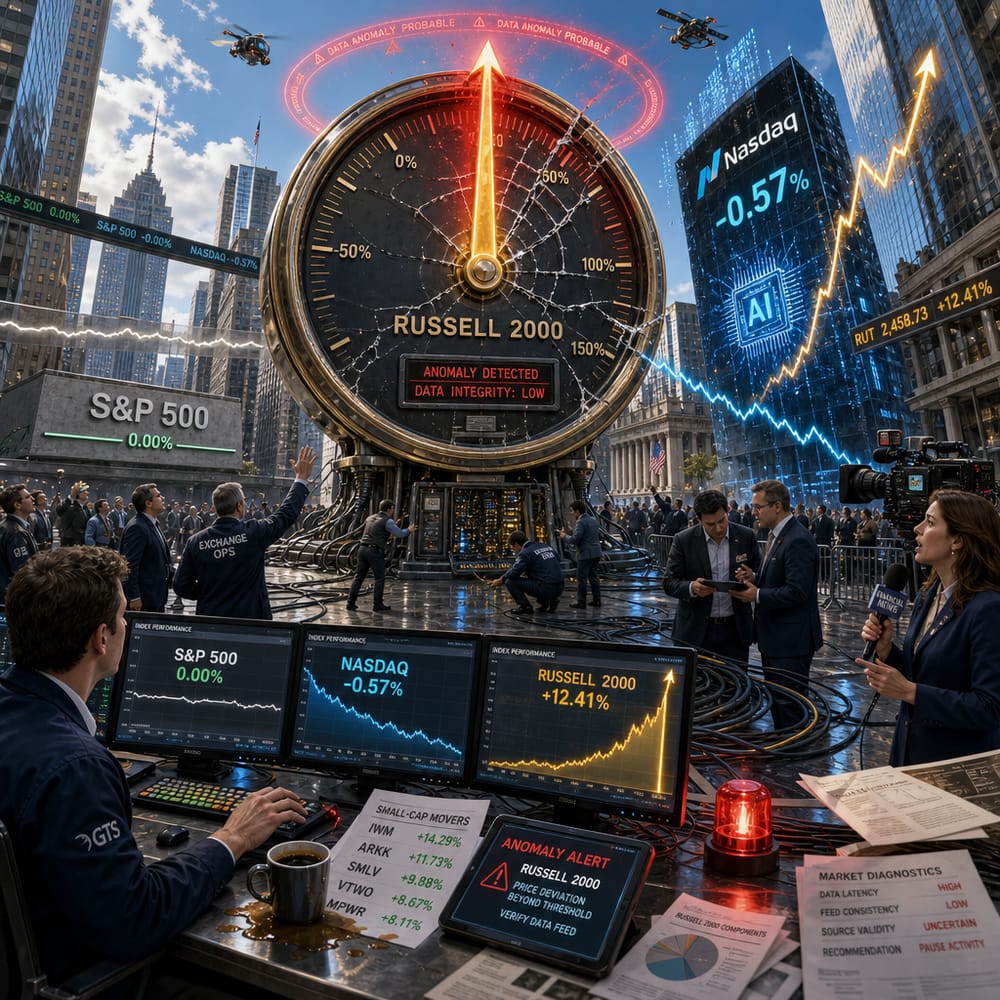
Last week, while the S&P 500 played it cool and flatlined, the Nasdaq took a 0.57% dip, proving once again that tech can either be your best friend or an unpredictable frenemy. But the real head-scratcher was the Russell 2000's bizarre spike. You know, the index that likes to hang out with smaller public companies and normally doesn’t cause much fuss? Suddenly, it decided to make headlines with a leap that left analysts scratching their heads, tea leaves in hand, trying to divine its message.
So what caused this Russell 2000 spike? Theories are swirling faster than a cat chasing a laser pointer. Some suggest it could be an erroneous data entry or a technical glitch. You know, the financial equivalent of sending a text to the wrong group chat. Others think it might be investors misreading signals amid the noise of economic reports and international tensions. Or maybe it was just a wild market dance induced by algorithmic trading systems—those quirky little bots that sometimes go rogue when they smell volatility.
And speaking of volatility, let's lay some blame at the feet of artificial intelligence. AI's been as erratic as a caffeinated squirrel lately, especially in the tech sector, where it's been swinging stock prices around like it's auditioning for Cirque du Soleil. AI promises futuristic wonders and market efficiencies, but right now, it's also a source of investment whiplash. Investors anticipate AI-driven innovations, keeping them tentatively hopeful, but also on edge, bracing for every twist and turn.
Amid this backdrop of uncertainty, it's crucial to not misinterpret these anomalies as the market's death knell or a harbinger of doom. Instead, they serve as reminders that the market's pulse is as unpredictable as ever. The Russell 2000's jump might not be a real sign of small-cap companies suddenly outdoing tech giants, but it does highlight the need for investors to dig deeper into the numbers and not rely solely on headline figures.
In this complex environment, keeping a cool head and a diversified portfolio becomes more important than ever. Think of it as having an eclectic playlist—if one song (or stock) isn't working for you, another might just hit the right note. It's also a great time to be on the lookout for potential buying opportunities, as the chaos often presents gems for patient and savvy investors.
For those who feel like they're wandering through a financial funhouse, here's a tip: Let the data-driven developments guide your strategy. While AI might be a capricious player today, don't discount its long-term potential to reshape industries. Understanding its impact and the ripple effects on different sectors will put you in good stead. And don't ignore the macroeconomic factors, like geopolitical shifts and tariffs, that are influencing market sentiment daily.
In the end, navigating the current market landscape might feel a bit like trying to solve a Rubik's Cube in the dark, but remember, you're not alone. Analysts, advisors, and even that sharp-witted friend who always seems to have a knack for these things are here to help. So take a deep breath, analyze your strategy, and maybe even embrace the chaos a little—after all, unpredictability is what gives the market its edge and character.
As we brace for the next wave of market mania, keep an eye on those indices, question the anomalies, and don't let the AI-induced whiplash throw you off. Because in the financial world, much like in life, it's about keeping your cool amidst the storm and knowing that every twist and turn eventually leads somewhere intriguing.
This article is for informational purposes only and is not investment advice. Always do your own research or consult a licensed financial professional before making investment decisions.
© Copyright 2024. All Rights Reserved.
© Copyright 2024. All Rights Reserved.