

Market Sentiment and Volatility Gauges Flash Mixed Signals
Sunday, November 15, 2026
MARKET SENTIMENT AND VOLATILITY GAUGES FLASH MIXED SIGNALS
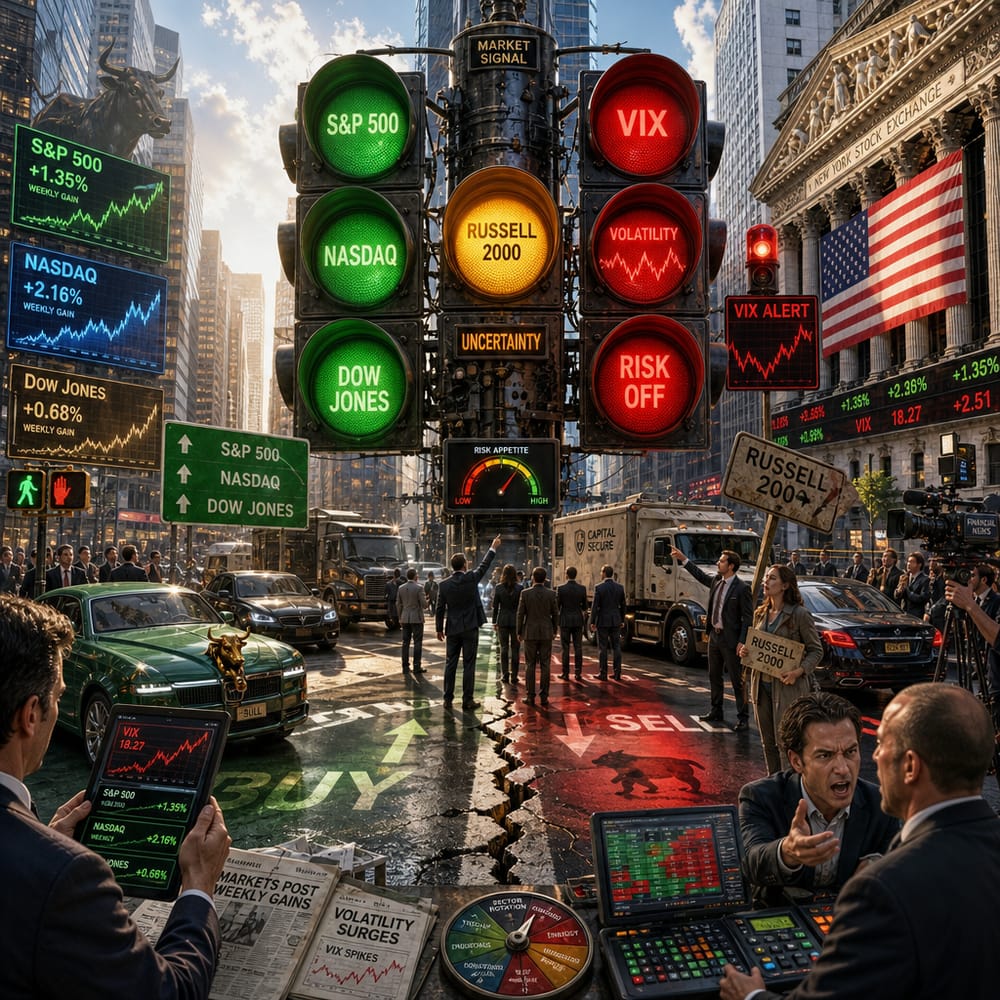
When the market serves up a cocktail of mixed signals, it’s time to put on your detective hat—Sherlock Holmes style—and dig into what's really happening beneath those glossy index numbers. The S&P 500, Nasdaq, and Dow just wrapped up a week that left them looking prim and proper in positive territory, but don’t let that fool you. Below the surface, it's a different story, one that could give even the most seasoned investors a jolt stronger than their morning espresso.
THE SIGNALS IN QUESTION
Let’s start with the usual suspects. The VIX, often dubbed the Fear Index, is the market's way of pricing in future volatility. Lately, it's been creeping upwards like a cat burglar on a moonless night. Rising volatility isn't just a spooky specter; it's a red flag waving in front of the raging bull run that we've been enjoying. Higher volatility means more unpredictability, and that shakes investors' confidence faster than you can say "portfolio diversification."
Meanwhile, the Russell 2000, representing small-cap stocks, isn't dancing to the same upbeat tune as its larger index cousins. While the S&P 500 might be dressed for success, the smaller players are sending a message of caution, showing that not everyone’s riding the euphoria express. When market internals like these show fragmentation, it suggests that the rally might not be as robust as the headlines make it seem.
WHAT IT ALL MEANS
So, what’s a savvy investor to make of these mixed signals? Here’s the deal: a rise in volatility often precedes market corrections. Think of it as Mother Nature’s way of telling us to carry an umbrella because, although it looks sunny now, storm clouds might be gathering. Rising volatility suggests that the market’s mood might swing from cheerful optimism to more of a “what's all this racket?” kind of vibe.
The mixed signals don’t scream "sell everything and run for the hills," but they do whisper "proceed with caution." Investors need to keep their eyes peeled for signs of broader sentiment shifts. A jittery market can overreact to news—be it a scandal from a tech giant, a political upheaval, or an unexpected economic report.
KEEPING AN EYE ON THE BALL
As we navigate the road ahead, here are some key indicators to keep on your radar. Watch the VIX—it might just be the canary in the coal mine. If volatility continues to rise, it could weigh on the market's ability to sustain its recent gains. Also, pay close attention to earnings reports from major players like Nvidia, especially in the wake of leadership shake-ups. With Jensen Huang’s resignation, Nvidia’s journey through the AI landscape is under new command, a situation that could ripple through market sentiment.
Investors should also stay tuned to the broader economic factors—any shift in interest rates or changes from the Federal Reserve can send ripples through the markets. You know, the kind of ripples that turn serene market ponds into chaotic whirlpools. Economic data releases and central bank comments are like breadcrumbs leading us through the dark forest of market uncertainty.
THE FINAL WORD
At the end of the day, markets are as much about psychology as they are about numbers. When the Fear Index flutters and small-cap stocks sulk, it’s a signal that the market’s collective mind might not be as confident as it appears. The recent rally might still have legs, but they could be a bit wobbly.
For retail investors, this is a time to be vigilant, not complacent. Stay informed, diversify wisely, and keep your investment strategy as flexible as a yoga instructor. Remember, mixed signals don’t mean disaster—they’re just the market’s way of keeping us on our toes, ready to pivot when the winds of change start to blow.
This article is for informational purposes only and is not investment advice. Always do your own research or consult a licensed financial professional before making investment decisions.
© Copyright 2024. All Rights Reserved.
© Copyright 2024. All Rights Reserved.