

Market Reversal Drama
Thursday, November 19, 2026
MARKET REVERSAL DRAMA
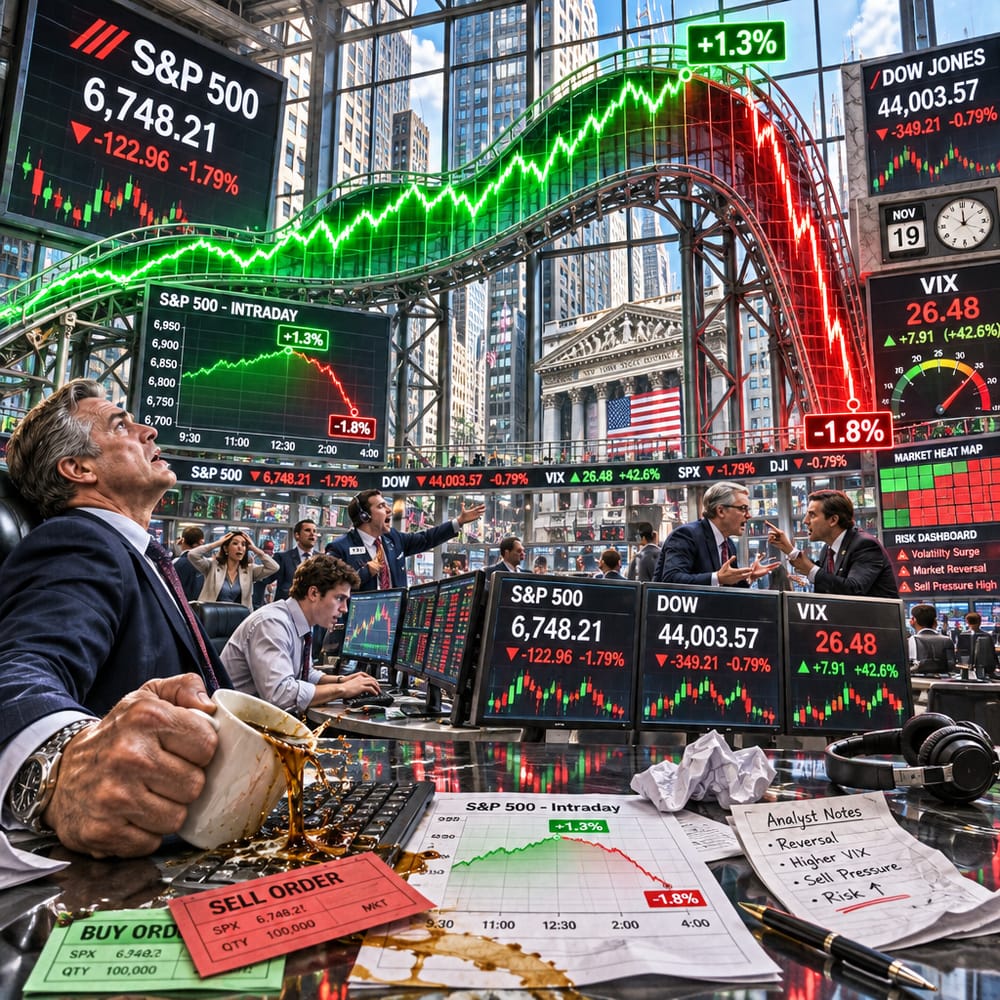
Hold onto your hats, folks. The stock market just gave us a rollercoaster ride worthy of an IMAX drama. On November 19, the S&P 500 went from celebrating a 1.3% gain to crying in its proverbial soup with a 1.8% loss—before anyone had time to blink twice. This wasn't just your regular Monday-morning mood swing; it was a moment that screamed volatility, and it has investors questioning what on earth is driving these head-spinning market moves.
So, what in the Wall Street gods' names triggered this sudden kind of whiplash? You can thank a cocktail of news that hit the market like a wet mop. On one hand, we had Congress passing a bill designed to protect older investors from financial fraud, which was the financial equivalent of sipping a calming chamomile tea. On the other, the AI wonder child, Anthropic, whose IPO had been hyped like the second coming, couldn't even keep the tech-enthused investors from fleeing. Instead of reviving faith in the AI sector, Anthropic's debut fizzled out like a damp firecracker, casting a shadow on tech stocks and dragging the broader market down with it.
But wait, there's more! The backdrop to all this was a cacophony of other unsettling headlines. The market was already jittery thanks to a week that saw Microsoft, the FAA, and Apple wobbling under tech outages. Add to that some geopolitical tremors with U.S. lawmakers contemplating new restrictions on Chinese aerospace investments. Let's be honest—it was the financial press equivalent of a soap opera, except without the comforting predictability.
Now, you might be wondering, "What about the fear index?"—more formally known as the VIX—which measures how skittish investors are. As expected, the VIX went skyward, as if it had chugged an energy drink, signaling that investors were reaching for their panic buttons. When the VIX gets jumpy, it means folks are racing to hedge against further market shenanigans, bracing for whatever might come next.
This sudden market reversal paints a vivid picture of how fragile investor confidence can be in the face of headline-driven news. It's like the stock market equivalent of a cat—one minute it's purring contentedly, the next it's tearing up the drapes. But what are the broader implications for us everyday investors who just want a piece of the action without the heart-stopping adrenaline?
For starters, this market drama underscores the brutal reality that investor sentiment can be as predictable as a reality TV season finale—spoiler alert: not very. The rapid mood shifts reveal that many investors are still tiptoeing around, and confidence is shaking like a leaf in a storm. No one wants to be the last one holding the bag when the music stops.
Moreover, this incident serves as a stark reminder to brace for turbulence. In a world where a single tech IPO can send shockwaves through our portfolios, diversification isn't just a buzzword—it's a lifeline. The S&P 500's wild swing might just be the nudge some retail investors need to reassess their strategies, ensuring they're not overexposed to high-drama sectors like tech.
So, what should you, the savvy retail investor, take away from all this? Beyond the captivating headlines and the allure of sectors like AI, it's crucial to stay grounded and remember that today's hot stock might be tomorrow's cautionary tale. Volatility isn't disappearing anytime soon; it's becoming a staple feature of our modern financial landscape. Having a balanced portfolio, keeping a cool head amid the noise, and never losing sight of your long-term goals can help navigate through the squalls.
In the end, the stock market is still the wild west, with its fair share of drama queens and shaky plots. As investors, our job is to ride the waves without getting sea-sick, keeping our eyes peeled for opportunities that arise from the chaos. Because if history has taught us anything, it's that past the storms, the market has a funny way of finding its footing—eventually. So buckle up, stay informed, and remember: sometimes, the best action is to simply hang on for the ride.
This article is for informational purposes only and is not investment advice. Always do your own research or consult a licensed financial professional before making investment decisions.
© Copyright 2024. All Rights Reserved.
© Copyright 2024. All Rights Reserved.