

Market Recovers After Steep November Selloff — Rally on Black Friday
Saturday, November 28, 2026
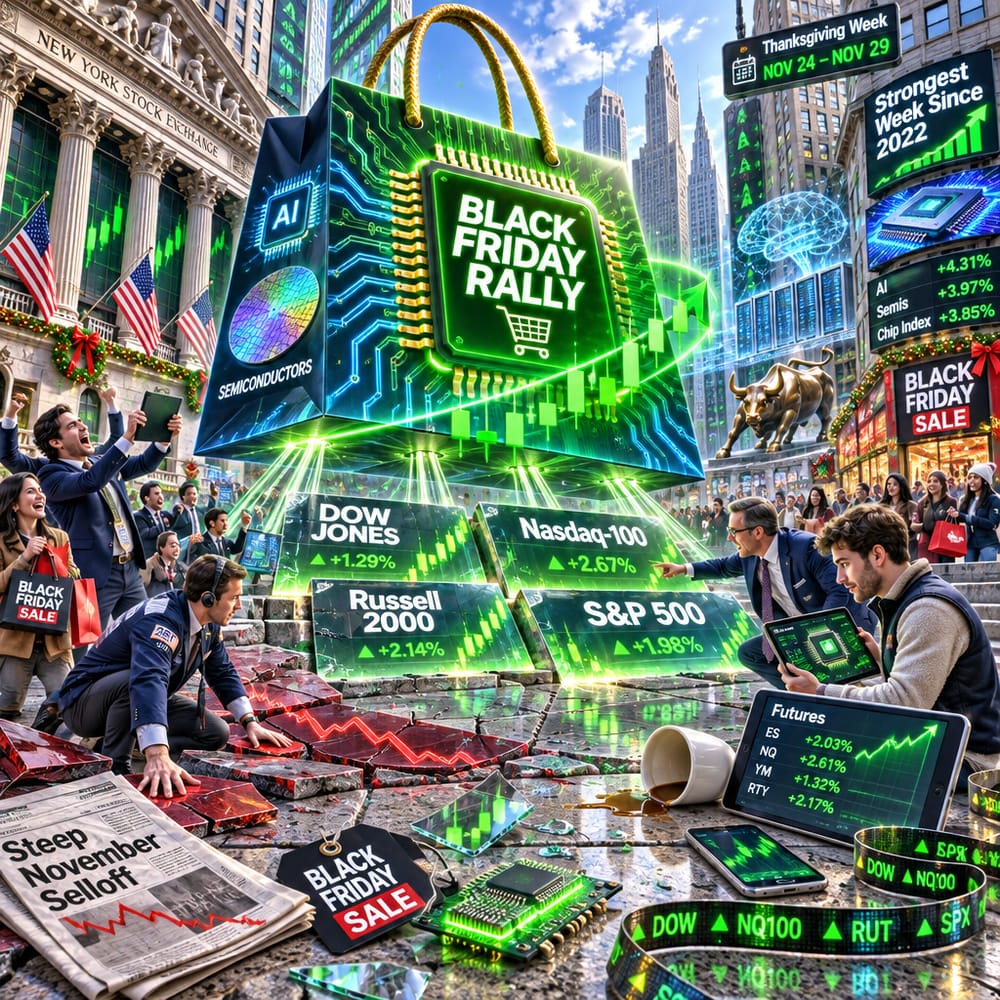
MARKET RECOVERS AFTER STEEP NOVEMBER SELLOFF — RALLY ON BLACK FRIDAY
If the stock market were a rollercoaster, last month it felt like someone forgot to tell investors they’d be taking the deep plunge. November sent portfolios on a stomach-churning nosedive, leaving everyone clutching their hats — and their wallets. But hold onto your peppermint mochas, because just in time for Thanksgiving, the markets decided to rebound harder than a turkey escapee on Thanksgiving eve.
During the Turkey Day week, U.S. markets pulled a rabbit out of the hat with the strongest week since 2022. Fueled by turbocharged AI and semiconductor stocks, the Dow Jones, Nasdaq-100, Russell 2000, and S&P 500 all gobbled up gains like there was no tomorrow. It’s as if investors decided ahead of Black Friday to treat themselves to some early holiday cheer.
So, what fueled this sudden market revival? Well, when you sprinkle some AI magic dust over tech stocks, especially in the semiconductor space, you get a rally that even Santa would admire. Companies like Nvidia and AMD were the rockstars of this rally, surfing the wave of investor optimism. In fact, Nvidia's recent headline drama didn’t deter its stock; it seems investors were more interested in its chips than Huang’s missteps.
AI and semiconductor stocks led the charge, and not by just a little. These sectors have been the darlings of Wall Street, promising to revolutionize everything from the way we work to the way we brush our teeth — okay, maybe not that last one, but you get the picture. With companies like TSMC expanding their chip production in the U.S., it's clear that the appetite for semiconductors isn’t waning anytime soon. President Trump’s recent groundbreaking ceremony on a massive Arizona plant expansion only underscores this point.
However, let’s not start popping the champagne just yet. The market's leap of faith raises the trillion-dollar question: Is this rebound truly sustainable, or just a limited-time offer before the market decides to throw another curveball? The economic landscape isn’t exactly a field of daisies. With ongoing geopolitical tensions, inflationary pressures, and a global economy that’s as shaky as a Jenga tower near the end of the game, there’s plenty to keep investors up at night.
Moreover, the broader economy still has some glaring cracks that a good rally can’t quite plaster over. Consumer spending, while still robust, is showing signs of fraying. Just take a listen to folks like Abbey Graf, who, despite her financial good news, still feels the pinch of economic pressure. Rising childcare costs are making families wonder if their next financial move should involve a lottery ticket.
As for the market itself, there's a school of thought that says this rebound is the market's attempt to recalibrate after an overreaction. The volatility we’ve seen lately is reminiscent of a teenager’s mood swings — unpredictable and occasionally unnerving. The AI and chip stock rally might well be investors' way of hedging against broader economic uncertainties, choosing sectors they believe will weather whatever storms lie ahead.
In the end, it’s possible that what we’re witnessing is the market’s early holiday present to itself — or perhaps just a brief sugar rush before it settles back into the more humdrum rhythm of economic reality. Whether this rally has the legs to run into the new year remains to be seen. For now, retail investors might be wise to enjoy the market’s upward swing but keep a cautious eye on the horizon for any signs of turbulence.
So, while the market’s rollercoaster ride may have hit an exhilarating peak this Thanksgiving week, savvy investors will stay buckled up. After all, what goes up can come down — and the financial playground is no exception. Until then, may your financial turkey be plump, your pies plentiful, and your portfolios prosper.
This article is for informational purposes only and is not investment advice. Always do your own research or consult a licensed financial professional before making investment decisions.
© Copyright 2024. All Rights Reserved.
© Copyright 2024. All Rights Reserved.