

Market Pullback: S&P 500 and Nasdaq Decline Amid Rising Yields and Oil Pressure
Tuesday, August 18, 2026
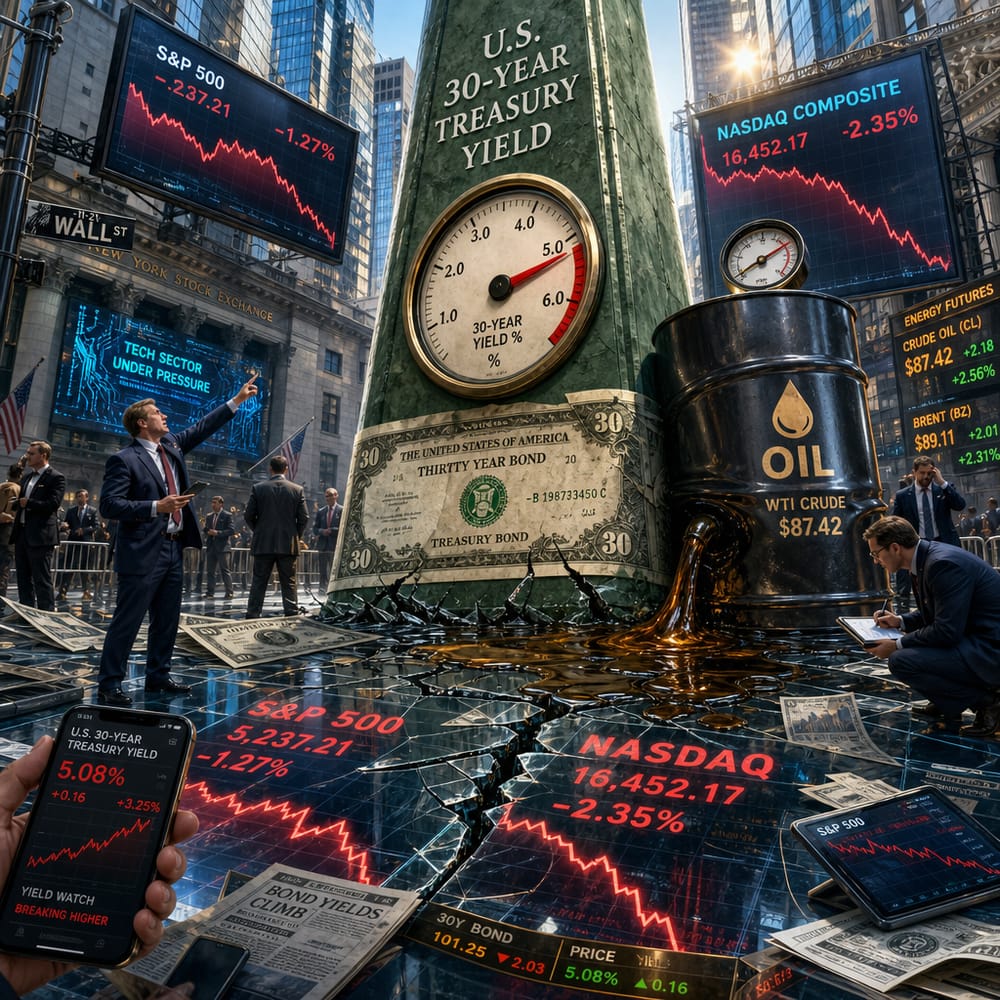
THE BIG MARKET PULLBACK: WHEN YIELDS AND OIL PRICES COLLIDE
Imagine you’re walking a tightrope, balancing a tray of fancy cocktails. Now picture someone throws you a bowling ball. Welcome to the August 18th state of the U.S. stock market, where rising Treasury yields and stubbornly high oil prices teamed up to cause quite the wobble on Wall Street. The S&P 500 took a 0.6% dip, and the Nasdaq swooned by 1.3%. That’s not a market correction, but it’s enough to make investors sit up and take notice.
RISING YIELDS: THE PARTY POOPER IN THE ROOM
First, let’s talk about those pesky Treasury yields. The U.S. 30-year Treasury yield just hit a high not seen in 19 years. It’s the teenager at the party who's just been told there's no Wi-Fi—things are getting tense. Why does this matter? Well, when bond yields rise, they take a bit of the shine off stocks. Investors can earn more money with less risk by parking their cash in bonds, so stocks need to do a heck of a lot to stay attractive.
This time around, it's all about inflation fears. Investors are spooked that high oil prices will keep inflation running hot, prompting the Federal Reserve to potentially slam the brakes harder on rate cuts. That’s why yields are on the up and up, making fixed-income investments more appealing and eating into the appetite for equities.
OIL PRICES: THE OTHER ELEPHANT IN THE ROOM
Then there’s oil, sticking its oar into the market like a drama-loving friend at a family gathering. Oil prices have been playing hard to get recently, thanks to geopolitical tensions and the classic supply-demand tango. The lack of progress in easing tensions between Iran and the U.S. has only added more uncertainty, pushing prices higher as everyone wonders if the Strait of Hormuz, a key oil passage, might become next week’s big news story.
So why should you, dear retail investor, care about oil prices? Well, if oil becomes more expensive, it costs more to transport goods and run businesses, squeezing corporate profits and hiking inflation. And inflation—yep, your friendly neighborhood yield-raiser—is already the talk of the town.
WHAT DOES THIS MEAN FOR STOCKS?
Put these two heavy-hitters together, and you have a recipe for some stock market indigestion. The rising bond yields are forcing investors to reassess the value of their stock portfolios. High-growth sectors like tech, ever reliant on the promise of future earnings, feel the pinch especially hard. The Nasdaq’s drop on August 18th is a case in point.
Take the tech sector tumble: companies like Western Digital, Sandisk, and Marvell Technology have been on the receiving end of some harsh market feedback. It’s like being stuck in a group text thread where everyone’s roasting your favorite show; you might love it, but the market sentiment is headed south.
WHAT NOW?
So what’s a savvy investor to do? First off, breathe. Market pullbacks are part of the deal, like that one relative who always brings up politics at Thanksgiving. You can’t avoid them, but you can prepare.
With yields high and oil prices unpredictable, diversifying your portfolio is more crucial than ever. That means looking beyond just tech and the usual suspects. Sectors like healthcare, consumer staples, or even some of those lesser-watched industrials might hold up better when the going gets tough.
And keep an eye on global signals. The big moves in U.S. bond yields are echoed around the world, with Japanese and European bonds also hitting highs. It’s a reminder that macroeconomic forces don’t care about borders; they're a global rollercoaster we’re all strapped into.
In this interconnected market, understanding the push and pull between yields, oil prices, and equities can help you navigate the ride. So grab your seatbelt—and maybe a snack—and watch how these forces play out. The market might be on a rollercoaster, but with the right approach, you can still enjoy the ride.
This article is for informational purposes only and is not investment advice. Always do your own research or consult a licensed financial professional before making investment decisions.
© Copyright 2024. All Rights Reserved.
© Copyright 2024. All Rights Reserved.