

Market Holds Near All-Time Highs Despite Weak Retail Spending Data—What’s Next for Risk Appetite?
Sunday, August 16, 2026
MARKET HOLDS NEAR ALL-TIME HIGHS DESPITE WEAK RETAIL SPENDING DATA—WHAT'S NEXT FOR RISK APPETITE?
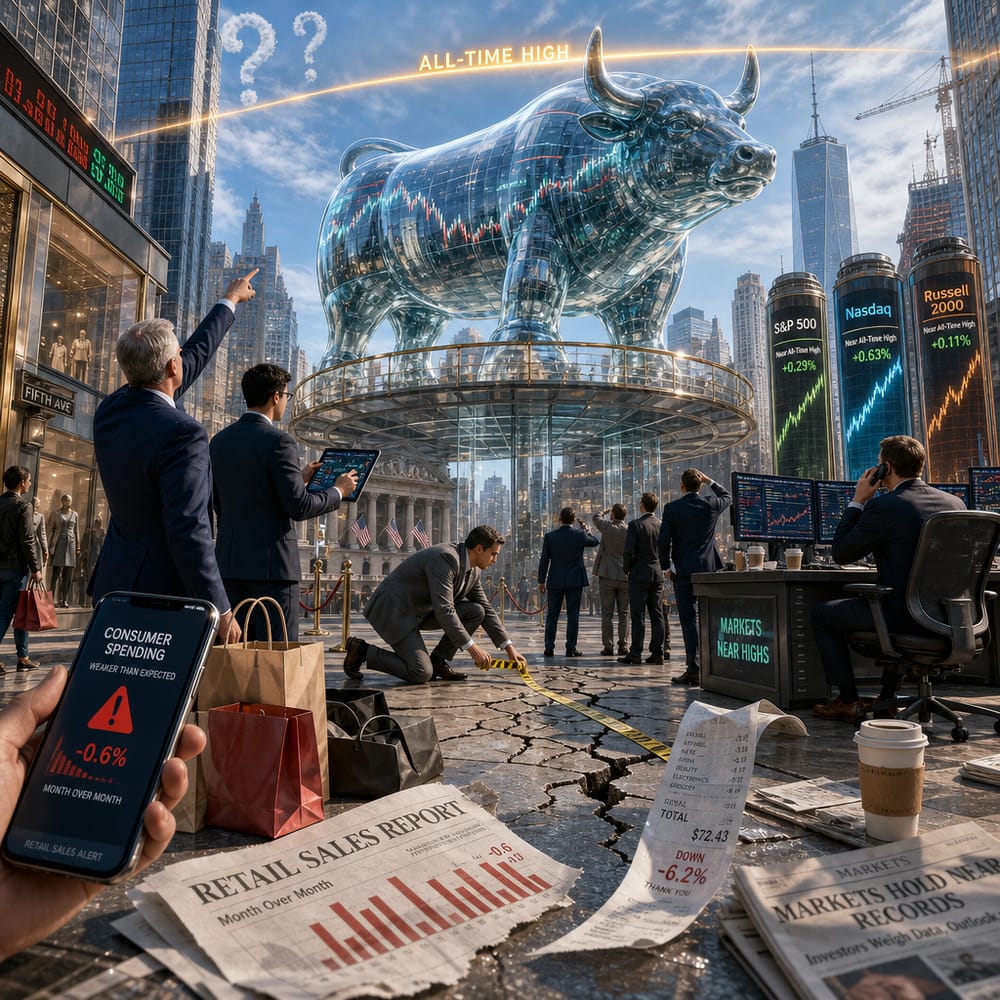
Whoever said the stock market makes sense probably hasn't been paying attention lately. Picture this: the economy throws a temper tantrum with weak retail spending data, yet the market waltzes around like it's celebrating a perpetual happy hour near all-time highs. So why exactly are investors partying like it's 1999 when the dance floor is looking a bit shaky?
Let's break it down. Retail spending recently took a nosedive, falling short of analysts' expectations. Normally, this plot twist would have investors scrambling like seagulls at a beach picnic, fearing economic gloom. But instead, they're lounging comfortably, martini in hand. So, why the chill attitude?
This market resilience might be signaling a robust risk appetite among investors. They're playing the long game, convinced that today's turbulence is a small speed bump in a marathon, not a catastrophic detour. The S&P 500, Nasdaq, and Russell 2000 have maintained their swagger, barely flinching at the underwhelming retail spending data. It's like they’re all collectively saying, "We see your weak sales, and raise you a tech boom."
Remember the good ol' days when investors would panic at the mere hint of storm clouds? Not anymore. The market's apparent tranquility is less about ignoring the economic clouds and more about believing that the Federal Reserve is holding an umbrella. If the economy slows down too much, the Fed might ease up on interest rates, giving the market a reason to keep its party hat on.
The big question on every investor's mind: How will the Fed react to these mixed signals? Weak retail data might push them to hit the brakes on interest rate hikes, a move likely to fuel further market optimism. Investors are essentially betting that the central bankers will blink first, prioritizing economic growth over inflation concerns.
But let's not get carried away with blind optimism. This market confidence, while fascinating, could easily backfire if the Fed's response doesn't meet expectations. Remember, the market is like a bull in a china shop—you think it’s calm until it suddenly decides to break everything.
Moreover, the current scenario reflects a transformation in market sentiment where bad news isn't automatically viewed as a calamity. Investors might be banking on sectors like tech remaining resilient, even in the face of economic slowdowns. With giants like Nvidia and Meta advancing their tech arsenals, the tech sector seems poised to continue its romp despite broader economic challenges.
However, this optimism isn't without its pitfalls. If economic indicators continue their lackluster performance, even the most stalwart optimists might start to squirm. The real test will hinge on how durable this confidence remains if the Fed doesn't provide the market with its much-anticipated safety net.
In the short term, retail investors should stay sharp. It's crucial to keep an eye on the Fed's every move, as it will likely be the traffic light governing market direction. Will they maintain their hawkish stance, or soften their position to nurture growth? The next few Fed meetings could set the stage for either a market rally or a reality check.
And let's not forget the age-old dance between fear and greed. As long as investors believe that the Fed has their back, risk appetite might remain voracious. But if confidence wavers, the market could give us a roller-coaster ride that's not for the faint of heart.
To wrap it up, this market's resilience amid weak economic signals might seem like a paradox, but it's a calculated gamble on the Fed’s next move. For those with nerves of steel and a willingness to embrace the uncertainty, the rewards could be substantial. Yet, caution is still the best companion as we navigate the choppy waters ahead. Who knows—maybe the market will keep thriving in this strange new world where bad news is, oddly enough, not all that bad. But then again, never underestimate the market's ability to surprise us.
This article is for informational purposes only and is not investment advice. Always do your own research or consult a licensed financial professional before making investment decisions.
© Copyright 2024. All Rights Reserved.
© Copyright 2024. All Rights Reserved.