

Market Complacency: VIX Hits Multi-Day Lows
Sunday, August 16, 2026
WHEN MARKETS GET TOO CHILL: IS IT TIME TO WORRY ABOUT THE LOW VIX?
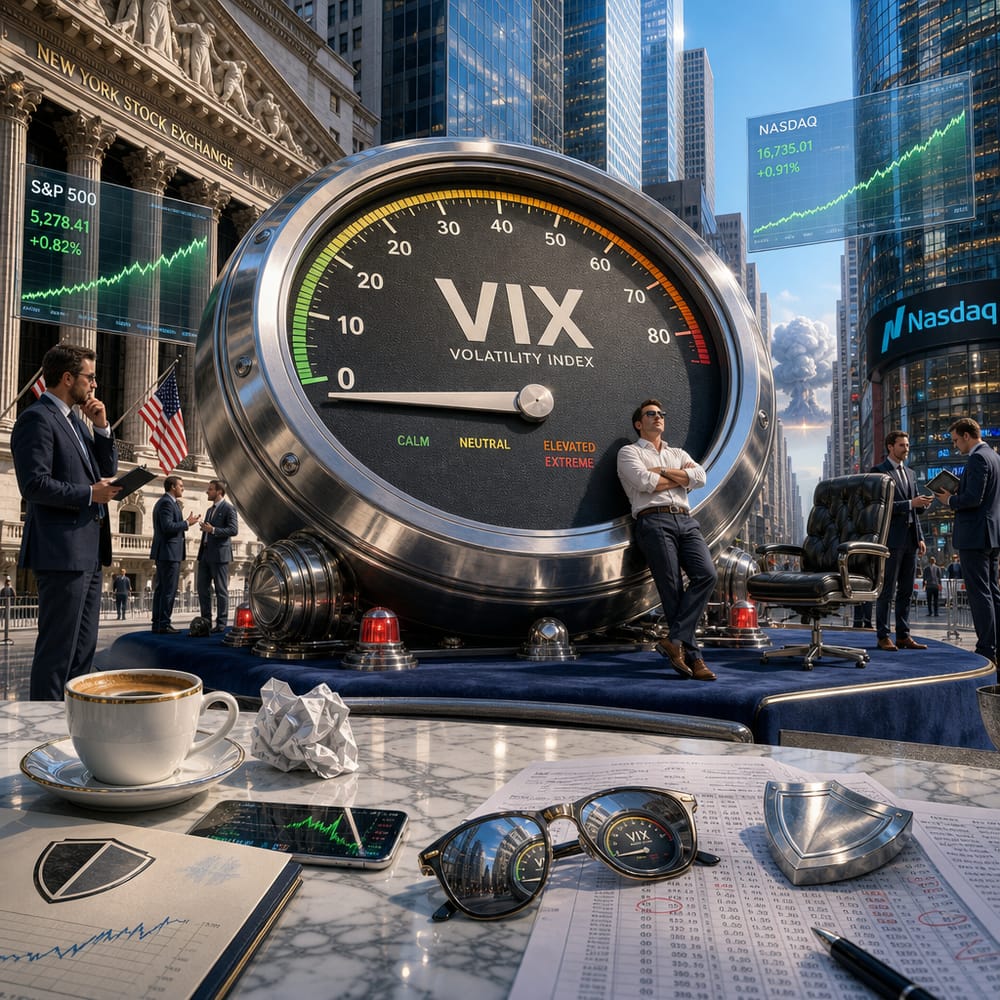
Hey, ever heard of the "calm before the storm"? Well, Wall Street might be living it right now. The VIX, that nifty little gizmo famously known as the "fear gauge," is lounging at multi-day lows, making the stock market look like a hammock swaying gently in a summer breeze. But should we be kicking back and enjoying the ride, or is this just a serene moment before the financial weather gets wild?
WHAT DOES LOW VIX TELL US?
Let's start with what the VIX actually is—a measure of how much the stock market expects prices to fluctuate in the near term. Think of it as a mood ring for traders. When it’s low, the ring’s showing tranquil blue, suggesting everyone’s cool, calm, and collective. But don’t get too comfy. A VIX in a lull could mean investors are getting too complacent, snoozing off while risks quietly loom in the background.
Right now, the low VIX suggests a market that's trading with some serious bravado. Investors seem to be strutting their confidence, plowing money into stocks like they’ve just stumbled upon a cheat sheet for the next big gold rush. This behavior often telegraphs a risk appetite as wide as the Grand Canyon. But here’s the catch: an overly chill VIX might also be the market's way of whistling past the graveyard.
POSSIBLE MARKET CORRECTION?
Here’s a fun fact: historically, markets have an annoying habit of going off-script right when everyone’s least expecting it. Remember the calm of 2007 before the financial crisis threw us into the spin cycle? Or the tranquility in early 2020 before the pandemic introduced itself with a loud, disruptive bang?
A low VIX doesn’t guarantee storms ahead, but it can be a signal that markets are blissfully ignorant of potential pitfalls. With current levels so subdued, it’s the equivalent of everyone at the poker table betting high and assuming no one’s bluffing. The question is, who’s holding the wild card?
HISTORICAL CONTEXT—THE VIX FLASHBACK
Now, if we whip out the history books, we’ll see that the VIX tends to spike during moments of chaos and uncertainty—financial crises, wars, election shockers. At the moment, the VIX is plodding along at levels below its historical average. Think of it as a cup that's normally half full but right now is barely a quarter. It reflects a market that’s not just chill, but maybe a tad too optimistic.
COMPARING TO THE GREAT CALMS OF YORE
So how does today’s placid VIX compare to the sleepy days of yore? During periods leading up to major market corrections, the VIX was often darting about at low levels, as if taking a catnap before the real action begins. Right now, we’re seeing a pattern resembling those quieter days before the storm—for market historians, this is the stuff of déjà vu.
WHY IT MATTERS
So, why should you care if a little market index is snoozing? Well, if you’re in the stock market, directly or through your 401(k), a complacent sentiment can mean your investments might be overlooking lurking risks. Low volatility could be a sign that investors are ignoring signs of a bubble. Or it could mean they’re just too cool for school, disregarding potential economic headwinds, like interest rate hikes or international tensions.
THE TAKEAWAY
While the VIX is currently in a state of zen-like tranquility, beware of mistaking this peace for a promise of smooth sailing. A low VIX might suggest that the market is overly complacent, but acting prudently could mean the difference between cruising through or capsizing when volatility returns. The savvy investor knows that it’s during the calm that one prepares for the storm.
In a world obsessed with reading trends and tea leaves, the smart money isn’t just watching the VIX; it’s planning for what happens when the dial inevitably cranks up again. So, keep your sense of humor handy, your wits sharper, and your investment strategy nimble. Because in the stock market, much like life, it’s best to expect the unexpected.
This article is for informational purposes only and is not investment advice. Always do your own research or consult a licensed financial professional before making investment decisions.
© Copyright 2024. All Rights Reserved.
© Copyright 2024. All Rights Reserved.