

Leveraged ETF Volatility Moves: A Trader's Playground
Thursday, November 26, 2026
LEVERAGED ETF VOLATILITY MOVES: A TRADER'S PLAYGROUND
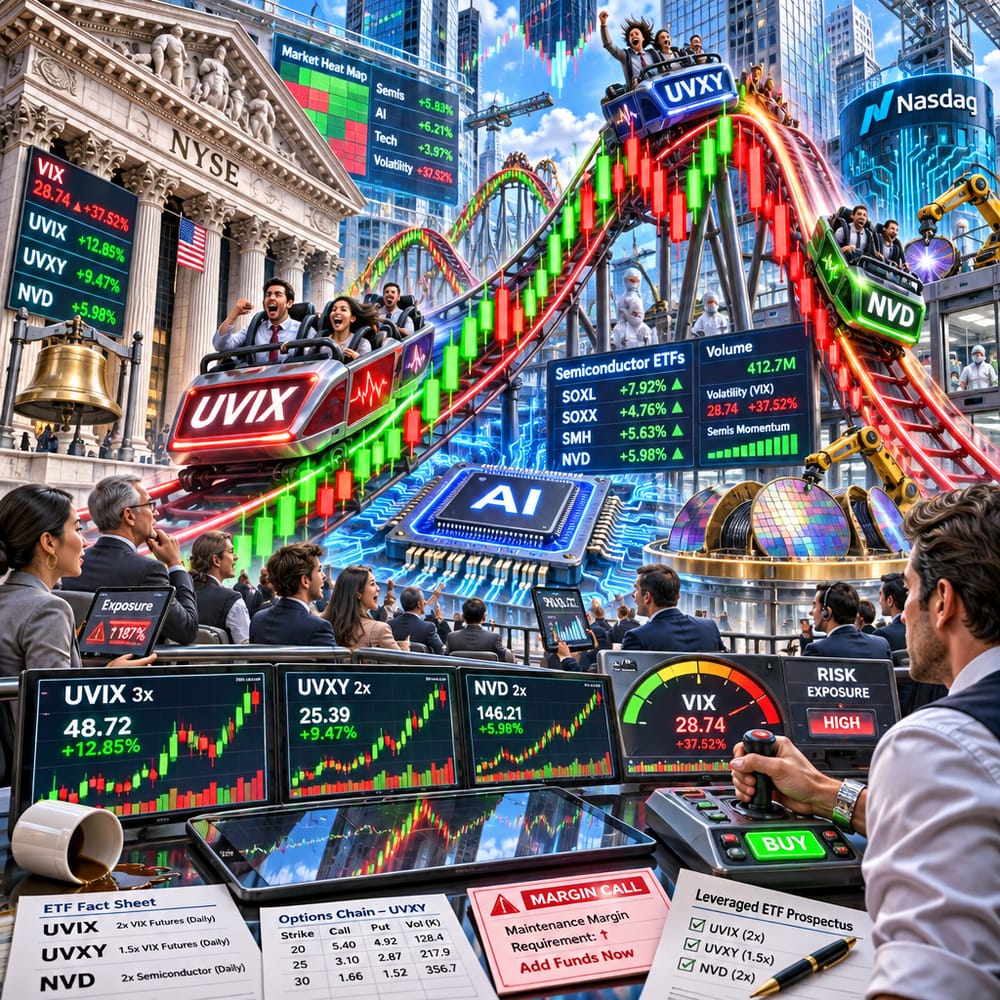
If the stock market were a rollercoaster, leveraged ETFs would be the loops, corkscrews, and sudden drops. You can’t ride them without a thrill—or a few stomach-churning moments. In the latest twist of market mania, leveraged ETFs like the UVIX and UVXY, which track volatility indexes, and the semiconductor-heavy NVDA are catching the eyes of traders looking to capitalize on the hysteria surrounding AI-driven market fluctuations. But what's driving these wild rides, and how are traders using them to their advantage?
WHY LEVERAGED ETFS ARE MAKING WAVES
First things first, let’s demystify the jargon. Leveraged ETFs are like regular ETFs on steroids. They aim to deliver multiples (think 2x or 3x) of the performance of the index they track, which sounds great when the market's in your favor. But here's the kicker: when markets tumble, losses can compound just as spectacularly. That’s why they’re the darlings of traders with a taste for high stakes—and dare we say, high rewards?
Now, why are these ETFs seeing spikes in activity? Blame it on the silicon rush. The semiconductor sector, championed by stocks like Nvidia, is at the heart of the AI revolution. With AI poised to reshape industries faster than you can say "neural network," investors are all ears—and wallets. But the buzz cuts both ways. Just as quickly as AI can promise profits, fears of overvaluation or tech glitches can send stocks spiraling, and the volatility ETFs will reflect these swings.
TRADERS' STRATEGIES: HEDGING OR HIGH-RISK GAMBLING?
Traders aren’t just throwing darts at a board here. They’re using these ETFs like a Swiss Army knife—adaptable for all market scenarios. For the cautious (or scarred) investor, these tools offer hedging—a way to protect existing positions from market downturns. Picture it like insurance, but instead of geckos and good hands, you've got financial wizards wielding data-driven forecasts.
On the flip side, there’s the speculative clique. These are the adrenaline junkies of the market, banking on short-term swings to make a quick buck. It’s less “buy low, sell high” and more “buy low, sell five minutes from now.” In the volatile current, every second counts, and leveraged ETFs can multiply their gambles—whether that's a jackpot or a dud is the risk they’re willing to take.
RISKS: PLAY WITH CAUTION
But let’s slow down the hype train for a second. The biggest risk with leveraged ETFs is that they can amplify losses just as they do gains. It's like driving a sports car at full throttle; exhilarating, but one wrong move and you're skidding into a guardrail. Daily rebalancing is another factor. Because these ETFs reset daily, holding them long term can lead to performance that diverges from the expected multiple of the underlying index. It's a detail that’s easy to overlook when adrenaline is high.
Moreover, in volatile conditions, these instruments can become a trader's worst nightmare if the market swings against their position. It's a reminder that while the potential for quick profits is tantalizing, the market has a way of humbling even the most seasoned veterans.
THE VOLATILE FUTURE
As AI continues to shape-shift the landscape, the ride is far from over. The heightened activity in these ETFs reflects a market not just reacting to AI's promise, but also grappling with its unpredictability. Like a game of financial chess, every move is calculated—yet equally vulnerable to the chaos of uncertainty.
For retail investors standing on the sidelines, the message is clear: approach leveraged ETFs with eyes wide open. They're a playground for the bold, but in the world of finance, even the playground can be a battleground. Whether you're hedging your bets or diving into the deep end of speculation, remember, volatility can be both friend and foe. And in this fast-paced era of AI, where opportunities and risks are as vast as a line of code, every investor must decide: is it worth the ride?
This article is for informational purposes only and is not investment advice. Always do your own research or consult a licensed financial professional before making investment decisions.
© Copyright 2024. All Rights Reserved.
© Copyright 2024. All Rights Reserved.