

Latin American Currencies Lead EMFX Performance Amid Policy Divergence
Monday, August 10, 2026
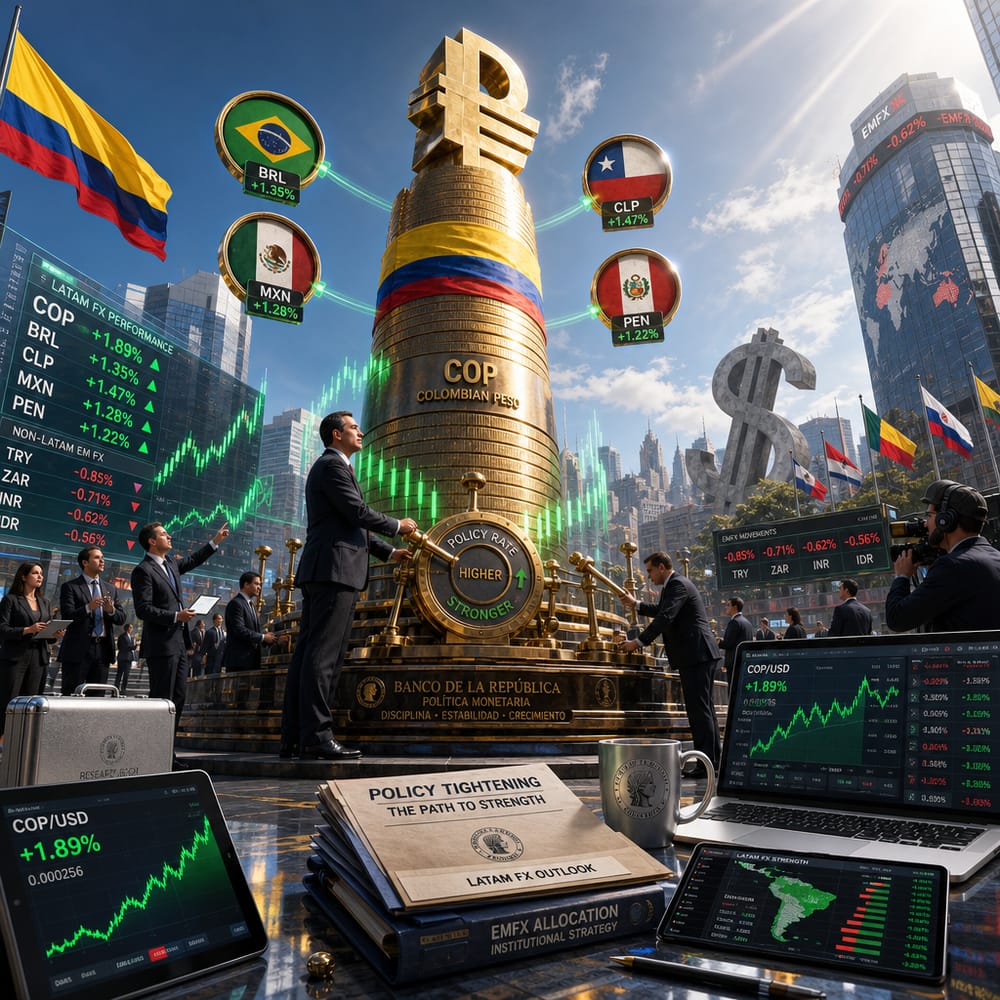
LATIN AMERICAN CURRENCIES LEAD EMFX PERFORMANCE AMID POLICY DIVERGENCE
Think Latin American currencies are taking a siesta? Think again. These financial dynamos are wide awake and trumping their emerging market peers. Call it the comeback tour of the Colombian peso and its Latin amigos as they leave other EM currencies in the dust. Cue the mariachi!
Let's start with Colombia's peso, strutting its stuff on the currency catwalk. This isn't just some lucky streak; it's backed by big brains making policy moves that would impress even the shrewdest chess player. While some countries shy away from tightening their monetary belts, Colombia's central bank is taking a more muscular approach, resuming policy tightening to combat inflation and stabilize the economy. It's like they’ve got the financial equivalent of an espresso shot.
But it’s not just Colombia basking in the spotlight. Peru’s sol, the Brazilian real, and the Chilean peso are riding the wave too. They’re all benefiting from what the financial experts call "policy divergence." Translation? When different countries’ central banks make different moves, it spices up the currency game. Think of it like a financial dance-off: the Latin currencies are executing salsa twirls while others fumble with the cha-cha.
So why should you care about these currency movements? Enter the world of carry trades. Picture this: you borrow money in a currency with low interest rates, then invest in a currency that's offering higher rates. Simple, right? This is where Latin America's current fiesta can lead to an opportunity. High yield-loving investors are diving into these carry trades, drawn like moths to a flame, and it’s easy to see why. After all, who doesn't love a currency offering a little more bang for your buck?
However, before you dive headlong into the peso pool, hold your horses! While these currency plays can look as irresistible as a fresh churro, they come with their own set of risks. Currency volatility is like that one relative who shows up uninvited at the family barbecue — a little unpredictable and sometimes downright troublesome. Political shifts, economic downturns, or even unexpected policy changes could spoil the fun faster than a rainstorm at a beach party. The carry trade is a game of high stakes. Investors seeking these short-term capital flows might find themselves in hot water if the winds change.
But what makes this even more intriguing is the backdrop of a global economy that’s less than stable. With inflation rates playing games and geopolitical tensions causing a stir, many emerging market currencies aren’t quite dancing to the same beat. Some are more like wallflowers at the dance, struggling with weaker economic backdrops and less aggressive central banks. It's a classic tale of the haves and the have-nots.
In a world that's still recovering from a pandemic hangover, investors are looking for yield wherever they can find it. And while the U.S. dollar continues its reign as the world’s cornerstone currency, these Latin American currencies are offering a tantalizing alternative. Their performance isn't just about high interest rates but also about savvy central banks navigating turbulent waters with finesse.
So, should you start eyeing Latin American currencies for your portfolio? Well, that depends on your tolerance for risk and your appetite for international financial intrigue. The opportunity is there, but it’s not without its hurdles. The key is staying informed, understanding the risks, and perhaps keeping a sombrero handy for when the sun shines just right.
In the end, whether you're a seasoned investor or just someone curious about the world of finance, the message is clear: Look beyond the obvious, be aware of the underlying dynamics, and remember, the currency game is as much about strategy as it is about numbers. So grab your metaphorical maracas, keep a keen eye on those interest rate differentials, and watch as Latin America continues to lead the charge in the currency conga line.
This article is for informational purposes only and is not investment advice. Always do your own research or consult a licensed financial professional before making investment decisions.
© Copyright 2024. All Rights Reserved.
© Copyright 2024. All Rights Reserved.