

Largest Crypto Exchange in Israel Reportedly Hacked, Personal Data Leaked
Monday, August 17, 2026
THE GHOST IN THE MACHINE: IS YOUR CRYPTO SAFE?
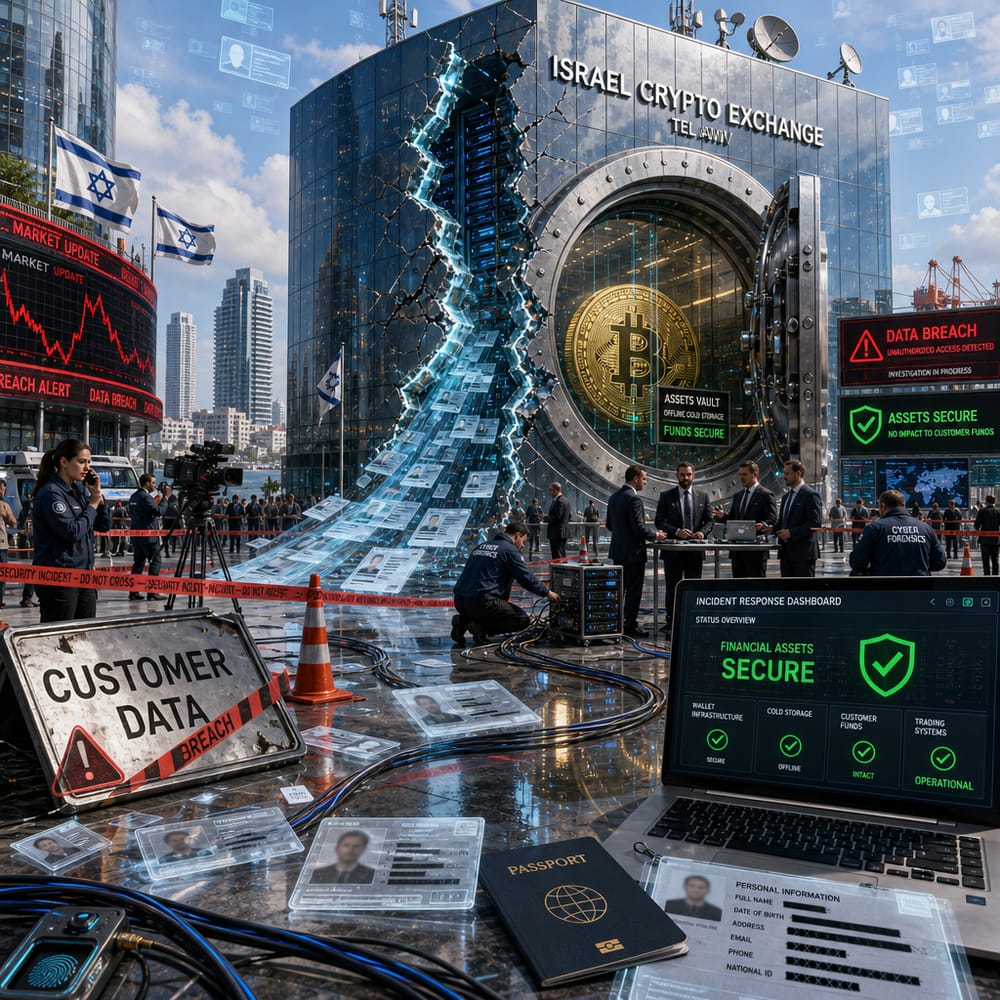
Picture this: you're lounging on a beach, cocktail in one hand, phone in the other, checking your crypto stash. Dreams of digital millions swim in your head until—bam!—a security breach slaps you back to reality. Welcome to the wild west of cryptocurrency, where even the seemingly impenetrable can crumble like a stale cookie. The largest crypto exchange in Israel just learned this the hard way—hacked, with personal data leaking faster than an overcooked faucet.
Now, before you dive headfirst into a spiral of panic about your own crypto holdings, let’s dissect what’s happening here. The good news? The hackers didn’t tap into financial information. Your coins are safe—for now. But customer data, the fingerprints of our digital identity, remains alarmingly exposed.
So, what's the deal with these crypto exchanges and their knack for getting hacked? Think of crypto exchanges as digital banks where you stash your cryptocurrencies. When you walk into a regular bank, you don’t expect the vault to have a revolving door. But in the digital realm, the vaults have vulnerabilities, and these bad actors are the smooth criminals waiting for their chance.
SECURITY VULNERABILITIES IN CRYPTO EXCHANGES
Crypto exchanges are gold mines for hackers. They’re decentralized, which sounds great in theory—power to the people and all. But that also means there’s no central authority looking out for you if things go south. The codes and keys that protect your digital assets are stored online, making them prime targets for cyber thieves.
Here’s the kicker: many exchanges still rely on outdated security protocols. Imagine locking your front door with a single rusty padlock while living in a neighborhood of master lock-pickers. Multi-factor authentication is a step up, but not nearly enough when one data breach can spill customer information worldwide.
HOW CAN EXCHANGES BETTER PROTECT CUSTOMER DATA?
The solution? It’s time for crypto exchanges to hit the gym and beef up their security practices. Think of it as digital CrossFit; they need to be stronger, faster, and way more robust.
First up, encryption, and I’m not talking about the kind you use for your Facebook password. We’re talking military-grade encryption, the digital equivalent of a fortress surrounded by a moat full of crocodiles.
Next, beef up that authentication. Two-factor authentication is like locking your car with a key and then setting the alarm. But why stop there? How about biometric data or hardware authentication keys that turn your crypto exchange account into Fort Knox?
Exchanges need to adopt a zero-trust policy. It sounds harsh, but it means assuming every device and every user is a potential threat. Only those with verified access should be allowed to pass go and collect digital currency.
But what about us, the humble users? We’ve got a role too. Stay alert, because complacency is cybercrime's best friend. Use strong, unique passwords, keep your software updated, and be skeptical of anything that smells phishy.
THE BIG PICTURE: WHY THIS MATTERS
While this recent hack in Israel might seem like a distant echo in the fast-paced, ever-evolving world of cryptocurrencies, it’s a siren call for all crypto exchanges globally. It highlights a critical issue that, if not addressed, could shake confidence in the entire crypto ecosystem. Let's be honest, the average retail investor needs peace of mind, knowing their digital assets and data are safe.
In a realm where headlines are often dominated by wild price swings and the latest Elon Musk tweet, it's easy to forget that behind every coin and digital wallet is a real person, with real data. This breach is a wake-up call to prioritize security over hype.
Remember, crypto may be the future, but it's useless if that future isn't secure. So, whether you’re trading Dogecoin like a WallStreetBets pro or just dipping your toes into the crypto pond, keep your eyes peeled and your security strong. After all, in the digital age, vigilance is the only currency that never loses value.
This article is for informational purposes only and is not investment advice. Always do your own research or consult a licensed financial professional before making investment decisions.
© Copyright 2024. All Rights Reserved.
© Copyright 2024. All Rights Reserved.