

L3Harris Technologies Faces Market Pressure After FAA Incident
Monday, November 16, 2026
L3Harris Technologies Faces Market Pressure After FAA Incident
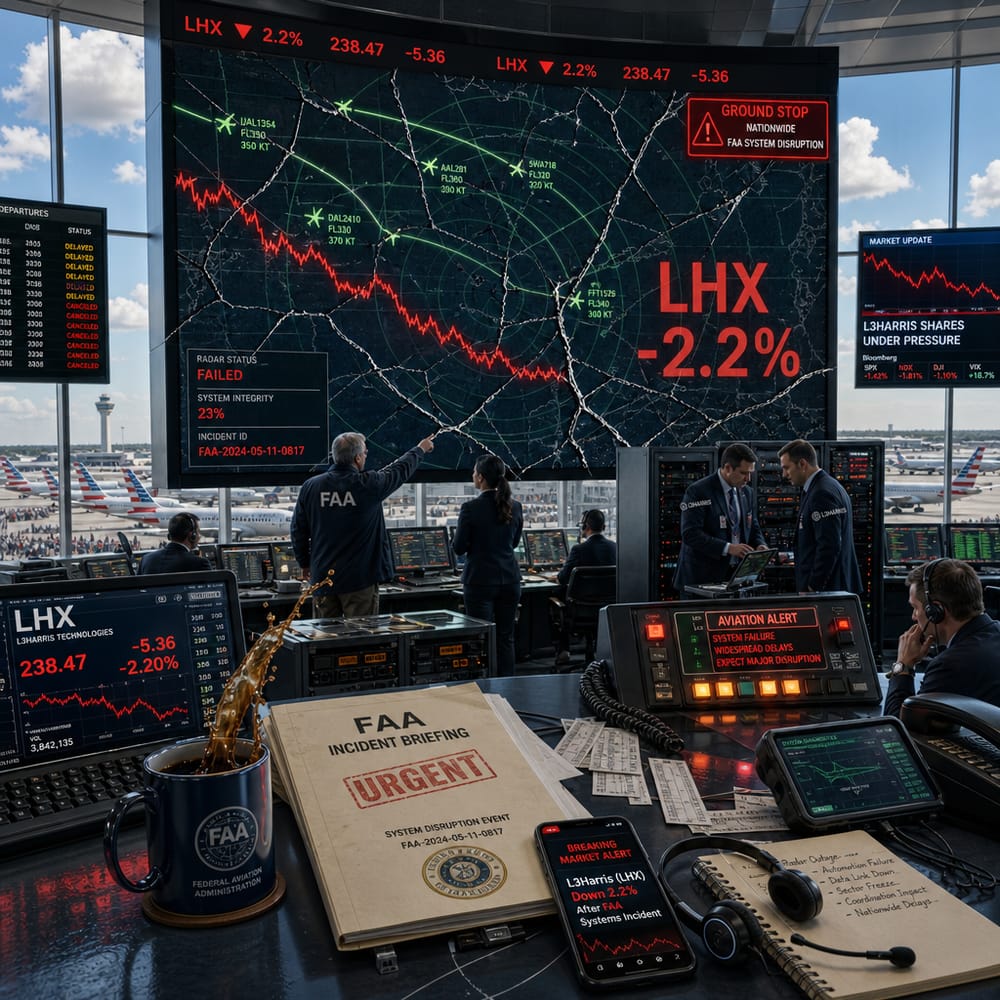
In the high-stakes world of defense contracting, a single blown circuit can feel like a torpedo to the hull. L3Harris Technologies just learned this the hard way. The aerospace and defense giant saw its stock slip by 2.2% this week, thanks to an FAA-triggered flight ground-stop that had stranded travelers gnashing their teeth en masse.
If you weren’t one of the thousands caught in the aviation apocalypse, here’s the scoop: on a fateful Friday, the Federal Aviation Administration (FAA) had to slam the brakes on all domestic flights for more than four hours. Imagine being told you can’t order your favorite takeout for four hours—now multiply that by a few hundred thousand jetsetters. The culprit? A balky router in the FAA's infrastructure, courtesy of L3Harris Technologies, which was faltering like a coffee machine on its last legs.
You might be wondering, “How does one little hardware hiccup send ripples through the stock market?” Well, let’s break it down. When you’re a company specializing in technology that keeps planes aloft and operable, a failure of this magnitude is like a dent in your shiny reputation. It raises eyebrows, no doubt, and more importantly, triggers investor jitters.
Investors react to such mishaps like cats to cucumbers—with a hefty dose of distrust. That's why L3Harris's stock took a nosedive. But here's where things get juicy: when a well-oiled machine falters, what does it mean for the future of the company and its stock?
PEERING THROUGH THE SMOKE
For L3Harris, this incident is more than an immediate stock dip; it’s a red flag that could unfurl further complications. Investors, especially the retail folks who don’t have time for a boardroom PowerPoint, might start to see L3Harris as the kid who keeps forgetting his homework. And in the realm of defense contracting, trust and reliability are as good as currency.
Historically, operational failures in this sector have had a mixed bag of outcomes. Some companies brush it off and bounce back like rubber balls, while others find themselves stuck like gum on the underside of a school desk. For instance, Boeing's ill-fated 737 Max ordeal led to extended grounding and sky-high financial loss. Yet, it eventually regained altitude in investor confidence. The key difference? Boeing's colossal market dominance and deep-rooted relations with global airlines.
So, what’s in the cards for L3Harris? Well, it's no Boeing, but it's not exactly a garage startup either. With clients spanning defense to aerospace, their tech is as ubiquitous as air, and a single failure, while serious, could be seen as an anomaly rather than a trend.
LOOKING AHEAD
L3Harris will need to do more than just issue a mea culpa to regain confidence. They have to reassure investors that this hiccup was a one-off, like your uncle’s dance moves at the last wedding. A robust damage-control plan and transparent communication about system improvements would be a good start. It's all about doing the public relations cha-cha, emphasizing future reliability, and smooth-sailing operations.
On the flip side, this incident also throws a spotlight on the risks of federal infrastructure failures and the ripple effect on defense stocks. L3Harris isn't sailing these choppy waters alone; the entire sector is under scrutiny when something of this scale goes awry. Companies within the sphere will be compelled to double down on internal reviews and technology checks to prevent their own unexpected stock spirals.
Given the rising global tension and defense budgets becoming hotter tickets than concert passes, the sector generally remains a sturdy bet. For retail investors, the lesson here is to keep eyes peeled: one storm doesn’t sink a ship, but it does highlight the importance of stability and reliability in this industry. As for L3Harris, how they handle their next steps will be pivotal. They can either emerge with a reinforced reputation or find themselves caught in an extended turbulence.
For now, investors will be watching—and waiting—like folks trying to spot a glimpse of land from a listing ship. If L3Harris plays its cards right, they might just turn this setback into a minor footnote in their corporate history.
This article is for informational purposes only and is not investment advice. Always do your own research or consult a licensed financial professional before making investment decisions.
© Copyright 2024. All Rights Reserved.
© Copyright 2024. All Rights Reserved.