

June Payrolls Gain Just 57,000; Downside Surprise
Friday, July 31, 2026
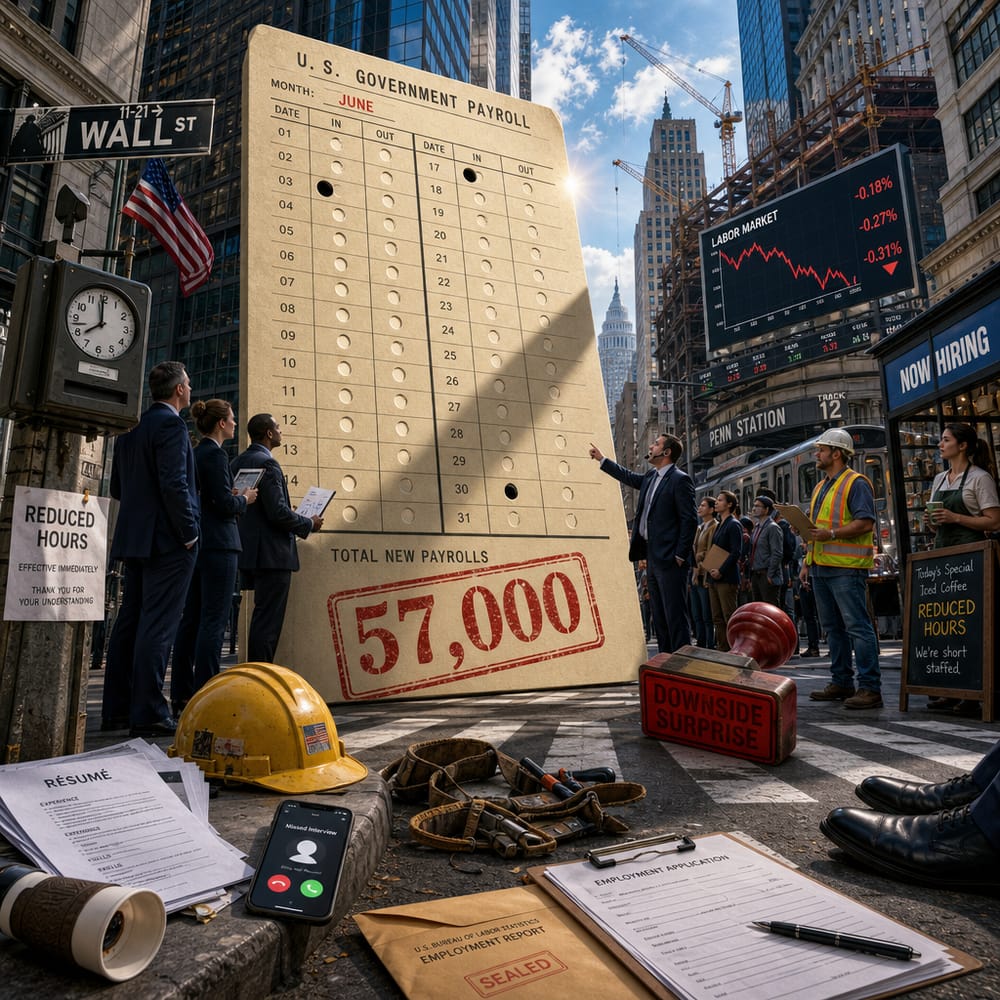
JUNE PAYROLLS: THE SNEEZE THAT STARTED A STORM
Hold onto your hats, folks, because June's nonfarm payroll numbers just took the markets for a joyride—and not the fun kind. Picture this: economists, investors, and anyone with a 401(k) biting their nails as the expected jobs report shows up like an uninvited guest at a wedding. Instead of the robust job growth everyone was hoping for, the U.S. economy added just 57,000 nonfarm payrolls in June. That’s the smallest increase since February, and it feels more like a hiccup in a marathon than a step forward.
So, what went wrong? Why did we get a payroll figure that’s making everyone from Wall Street to Main Street uneasy? Grab a coffee and let’s dive into this economic puzzle.
MYSTERY OF THE MISSING JOBS
First, let’s dissect the factors behind this underwhelming performance. Many were expecting a post-pandemic boom, but it turns out, things aren’t quite that simple. Labor market recovery has been a wobbly dance, tripping over supply chain issues, geopolitical tensions, and changing workforce dynamics. Businesses are struggling to find workers, and workers are struggling to find the right jobs. It’s like a middle school dance where nobody knows the steps.
Then, there’s the elephant in the room: inflation. Sky-high prices are making life expensive, and that’s impacting both hiring and consumer spending. Employers are hesitant to expand when every dollar has less purchasing power. The Fed’s hawkish hold on interest rates is like an umbrella in a hurricane, doing little to prevent the storm.
THE FED: BETWEEN A ROCK AND A HARD PLACE
Now, let’s talk about how this affects our friends at the Federal Reserve. The Fed just concluded its meeting, leaving interest rates untouched, but everyone’s betting there’s a hike on the horizon. Think of the Fed as the referee trying to keep the boxing match fair. Only, in this case, the fighters are inflation and economic growth, and they can’t seem to keep their gloves up.
With such a disappointing jobs report, the pressure is heating up on the Fed to act—except they’re already on a tightrope. Raise rates too fast, and they risk knocking the wind out of the economy’s sails. Hold steady, and inflation keeps burning a hole in our wallets. It’s a classic Catch-22 situation, and Fed Chairman Kevin Warsh has the unenviable task of balancing these opposing forces.
WHAT IT ALL MEANS FOR YOU
So, what’s in it for the everyday investor scrolling through this article? Well, buckle up. Weak payroll growth signals potential turbulence ahead. The markets aren’t exactly fond of uncertainty, and this report just cranked up the fog machine.
Stocks might experience volatility, especially if investors start fretting about a sluggish economy. Sectors closely tied to consumer spending, like retail and travel, could feel the pinch more than others. Meanwhile, the bond market is sending mixed signals, with some investors hedging their bets on the Fed’s next move.
For the forward-thinking investor, this might be the moment to reassess your portfolio. Diversification remains key—consider spreading your bets across sectors and geographies to soften the blow of market swings.
STAYING THE COURSE
What happens next is anyone’s guess, but it’s clear that we’re wading through uncharted waters. The jobs report has sent ripples through the economic pond, and it’s time to see whether they turn into waves or settle down. Meanwhile, keep an eye on the Fed’s next steps—any flinch could sway the market’s mood.
In the meantime, take a deep breath. Economic recovery is not a sprint, but a marathon. Sometimes, even the best runners hit a wall before finding their second wind. While June’s payroll numbers might be a letdown, they’re just one piece of an evolving economic puzzle.
So, as you ponder the latest numbers, remember: the only real constant in the market is change. Hang tight, and let’s see where this rollercoaster takes us next.
This article is for informational purposes only and is not investment advice. Always do your own research or consult a licensed financial professional before making investment decisions.
© Copyright 2024. All Rights Reserved.
© Copyright 2024. All Rights Reserved.