

July Jobs Report: Payroll Decline and Participation Drop
Wednesday, August 19, 2026
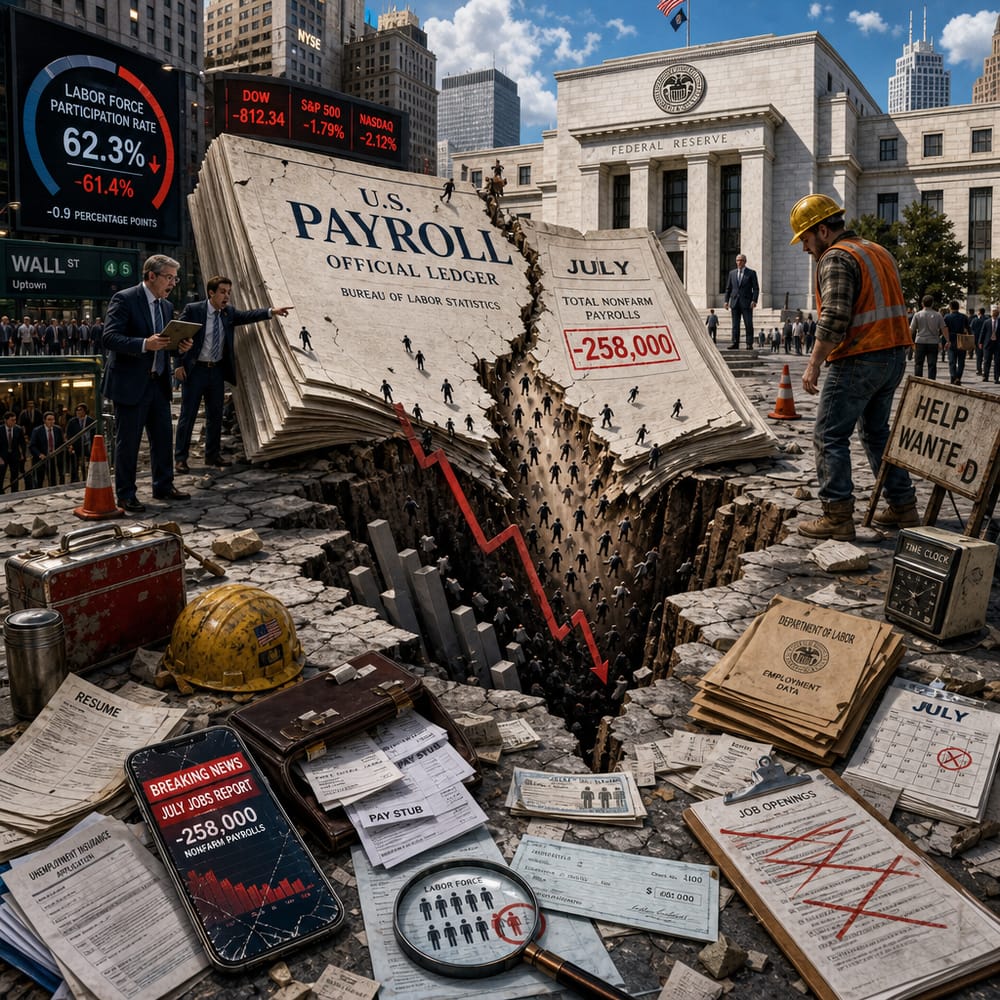
JULY JOBS REPORT: PAYROLL DECLINE AND PARTICIPATION DROP
The July jobs report just dropped like a bad habit, and it's not the kind of news you'd celebrate with a confetti cannon. The U.S. economy unexpectedly shed 23,000 jobs last month, a surprising twist in a labor market saga that had mostly been about growth. It's the first net loss in years, and yet, the unemployment rate still dipped. Confused? Let's peel back the layers and see what's really going on here.
Imagine you've baked a cake but the middle is missing—looks good from the outside, but there's a hollow void where deliciousness should be. That's the U.S. labor market for you right now. Sure, the unemployment rate fell, but it wasn't because more people found jobs. Instead, fewer people were actively looking for work, leading to a decline in the labor force participation rate. In plain English, people are stepping back from the job hunt, and that's why the unemployment rate's drop feels more like smoke and mirrors than a true economic triumph.
So, what does this mean for the broader U.S. economy? A declining labor force is about as welcome as a fly in your soup. Fewer people chasing jobs can lead to slower economic growth, and it strains businesses that are in desperate need of talent. It’s a domino effect: less workforce participation can mean decreased consumer spending, which can put a damper on economic dynamism. And if you were hoping this would nudge the Federal Reserve to lower interest rates, think again. It's complicated.
Enter the Federal Reserve, stage left, tasked with the delicate balancing act of juggling employment and inflation. With inflation still persistently hanging around like an uninvited guest, the Fed's job isn't getting any easier. A weakening labor market puts them in a tough spot. Typically, they might consider lowering interest rates to spur economic activity. But with inflation not budging, they’re caught in a game of monetary chicken. Raising rates could cool inflation but also risks pushing the economy into a deeper labor funk. Lowering them might boost employment but could fuel inflation further.
It’s like trying to solve a Rubik’s Cube while blindfolded. The Fed’s dual mandate is to promote maximum employment and keep prices stable. But what happens when these two goals are at odds? It's a tightrope walk without a net.
This labor market conundrum also has Wall Street scratching its well-coiffed head. Stock futures barely moved after the S&P 500 posted its third straight losing day, with tech stocks feeling the heat from rising bond yields. Investors are in a holding pattern, waiting for the next move from the Fed like it’s the finale of a Netflix series. Any hawkish signal could rattle markets further, while a dovish tilt might offer some short-lived relief.
And let's talk about sectors. Those relying heavily on consumer spending—think retail and hospitality—could feel the pinch. If fewer people are participating in the labor market, fewer paychecks are being cashed, potentially slowing down consumer-driven sectors. Yet, in the midst of this gloom, there might be a sliver of silver lining for blue-collar jobs. A smaller labor pool might empower workers to demand higher wages, potentially improving conditions for those who remain employed.
So, what's the takeaway here? The July jobs report is a mixed bag that raises more questions than it answers. It underscores the precarious state of the U.S. economy, balancing on the edge of a labor force that’s shrinking in participation. Meanwhile, the Fed is left with the unenviable task of navigating this economic labyrinth without upsetting the fragile balance between employment and inflation.
In the coming months, all eyes will be on the Federal Reserve. Will they hold their nerve, or will they blink in the face of this labor market riddle? Whatever happens, fasten your seatbelts. It’s going to be a bumpy ride.
This article is for informational purposes only and is not investment advice. Always do your own research or consult a licensed financial professional before making investment decisions.
© Copyright 2024. All Rights Reserved.
© Copyright 2024. All Rights Reserved.