

Jackson Hole Hawkish Tone Lifts Risk Sentiment, Bolsters Weekly Market Performance
Friday, August 28, 2026
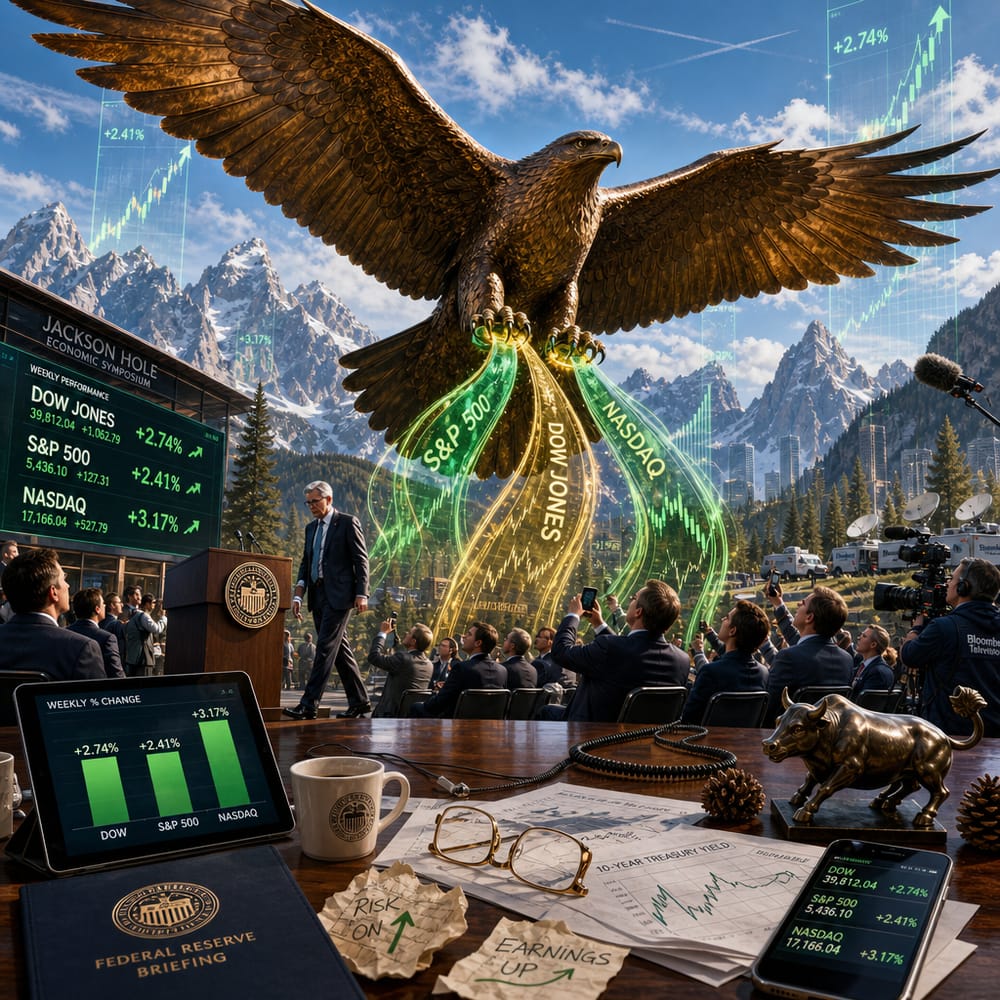
JACKSON HOLE: FED HAWKNESS AND THE RETURN OF MARKET SWAGGER
The financial world paused its regular programming last week to tune into the annual Jackson Hole shindig, the Davos of the economic world, set against the rugged backdrop of Wyoming's Tetons. Here, Federal Reserve Chairman Kevin Warsh didn’t just show up; he delivered a hawkish sermon that pulled the financial markets from their summer daze and gave retail investors something to text about other than summer blockbusters or NFL drafts.
Now, for the uninitiated, a "hawkish" Fed stance isn't about ornithology. It means Warsh is eyeing those interest rates with the intensity of a hawk spotting a field mouse. And it was the kind of tough love talk that the markets had been craving. Warsh, who had once left us all scratching our heads with his cryptic statements, finally provided clarity that hinted at possible interest rate hikes, should inflation not decide to cool off on its own.
The market, like a caffeinated teenager on TikTok, reacted immediately. Warsh's no-nonsense rhetoric sent tremors through Wall Street, lighting a fire under the S&P 500 and Dow Jones. By the end of the week, both indexes were flirting with their first gains in weeks. The S&P 500, up ever so slightly, and the Dow, prancing up by about 1%, were the belles of the ball, showing investors that the markets can dance even when inflation is the DJ.
So, why was Warsh's speech such a big deal? Because those words have power. When Warsh talks inflation, investors listen. His commitment to tackling inflation offers a glimmer of certainty in an otherwise uncertain economic landscape. It's like getting a weather forecast that actually predicts the weather right.
Let's break it down. Warsh's speech not only signaled potential rate hikes but also dominated market sentiment. In response, the 2-year Treasury yield spiked—a move that mirrored Warsh's hawkish tone, reflecting higher expectations for short-term interest rates. Long-term yields, however, remained a bit more subdued. It's as if the bond market decided to give Warsh the side-eye while saying, "We'll see, Kevin."
With inflation still the elephant in the room, Warsh’s hawkish rhetoric suggests the Fed might have to keep interest rates higher for longer. This is the iron fist wrapped in an inflation-fighting glove: it could slow down growth, but it's intended to prevent an overheated economy from burning out entirely.
Different sectors processed the news with varying degrees of enthusiasm. Tech stocks, forever the delicate darlings of the market, took a dip. Nvidia and Intel shares slipped, taking the Nasdaq down by 0.3%. Chalk it up to the sector's sensitivity to interest rates—higher rates make borrowing more expensive, which is like kryptonite to tech giants with big growth plans.
Meanwhile, consumer goods and services sectors found their groove. The Dow's gains were buoyed by strong performances from companies like Microsoft, which soared past its competitors with a new buy signal, while Amazon saw a leap in its stock price. It’s almost as if consumer goods stocks were saying, “thanks for the heads-up, Warsh, but we’ve got this.”
As Warsh's speech resonates through trading floors and living rooms alike, investors are left pondering the implications of future Fed policy. How aggressive will the Fed get in its inflation fight? And how will this determination to tackle inflation shape the broader economic landscape?
So what should retail investors make of all this? Stay savvy, folks. Warsh may have laid down the gauntlet, but the real action is just getting started. Whether you're knee-deep in blue chips or cutting your teeth on the latest AI stocks, the Fed's hawkish stance will be the wind in your investing sails or the wave crashing over your portfolio. Stay informed, and as always, keep your eyes on the prize—or, in this case, the Fed's next move.
This article is for informational purposes only and is not investment advice. Always do your own research or consult a licensed financial professional before making investment decisions.
© Copyright 2024. All Rights Reserved.
© Copyright 2024. All Rights Reserved.