

International Equity ETF Rotation – South Korea and Japan in Focus
Tuesday, August 18, 2026
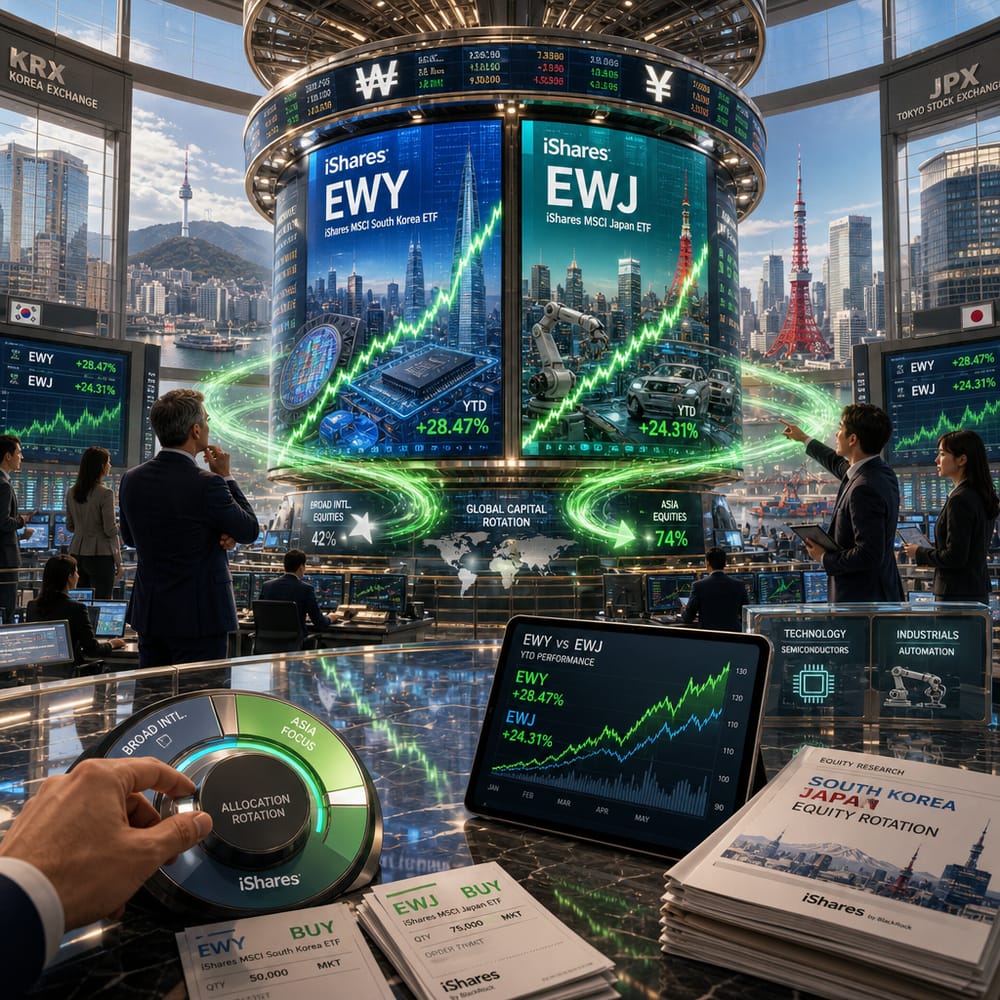
STOCKS RISING IN THE EAST: WHAT'S BEHIND THE SURGE IN SOUTH KOREA AND JAPAN ETFS?
Look out West, Wall Street, because there's a new kid on the block—or rather, two old kids making a comeback. If you haven't been paying attention, iShares' MSCI South Korea (EWY) and Japan (EWJ) ETFs are having a moment, and it's worth asking why. What exactly is powering this regional rotation to the Far East? And what could it mean for those tech and auto giants we've all come to love (and invest in)?
Let's dive in.
THE MACROECONOMIC FACTORS
Picture this: global bond yields are behaving like your caffeine consumption on a Monday morning—skyrocketing. As sovereign bond yields reach stratospheric highs in the U.S. and Europe, investors are casting their eyes eastward, looking for yields that don't make them break into a cold sweat. South Korea and Japan have emerged as prime real estate for savvy investors.
Both countries offer a well-tailored cocktail of stable governance, established tech sectors, and export-driven economies that find themselves in the spotlight as Western markets grapple with inflation and high oil prices. As bond yields surge, the allure of East Asia's relatively lower-risk equities becomes hard to resist.
Moreover, South Korea’s tech sector, with powerhouses like Samsung, and Japan’s diversified industries, including Toyota and Sony, are basking in the glow of a tech renaissance. In a world that's increasingly digital, these stalwarts are safe bets for those wary of wading through volatile markets.
IMPLICATIONS FOR KOREAN AND JAPANESE COMPANIES
It's not just about finding a safe haven; it's about seizing opportunities. South Korea's tech giants could see an uptick in investment, paving the way for potential innovations and expansions. The semiconductor space, despite some bumps in the road, remains a lucrative field. After all, chips are the lifeblood of the tech industry, and South Korea is one of its main veins.
In Japan, the focus shifts a bit. The country’s automotive sector stands ready to capitalize on the global push towards electric vehicles (EVs). If you think Tesla is your only EV option, think again. Japanese automakers are revving their engines, with investments that could reshape the future of transportation. High investment inflows might just be the fuel needed to accelerate their green ambitions.
THE MILLION-DOLLAR QUESTION: WILL IT LAST?
Trends come and go as quickly as avocado toast, so is this rotation here to stay? Well, that depends on a couple of variables.
For one, if you’ve been keeping an eye on the Federal Reserve’s tea leaves, you’ll know there's a sense of impending dovishness—that is, a potential easing of interest rates. If the Fed chooses to pump the brakes on rate hikes, we could see a return of capital to U.S. markets, slowing the momentum of ETFs like EWY and EWJ.
Oil prices and global trade narratives are also in play. Trade negotiations, such as those between the U.S. and Canada, could shift market dynamics in unpredictable ways. Tariffs or trade barriers can send ripples—or tsunamis—through markets, impacting export-heavy economies like South Korea and Japan.
However, if inflation remains sticky and bond yields keep climbing like Spider-Man on skyscrapers, expect this East Asian rotation to maintain its momentum. Investors seeking refuge from volatility are likely to continue backing the stable, growth-focused equities that Japan and South Korea provide.
A FINAL THOUGHT
So, should you jump onto the South Korea and Japan bandwagon? Well, if you're looking for a mix of stability and growth potential and aren't allergic to a bit of risk, these ETFs might just tick the boxes. Keep an eye on macroeconomic winds and global trade currents, but there's certainly a case for thinking globally while investing locally—especially if "local" includes a sushi bar or a K-pop concert.
Remember, in the financial world, as in life, fortune favors the bold. Or at least, those who read beyond the headlines.
This article is for informational purposes only and is not investment advice. Always do your own research or consult a licensed financial professional before making investment decisions.
© Copyright 2024. All Rights Reserved.
© Copyright 2024. All Rights Reserved.