

Infrastructure Glitches Shake Confidence in Financial Systems
Tuesday, November 17, 2026
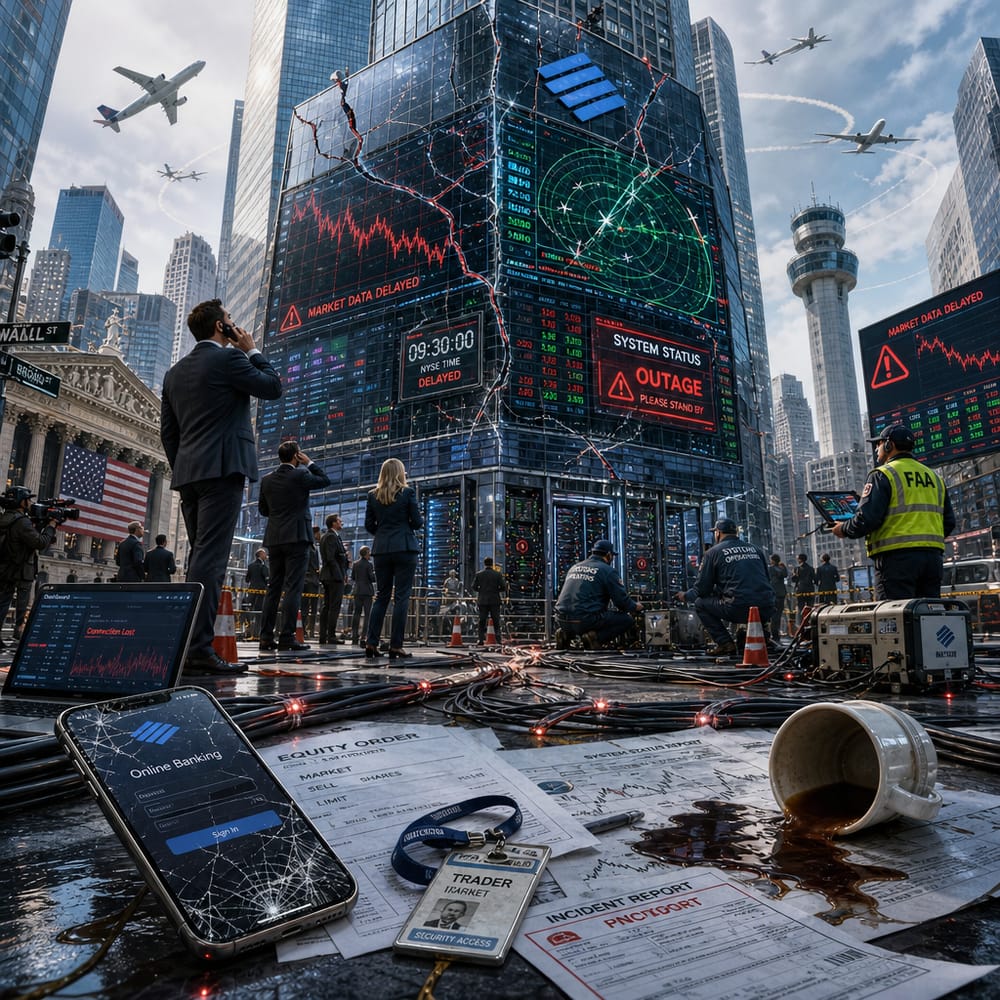
INFRASTRUCTURE GLITCHES SHAKE CONFIDENCE IN FINANCIAL SYSTEMS
Ever had one of those days where everything works perfectly until the universe decides to remind you who's boss? Now imagine that day happening at JPMorgan Chase or the Federal Aviation Administration. Not so funny anymore, right? Recent tech glitches at these cornerstone institutions have highlighted a sobering truth: our critical infrastructure might be more 'duct tape and dreams' than 'iron-clad reliability.'
There's nothing quite like a tech outage to shake market confidence and instill a fresh bout of anxiety in investors already navigating a sea of volatility. It's like the financial markets have suddenly realized the high-wire act they've been performing doesn’t have a safety net. And when these systems hiccup, the whole market seems ready to puke.
Picture this: a nationwide ground stop of flights because an overloaded router decided to throw a tantrum. The FAA had to pause its operations, creating the longest halt since 9/11. This wasn’t just a ripple in a pond; it was more like an elephant belly-flopping into a kiddie pool. Flights were grounded, business trips delayed, vacation plans dashed, and worst of all, confidence in the efficiency of air travel wobbled. Meanwhile, JPMorgan Chase, a titan of finance, faced its own technical gremlins, further fueling the sense of unease.
WHAT DOES THIS MEAN FOR THE MARKET?
These infrastructure failures serve as a not-so-gentle reminder of the vulnerabilities within our financial and transportation systems. For investors, it’s a cue to reassess the risks lurking under the hood of the markets. If these behemoths can falter, what about smaller players? With confidence taking a hit, the market’s knee-jerk reaction is a flight to safety. It's like reaching for a security blanket during a thunderstorm. Unfortunately, in financial terms, this often means pulling money out of the market, which can lead to increased volatility.
The broader implications are significant. Beyond just the immediate disruptions and stock price wobbles, there’s a growing realization that these infrastructures need an upgrade—a serious one. Think of it like dragging a family van into the mechanic's and realizing it's time for a flashy new electric SUV. The costs and complexities are daunting, but so are the potential consequences of another major failure.
HOW ARE INVESTORS REACTING?
Investors are, understandably, jittery. In response to the outages, the Dow took a nosedive of 900 points. It wasn't just a fluke—a combination of tech sector jitters and infrastructure concerns sent the market into a tizzy. Investors are eyeing their portfolios with the same suspicion as you might eye a leftover slice of pizza: it's usually safe, but you're never completely sure.
The NSA outage added another layer to the paranoia parfait. Although it was eventually chalked up to routine maintenance, the initial silence felt like waiting for a horror movie jump scare that never comes. The markets don’t like uncertainty, and right now, they’re getting more of it than they ordered.
PREVENTING FUTURE OUTAGES
Rather than just scrambling for band-aid solutions, discussions are underway about improving infrastructure resilience. The FAA has already paused its installation of new routers while dissecting what went wrong. It's a move reminiscent of stopping the assembly line to find out why the cars keep catching fire. Meanwhile, JPMorgan Chase and other financial institutions are likely doubling down on their tech investments, hoping to avoid future embarrassments.
But here’s where the rubber meets the road: what are these organizations actually doing to fix the problem? Are they investing in new technologies, or just patching up the old systems? We've seen this movie before, and we know the ending isn't usually pretty if the fix is just cosmetic.
Investors and regulators alike are pushing for greater transparency and accountability. They don’t just want assurances that things will be better—they want to see concrete plans. The stakes are too high for anything less.
IN CONCLUSION
As the dust settles from these latest outages, the real question becomes: will these incidents serve as a wake-up call or just a fleeting blip in the relentless drive toward growth and profit? The potential for market volatility and loss of confidence makes it clear that this is more than just a tech issue—it's a financial one, and one that demands immediate attention.
If nothing else, these tech glitches serve as a reminder of our dependency on these infrastructures. Investors are left wondering: if the backbone of the financial and travel systems can wobble, what’s next? It's a question nobody really wants to answer, but it's one that the markets can’t afford to ignore.
This article is for informational purposes only and is not investment advice. Always do your own research or consult a licensed financial professional before making investment decisions.
© Copyright 2024. All Rights Reserved.
© Copyright 2024. All Rights Reserved.