

Industrial Breakups Are Back: Why Wall Street Wants Simpler Companies
Tuesday, June 30, 2026
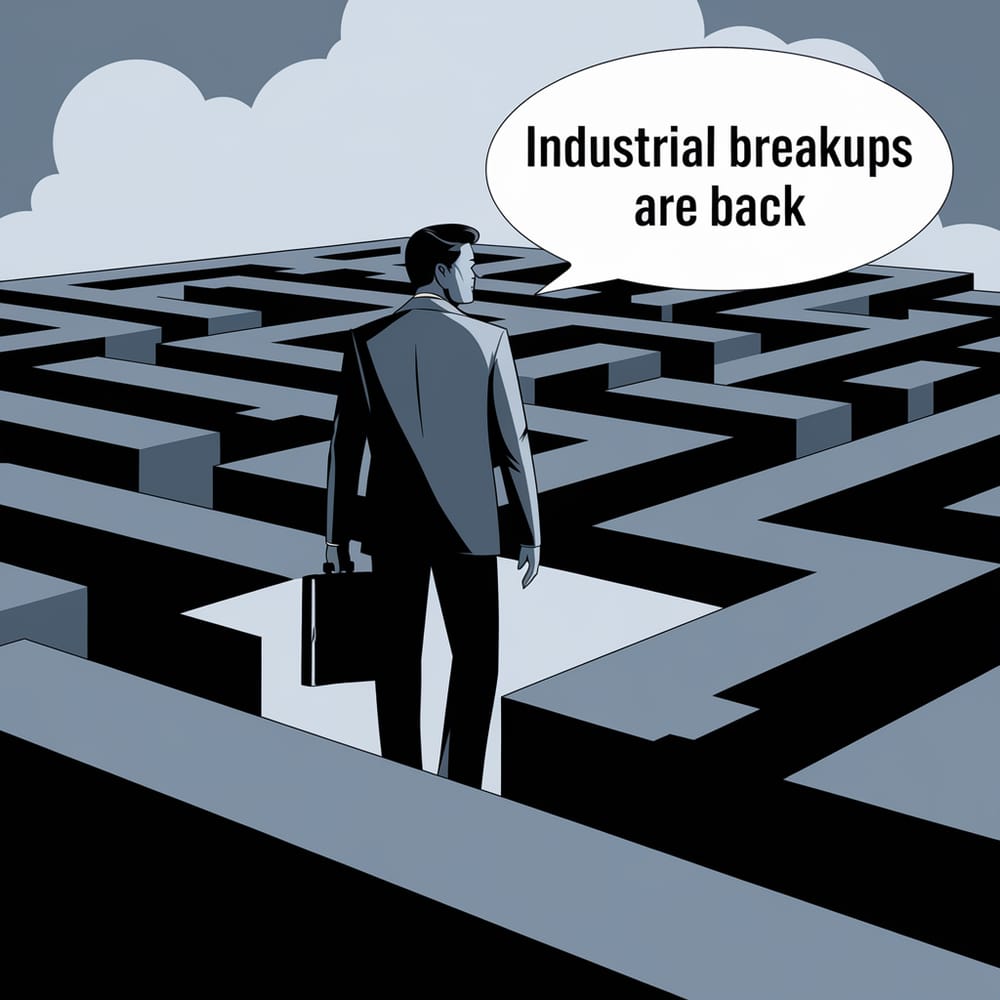
The golden age of the corporate empire is officially dead. For decades, the undisputed playbook on Wall Street was to build sprawling conglomerates—buying up vastly different businesses under one massive umbrella to achieve "synergy" and weather economic downturns.
But within a matter of days, two of the market’s most iconic, deeply consolidated giants threw in the towel on that diversification strategy. Honeywell completed its highly anticipated corporate separation of Honeywell Aerospace ($HONA), and Comcast stunned the media landscape by announcing a full-blown split of its core connectivity network from a standalone media titan anchored by NBCUniversal and Sky.
The message from the trading floor is loud and clear: Wall Street no longer values size for the sake of size. Investors want focused, hyper-specialized pure plays with transparent earnings stories, and they are willing to force breakups to get them.
Shaking Off the "Conglomerate Discount"
To understand why large corporations are actively dismantling themselves, you have to look at how modern institutional capital is deployed. When a single management team runs multiple completely unrelated businesses, the stock almost always suffers from what analysts call a conglomerate discount.
Complexity creates an analytical headache. An investor who wants high-yield, defensive cash flow from Comcast's broadband infrastructure doesn’t want to inherit the volatile, hyper-competitive streaming wars of Peacock. Similarly, an investor looking for software-driven industrial automation at Honeywell shouldn't be forced to ride out lumpy commercial aviation supply chains.
By slicing these empires apart, corporate boards are removing the analytical noise. Focused businesses trade at higher valuation multiples because their capital allocation is clean, their strategic goals are unified, and they are significantly easier for the market to price to perfection.
Comcast Unwinds 15 Years of Media Consolidation
Comcast’s structural overhaul marks the grand finale of the telecom-and-media integration era. Back in the 2010s, pairing a massive distribution pipeline (cable and internet cords) with a massive content engine (NBCUniversal) was viewed as a stroke of genius.
By June 2026, the strategy completely ran out of gas. Confronted by relentless cord-cutting and aggressive broadband competition from fixed-wireless networks, Comcast leadership admitted that the benefits of scale no longer outweigh the drag of complexity.
This historic unwinding creates two distinct entities:
-The New Comcast: A streamlined technology utility focusing entirely on its broadband, mobile, and business connectivity networks, serving over 65 million homes.
-NBCUniversal: A global media, entertainment, and theme park pure play combining Universal Studios, Peacock, and European pay-TV operator Sky.
Critically, separating the businesses doesn't just simplify their earnings reports; it sets them up for aggressive consolidation. Stripped of regulatory baggage, a standalone NBCUniversal instantly transforms into a massive, highly nimble player in the media M&A landscape.
Do Spin-Offs Create Real Value or Just Temporary Hype?
The initial market reaction to a breakup announcement is almost always a wave of buying euphoria. Honeywell and Comcast both saw immediate stock spikes as traders celebrated the impending unlock of value. Historically, academic studies show that independent spin-offs tend to outperform the broader market during their first 24 months of independent trading because of renewed management focus.
However, corporate splits are not guaranteed home runs. For retail investors navigating a corporate breakup, the real work begins after the initial announcement. To determine if a spin-off will create long-term value, three critical metrics must be scrutinized:
-The Debt Dumping Ground: Spinoffs are highly vulnerable to a corporate maneuver where the parent company transfers a disproportionate share of its legacy liabilities and debt onto the newly created entity (the "SpinCo"). Investors must verify that the spun-off business has an independent, investment-grade balance sheet that can actually fund its own growth.
-The Dividend Squeeze: Sprawling conglomerates are often prized for their steady, reliable dividends. When a split occurs, that payout is rarely maintained equally across both entities. Typically, the cash-generative utility side of the business keeps the dividend, while the growth-oriented spin-off eliminates it entirely to reinvest capital.
-The Execution Interregnum: Moving from a public announcement to final independence takes anywhere from nine to twelve months to clear regulatory, tax, and shareholder hurdles. During this transition period, corporate momentum can stall, and executive distraction can cause core operations to slip.
The Sectors Placed on Breakup Watch
With Elliott Investment Management successfully forcing Honeywell’s hand and Comcast moving aggressively on its own terms, the activist-driven breakup trend is poised to sweep across other heavily consolidated sectors.
The legacy media and telecom space is highly vulnerable to further fragmentation. Sprawling portfolios that mixed linear cable networks, satellite delivery, and streaming assets are facing severe pressure from shareholders to simplify or die. Concurrently, the defense and diversified industrial sectors are under the microscope. Any multi-industrial firm whose component parts are mathematically worth more on the open market than combined under a legacy corporate banner will face an aggressive push to execute a split before the end of the year.
The Takeaway for Investors
The return of the industrial and media breakup trend proves that the market has completely lost its appetite for corporate bloat. The investment thesis for the late 2020s is firmly anchored in operational simplicity and pure-play exposure.
While the initial announcement of a corporate breakup offers an attractive short-term trading catalyst, long-term investors should maintain strict valuation discipline. The value isn't created by the act of the split itself; it is unlocked by what each company does with its newfound freedom once the corporate cords are finally cut.
This article is for informational purposes only and is not investment advice. Always do your own research or consult a licensed financial professional before making investment decisions.
© Copyright 2024. All Rights Reserved.
© Copyright 2024. All Rights Reserved.