

Impact of Rising Treasury Yields on Mega-Cap Tech Stocks
Tuesday, August 18, 2026
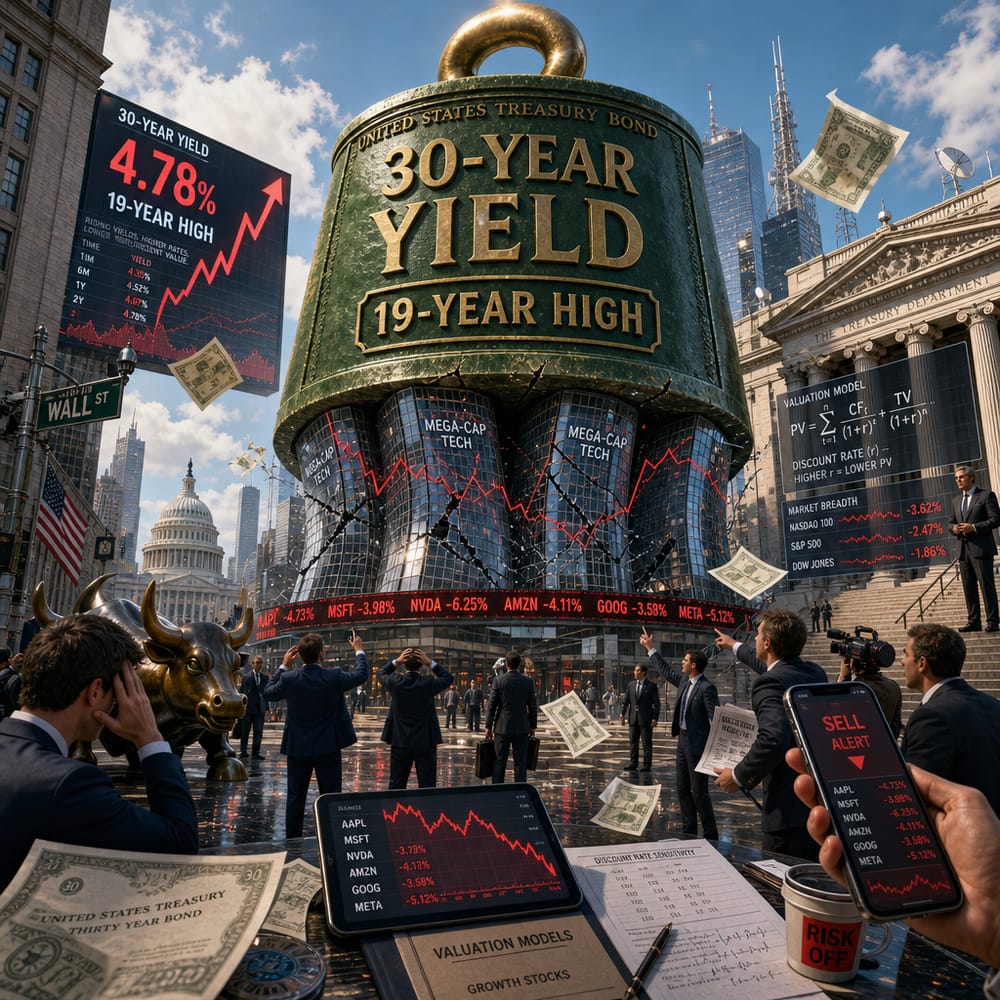
MELTDOWN IN THE TECH SPHERE: HOW RISING TREASURY YIELDS ARE RAINING ON BIG TECH'S PARADE
Picture this: You're a giant among giants, strutting confidently across the Wall Street stage, glittering with all the allure that only a trillion-dollar market cap can bestow. Then, out of nowhere, Uncle Sam hikes up his Treasury yields, and suddenly, the spotlight feels a little too hot.
Welcome to the world of mega-cap tech stocks in 2026, where 30-year U.S. Treasury yields have ballooned to a nosebleed-inducing 5.33%, the highest in 19 years. What's the big deal, you ask? Well, higher Treasury yields are like kryptonite to growth stocks, and our tech titans—think Apple, Microsoft, and Alphabet—are feeling the sting.
But first, why are tech stocks so sensitive to interest rates? It's all about the discount rate, folks. Investors evaluate companies based on their future cash flows. When Treasury yields rise, the discount rate also climbs, making those future profits a tad less shiny. In plain English, tech stocks look less attractive, and their valuations, which often fly high on pie-in-the-sky expectations, can nosedive faster than a college student's GPA during finals week.
So, how are our beloved tech behemoths responding? They're not exactly throwing a ticker tape parade. Stocks like Nvidia and its ilk are grappling with the dual pressures of high interest rates and competitive tensions. Even the AI gold rush, which Nvidia has ridden like an old prospector chasing after a motherlode, can't fully shield it from market jitters.
Market reactions are as volatile as a toddler on a sugar high. On days when yields creep up, tech stocks tend to retreat, weighing heavily on indices like the Nasdaq. The chorus of "sell" echoes across trading floors, sending ripples through investor portfolios. It's a tale as old as time: higher yields, lower tech valuations, rinse, repeat.
Yet, every dark cloud has its silver lining—or at least a workaround. What can savvy investors do to navigate these choppy waters? Diversification is the name of the game. Don’t put all your apples in one basket, or in this case, don't bet your entire 401(k) on Silicon Valley's finest.
Consider branching out into sectors less sensitive to rising rates, like consumer staples or healthcare, which aren't as reliant on future growth and thus less prone to the whims of yield fluctuations. Think of them as your financial comfort food—steady, reliable, and always there when you need them.
Another strategy? Keep a close watch on the yield curve. If short-term yields rise faster than long-term ones, it could be a recessionary signal, prompting a shift in how investors approach risk. A flatter curve might mean it's time to buckle up and brace for economic turbulence, leaving the high-flying tech plays in the hangar.
It's also worth exploring fixed-income investments. With yields this high, bonds become a more attractive option, serving as a ballast against stock market volatility. CDs—those trusty certificates of deposit—might not seem glamorous, but with banks offering interest rates reminiscent of yesteryears, they’re worth a second glance.
Finally, for those still daring enough to dance with tech stocks, focus on fundamentals. Not all tech companies are created equal, and those with solid balance sheets and tangible competitive advantages might weather the storm better than their peers. Nvidia, for instance, has not only its chips but also capital at its disposal—a lifeline for leveraging during lean times.
In the end, rising Treasury yields are more than just a blip on the financial radar; they're a wake-up call for investors. With valuations under siege, it's time to reassess, regroup, and maybe, just maybe, rediscover the joys of boring-but-steady investments.
So, while big tech grapples with its existential yield crisis, remember that markets are cyclical, and a strategic pivot now could pay dividends—or at least staunch some bleeding—down the line. Who knows, when the dust settles, you might just find yourself in a more robust, diversified portfolio that stands the test of time. And in the world of investing, that's the ultimate endgame.
This article is for informational purposes only and is not investment advice. Always do your own research or consult a licensed financial professional before making investment decisions.
© Copyright 2024. All Rights Reserved.
© Copyright 2024. All Rights Reserved.