

IMF's FX Shock Toolkit for EM Currencies
Friday, October 02, 2026
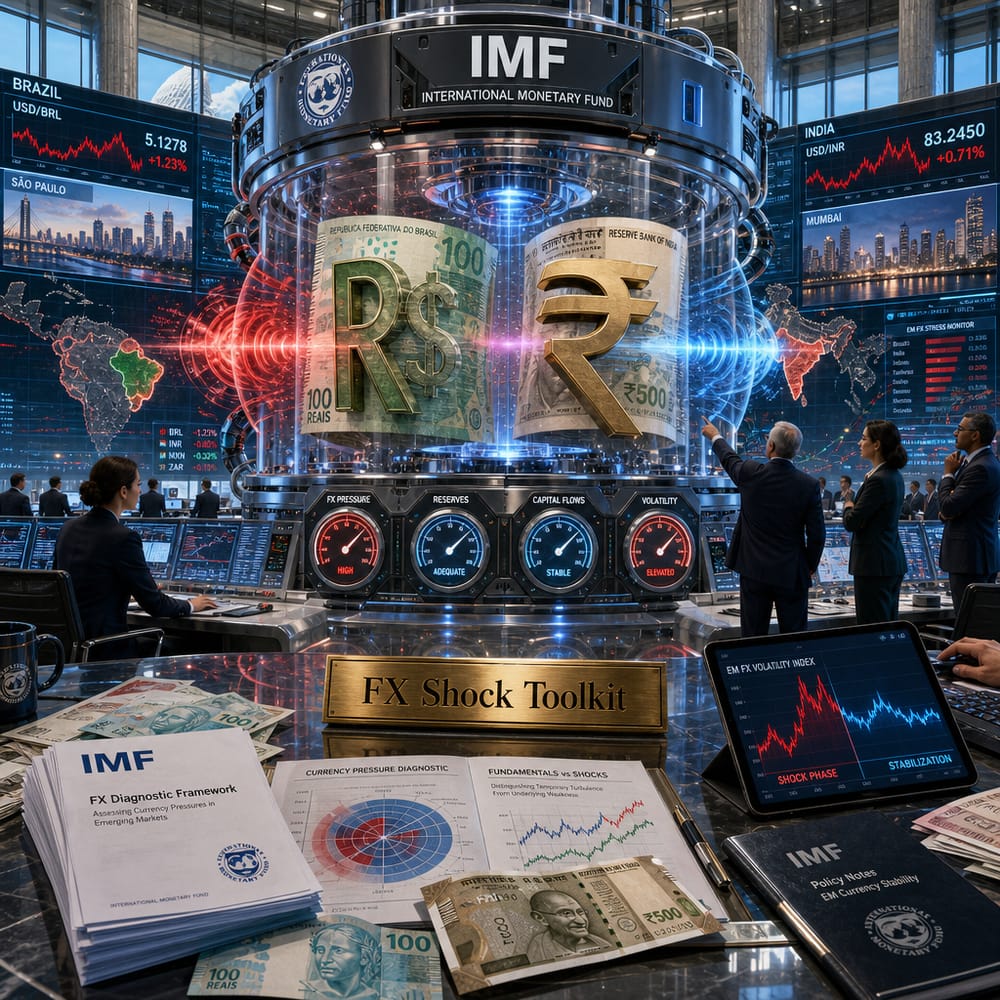
IMF's FX Shock Toolkit for EM Currencies: A Lifeline or Just Another Guide?
In the wild world of foreign exchange, where currencies can rise and fall faster than your favorite meme stock, the International Monetary Fund's (IMF) new toolkit is here to help emerging markets (EM) navigate the choppy waters of financial shocks. But here's the million-dollar question: Is this toolkit just a shiny new brochure, or could it really make a difference for EM currencies like the Brazilian real and Indian rupee when the financial storms hit?
EMERGING MARKETS IN THE CROSSHAIRS
Picture this: You’re a central banker in an emerging market, sipping your coffee, and suddenly, you’re hit with a financial shock. Maybe it’s a sudden interest rate hike in the U.S., or perhaps another geopolitical spat sending investors running for cover. Whatever the cause, your currency is taking a nosedive, and your crystal ball is out of commission. This is where the IMF's new framework comes into play, aiming to help identify when currency swings are due to financial shocks rather than fundamental economic issues.
So, which currencies are most at risk? Well, it’s like asking which member of a pop band is likely to go solo—it depends on what’s happening in the world. However, the Brazilian real and Indian rupee generally find themselves in the spotlight. Both are major players in global trade, making them susceptible to international financial whims.
THE TOOLKIT: A NEW HOPE?
The IMF's framework supposedly acts like a weather app for currency storms. It analyzes a cocktail of signals and variables—kind of like checking the wind speed, humidity, and pollen count before a picnic, but for money. The idea is to differentiate between currency movements caused by genuine economic factors and those whipped up by transient financial gusts.
The toolkit provides guidelines for policymakers on how to respond when these non-fundamental pressures are at play. Think of it as an emergency manual for when you're stuck on a financial rollercoaster with no seatbelt.
For the Brazilian real, this could mean strategizing against volatile commodities prices, since Brazil's economy is heavily linked to natural resources. Meanwhile, India might have to tackle issues stemming from capital flows as investors react to global interest rate changes.
POLICYMAKERS SUIT UP
So, what can policymakers actually do with this toolkit? Imagine you’re dealing with currency pressures. Instead of reaching for the panic button or making rash decisions like an inexperienced day trader, this framework gives you a strategy. You can deploy foreign exchange reserves, adjust interest rates, or even roll out macroprudential measures—fancy speak for policies ensuring the financial system stays stable.
However, having the right tool doesn't guarantee you’ll fix the problem—just like owning a gym membership doesn’t mean you’ll magically get fit. Policymakers need to understand their specific economic landscape to make informed decisions. It’s all about making moves that align with the nation's financial health rather than just reacting to the latest market hiccup.
THE GLOBAL SCENE: WHY IT MATTERS
The IMF's initiative couldn't come at a more critical time. As global central banks play a game of “who blinks first” with interest rates, the potential for misalignment is high. For emerging markets, this often translates into currency swings as investors chase the best returns around the globe.
Amidst all this, understanding whether a currency's movement is driven by fundamentals or market panic is paramount. Get it wrong, and you might intervene inappropriately, worsening the situation like pouring water on a grease fire.
THE FUTURE OF EM CURRENCIES
The IMF's toolkit aims to provide a steady hand amidst the chaos, a lighthouse for when the financial fog rolls in. But like any tool, its effectiveness is in the hands of its users. Will it be the lifeline emerging markets need, or just another theoretical exercise to gather dust on IMF’s proverbial shelf?
Time will tell. For now, the Brazilian real and Indian rupee—and other emerging market currencies—must brace for whatever the financial world throws their way, armed with a toolkit that promises to make navigating the chaos just a little bit easier. Investors and policymakers alike will surely be watching closely, because in the world of forex, fortunes can change faster than you can say "exchange rate."
This article is for informational purposes only and is not investment advice. Always do your own research or consult a licensed financial professional before making investment decisions.
© Copyright 2024. All Rights Reserved.
© Copyright 2024. All Rights Reserved.