

Hyperscaler Debt Pressure
Sunday, September 27, 2026
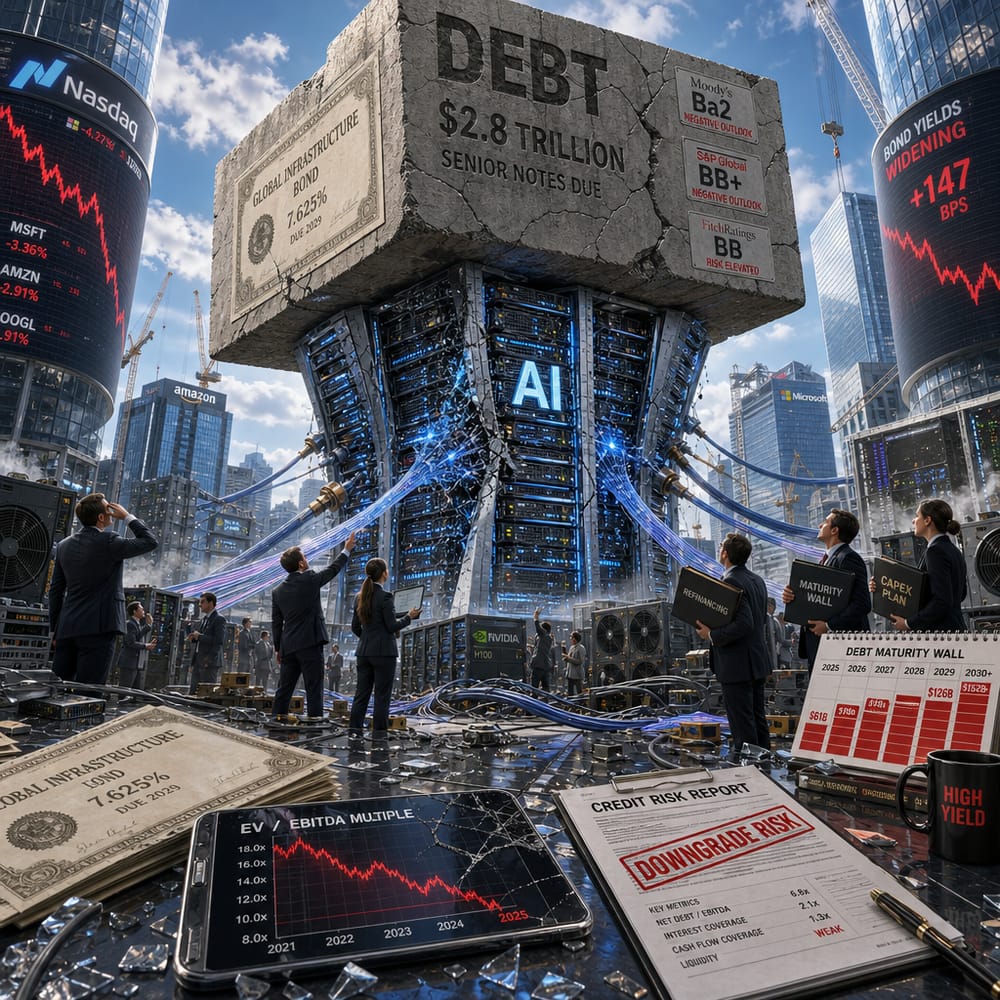
THE AI HYPERSCALER DEBT DILEMMA: WHEN SKY-HIGH YIELDS MEET CLOUDY FORECASTS
In the heady world of tech giants, where AI hyperscalers like Alphabet, Oracle, and Microsoft reside, everything seems larger than life — from their ambitious AI infrastructures to their ballooning debt levels. It's a land where cloud computing is king, and building the vast digital landscapes of tomorrow requires capital, and plenty of it. But as the old saying goes, "What goes up, must come down," and these tech titans may soon feel the gravitational pull of financial reality.
Welcome to the realm of soaring Treasury yields, where borrowing isn’t just expensive—it’s a potential public relations nightmare. With yields reaching levels not seen since the days when flip phones were cutting-edge, hyperscalers are about to discover that the cost of funding their AI dreams is climbing faster than a SpaceX rocket.
THE DEBT DRAGON
JPMorgan Chase recently estimated that a whopping $4.1 trillion in AI-related debt might be issued by 2030. That’s not just pocket change; it's a massive mountain of obligations. And with the 10-year Treasury yield now flirting with 5.17%, the cost of borrowing is more painful than stepping on a LEGO in the dark.
This isn’t just an accounting footnote. Debt levels have a nasty habit of catching the attention of credit rating agencies, those financial hall monitors who wield the power to downgrade a company's creditworthiness. A downgrade can send borrowing costs spiraling even further, making investors skittish while stock valuations take a nosedive.
CREDIT RATINGS: ON THE EDGE?
So, how are these rising debt levels affecting our tech darlings' credit ratings? The agencies aren't panicking—yet. But they’re definitely eyeing these companies like a hawk. Microsoft and Alphabet, often seen as the cool kids of Wall Street, have kept their top-tier ratings so far. Oracle, however, isn’t laughing all the way to the bank. With its debt pile growing, Oracle's risk of a downgrade isn’t just hypothetical—it’s on the horizon.
For investors glued to their stock tickers, these credit ratings are more than a mere formality. They’re a bellwether of future profitability and stock performance. A downgrade can signal choppy waters ahead, making those shiny tech stocks lose some of their luster.
THE RIPPLE EFFECT
But what does this mean for you, the everyday investor scrolling through endless financial news? When giants stumble, the tremors are felt across the market. Stocks that were once the darlings of Silicon Valley could see their valuations slip from cloud to canyon in the blink of an eye.
There's a possible shift in investor sentiment looming. Debt-heavy tech stocks might not be the golden goose they once were if borrowing costs continue their upward march. Savvy investors might start looking toward sectors with more reliable returns, like dividend-paying stalwarts or even those ever-so-boring Treasury bonds.
A CHANGE IN THE WEATHER
As bonds become more attractive, money might begin flowing away from high-flying tech stocks, seeking the safe haven of fixed-income investments. With bond yields at their highest in nearly two decades, the risk-reward calculus is changing, and it's not in favor of sky-high valuations based on speculative AI futures.
We’re on the brink of a financial climate change, folks. AI hyperscalers are racing to outdo each other in building the digital future, but as they pile on debt, they may find themselves caught between a rock and a high-interest-rate hard place. For investors, it’s time to keep a wary eye on those credit ratings and consider diversifying before the market shifts beneath your feet.
The tech sector’s narrative is morphing, and it’s not just about innovation anymore. Debt is the new protagonist in the AI saga, and it’s stirring up a drama worthy of its own Netflix thriller. So, whether you’re a tech enthusiast or a bond market traditionalist, it’s time to watch this space. It’s bound to be a fascinating ride.
This article is for informational purposes only and is not investment advice. Always do your own research or consult a licensed financial professional before making investment decisions.
© Copyright 2024. All Rights Reserved.
© Copyright 2024. All Rights Reserved.