

How China’s DUV Lithography Milestone Is Disrupting U.S. Chip‑Equipment Giants
Monday, August 03, 2026
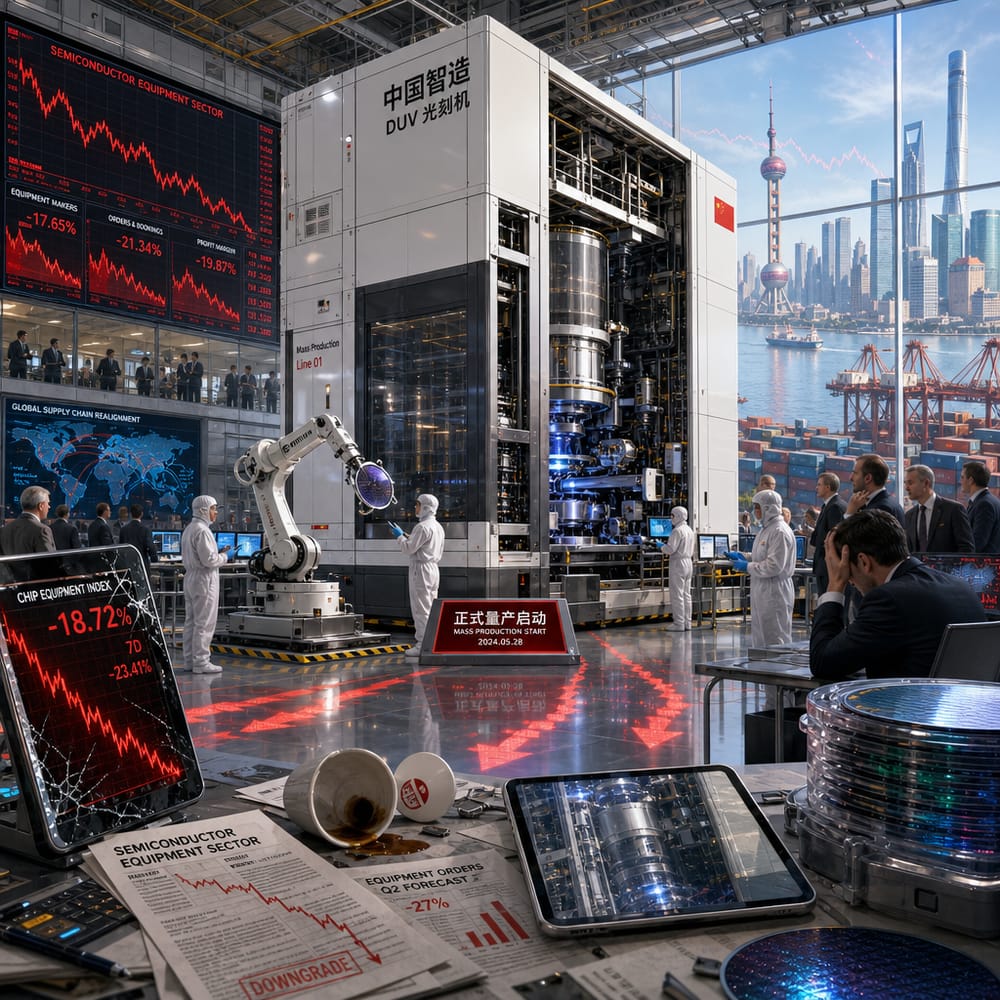
HOW CHINA'S DUV LITHOGRAPHY MILESTONE IS DISRUPTING U.S. CHIP-EQUIPMENT GIANTS
In a plot twist that could rival the latest Hollywood blockbuster, China has pulled a rabbit out of its tech hat. A Shanghai-based, state-backed firm is reportedly breaking new ground by mass-producing cutting-edge DUV lithography machines. And the repercussions? Well, they're sending shockwaves all the way across the Pacific to Silicon Valley, shaking up U.S. semiconductor equipment makers.
So what’s the big fuss about these DUV lithography machines? Let me paint the picture. Imagine trying to create intricate patterns on a silicon wafer that's about as big as a thumbnail. These machines are the artist's brush in the semiconductor world, using deep ultraviolet (DUV) light to etch those patterns. It’s a bit like getting a tattoo, but on a microscopic scale. They are essential for producing chips that power everything from smartphones to supercomputers.
Historically, this space has been dominated by a few behemoths, like Dutch powerhouse ASML and U.S. giants Lam Research, Applied Materials, and KLA. These companies have been the go-to for their stellar machines and technology. But now, with China's new leap, they might face their first real competition in this high-stakes game.
Why is this a big deal, you ask? For starters, it could dramatically reshape the global semiconductor supply chain. Right now, the U.S. counts on a tight-knit circle of allies for its chip-making machinery. With China ramping up its own production capabilities, that circle might just get a little wider, or perhaps, more crowded. This development could make China less reliant on external tech, a strategic move with both economic and geopolitical implications.
Now, you might be wondering how this affects U.S. companies in the grand scheme of things. Picture this: you’re a star player on a football team, and suddenly, a new rival walks onto the field, ready to take the spotlight. It's not just about losing market share; it's about a potential pivot in control over chip production and innovation. The balance of power in tech could shift, and companies like ASML, Lam Research, and their peers might have to rethink their game plan.
The drop in shares of these U.S. chip-equipment companies isn't just a knee-jerk reaction; it's investors grappling with a new reality where the competition landscape suddenly looks different. The U.S. firms have long thrived on their technological edge and substantial R&D investments, but with China's new capabilities, they'll need to double down on innovation to maintain their lead.
What are the long-term effects of this shake-up? It's a little like opening Pandora's box in the tech world. For one, we may see accelerated innovation as firms race to outdo each other. It could spark a semiconductor renaissance of sorts, pushing the boundaries of what these tiny chips can do.
On the flip side, this could lead to increased tensions in trade relationships and tech partnerships. Countries might start reconsidering their alliances and supply chains, especially if it means gaining or losing access to cutting-edge technology. The semiconductor industry, often seen as the backbone of modern technology, might witness a geopolitical tug-of-war.
In this evolving saga, the spotlight isn’t just on the machines but also on the strategic moves by countries and companies. Will U.S. firms rise to the challenge, or will China manage to carve a permanent spot at the table? The semiconductor world is, without a doubt, on the brink of a major shake-up.
As everyday investors, it's crucial to keep an eye on this unfolding story. The stocks of companies like ASML, Lam Research, Applied Materials, and KLA could be in for a rollercoaster ride. As they say, in the world of tech, change is the only constant. So buckle up, because this semiconductor showdown is just getting started.
This article is for informational purposes only and is not investment advice. Always do your own research or consult a licensed financial professional before making investment decisions.
© Copyright 2024. All Rights Reserved.
© Copyright 2024. All Rights Reserved.