

Home Prices Keep Rising, but Real Home Values Are Falling: The Housing Market’s Strange Split
Tuesday, June 30, 2026
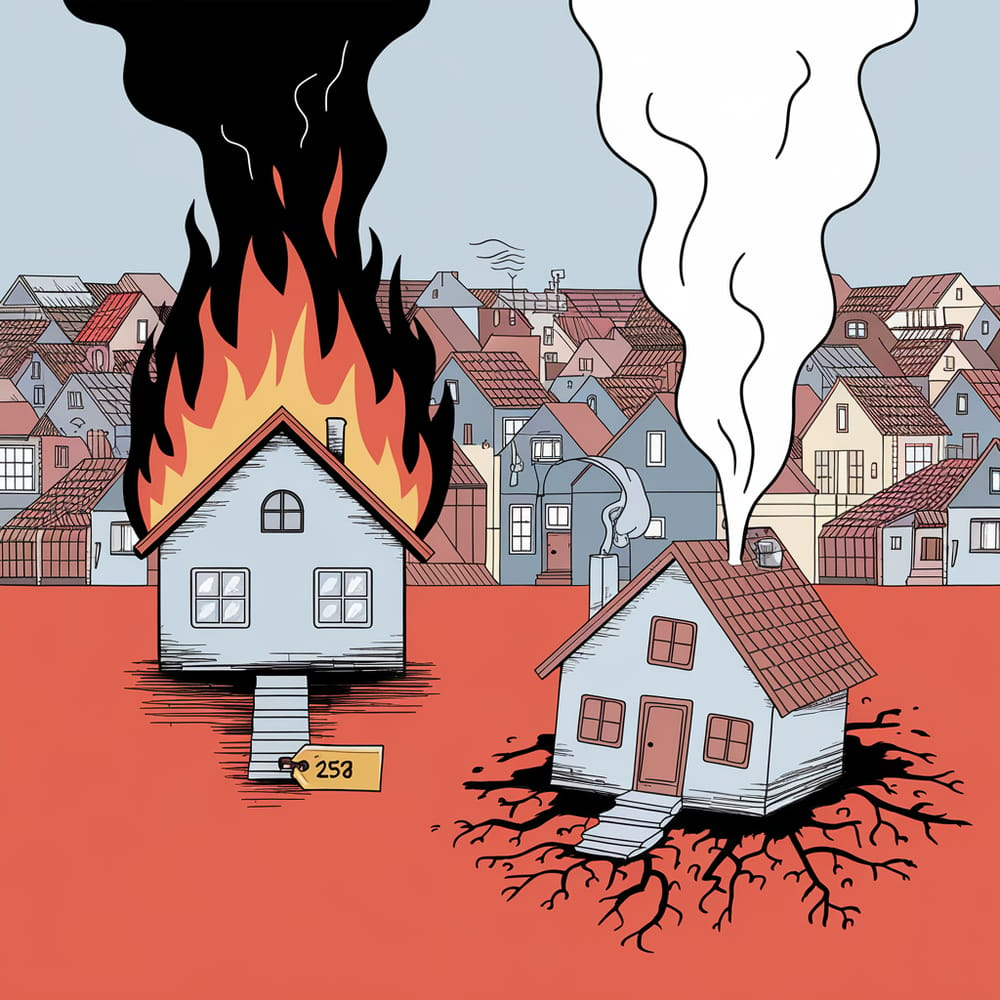
If you glance at the latest headline real estate data, the U.S. housing market looks stubbornly resilient. The fresh S&P Case-Shiller National Home Price Index numbers show that nominal home prices ticked up by 0.8% year-over-year. To the casual observer, it looks like real estate is continuing its slow, unyielding march upward, defying high interest rates.
But look beneath the hood, and you’ll find a massive optical illusion. While nominal prices are technically hitting positive territory, inflation is currently running at a much faster 3.8% clip. Because consumer prices are outstripping property appreciation by a wide margin, U.S. home values have actually declined in real, inflation-adjusted terms for the 11th consecutive month. We are witnessing a historic, quiet deflation of the housing market—and it has major implications for homebuilders, retail giants, and consumer balance sheets alike.
Nominal vs. Real: The Wealth Illusion Explained
To understand why this distinction matters, you have to separate what a house is worth on paper from what that equity can actually buy in the real world.
-Nominal Growth: This is the face-value number. If you bought a home for $400,000 and it is now worth $403,200, it has achieved 0.8% nominal growth.
-Real Growth: This subtracts the eroding power of inflation. Because the broader cost of living rose 3.8% over that same period, your $403,200 asset actually buys less than your $400,000 did a year ago. In real terms, your housing wealth just shrank by roughly 3%.
This real-term decline is eroding the traditional "wealth effect." Typically, when home prices rise, homeowners feel richer and spend more money in the broader economy. But with real values falling and 30-year fixed mortgage rates hovering stubbornly between 6.3% and 6.5%, the psychological boost of homeownership is hitting a wall. Consumer balance sheets are increasingly pinched, locked into properties they can't afford to sell because moving would mean sacrificing their legacy 3% mortgage rates.
Why Homebuilders Are Beating the Real Estate Blues
Given that real home values are falling and affordability is near historic troughs, you would expect homebuilding stocks to be in absolute freefall. Instead, giants like D.R. Horton ($DHI), Lennar ($LEN), and PulteGroup ($PHM) have remained remarkably attractive to Wall Street.
This paradox comes down to a structural supply deficit. Because existing homeowners are trapped by the "lock-in effect" and refusing to list their properties, the inventory of used homes is drastically low. This has handed public homebuilders an unprecedented monopoly on available housing supply.
The Incentive Moat: Unlike individual homeowners, massive homebuilders have the financial muscle to manipulate affordability. They are aggressively using "mortgage rate buy-downs"—temporarily paying down a buyer's interest rate from 6.5% to 5.5% using their own corporate capital. By absorbing that upfront cost, homebuilders are capturing a massive chunk of remaining buyer demand, allowing sector ETFs like the iShares U.S. Home Construction ETF ($ITB) and the SPDR S&P Homebuilders ETF ($XHB) to defy the broader real estate malaise.
The Downstream Pinch: Home Depot and Lowe's Enter the Trough
While homebuilders have found a clever way to bypass the affordability crisis, the companies that rely on moving vans and heavy remodeling are feeling the full weight of the housing split.
Home improvement retail heavyweights like Home Depot ($HD) and Lowe's ($LOW) are facing a distinct headwinds cycle. When housing turnover freezes—meaning fewer people are buying and selling existing homes—remodeling activity drops off a cliff.
Furthermore, because homeowners are watching their real, inflation-adjusted equity decline month after month, they are thinking twice about taking out home equity lines of credit (HELOCs) to fund $50,000 kitchen renovations. Instead, discretionary spending has shifted strictly to emergency maintenance and minor repairs. Until the gap between inflation and nominal home price appreciation closes, big-ticket retail spending inside the home will remain under heavy pressure.
The Takeaway for Investors
The U.S. housing market is not repeating the catastrophic, credit-fueled collapse of 2008. Instead, it is undergoing a slow, grinding valuation reset where inflation is doing the dirty work of deflating a pandemic-era price bubble without triggering a wave of foreclosures.
For investors, the strategy requires surgical precision. Avoid treating the housing ecosystem as a single, uniform entity. Legacy home improvement retailers are stuck waiting for a macro thaw, while public homebuilders continue to leverage their rate-buydown moats to print reliable profits out of an inventory drought. Housing is quietly treading water in nominal terms, but if you are looking for true, unadulterated growth, you'll need to look past the paper wealth illusion.
This article is for informational purposes only and is not investment advice. Always do your own research or consult a licensed financial professional before making investment decisions.
© Copyright 2024. All Rights Reserved.
© Copyright 2024. All Rights Reserved.