

High Treasury Yields Despite Weak Economic Data
Sunday, August 16, 2026
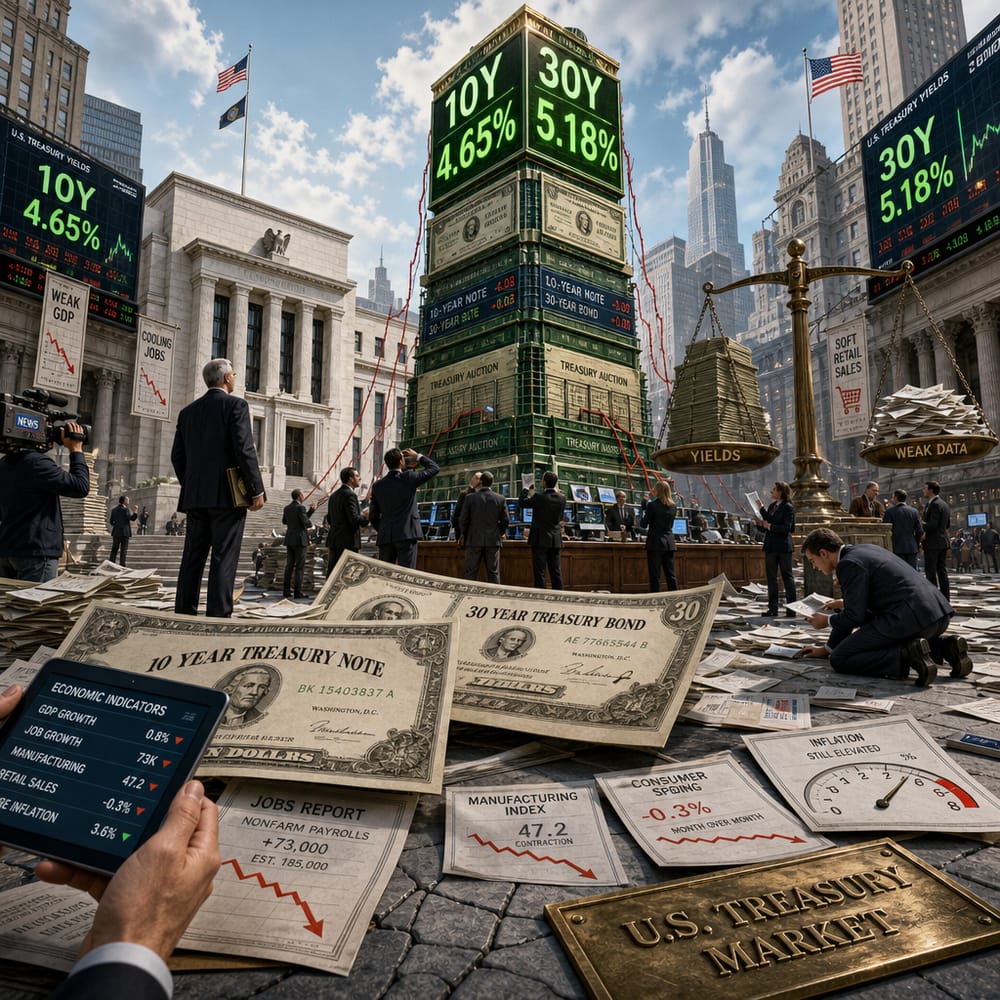
WHY ARE TREASURY YIELDS HIGH WHEN THE ECONOMY IS NOT?
If you’ve been keeping one eye on the economy and another on your Treasury bonds, you might be scratching your head right now. Despite the economic data looking about as cheerful as a Monday morning without coffee, U.S. Treasury yields are partying like it’s 1999 – the 10-year yield is hanging around 4.65% and the 30-year yield is strutting at 5.18%. So, what’s going on? Grab a cup of something strong, and let's dive into this puzzling bond market behavior.
THE HEAD-SCRATCHER: STRONG YIELDS, WEAK DATA
In theory, when economic indicators start pointing downwards like your optimism at the end of a long workweek, Treasury yields should follow. Investors traditionally flock to the relative safety of bonds during economic downturns, pushing prices up and yields down. But right now, yields are staying stubbornly high. It's like the bond market didn’t get the memo about the economy's current mood.
So, why aren't these yields acting like the economic wallflower we expect them to be? One word: uncertainty. When the future's murky, investors demand a higher yield as compensation for playing ball in the unpredictable game of bonds. That uncertainty includes everything from geopolitical tensions to economic policies that seem as clear as mud.
THE RISKS: WHAT'S IN THE BALANCE?
High Treasury yields might seem like a party for some investors, but they could be the DJ spinning a track that spells trouble for the financial markets and the economy. For one, they can make borrowing more expensive than a dinner date in Manhattan. When businesses face higher borrowing costs, they tend to curb spending, which can slow down economic growth even further. It’s a vicious cycle where everyone’s still thirsty but can’t afford a drink.
Moreover, higher yields can put pressure on stock valuations. Companies are suddenly facing a world where the risk-free rate of return is rising. Investors might start questioning why they’re risking their money in stocks when Treasuries offer a safer return. If enough investors start thinking this way, we could see stocks taking a dip.
FEDERAL RESERVE: BETWEEN A ROCK AND A HARD PLACE
Now, let’s talk about the elephant in the room: the Federal Reserve. How might they respond to this bond market behavior? The Fed, the grand puppeteer of interest rates, is in a bit of a pickle. Traditionally, the Fed might adjust interest rates to cool down or heat up the economy. But with yields already high, any further rate hikes could pour gasoline on the fire, making borrowing even more expensive and potentially slowing the economy further.
On the flip side, cutting rates to calm bond yields might seem like an attractive option, but it could also spark inflation – the financial equivalent of letting a toddler loose in a candy store. With inflation already a headline-grabber, a rate cut could exacerbate the issue.
WHAT'S BEHIND THE BOND CURTAIN?
Several factors could be pushing these yields higher despite the dreary economic data. For starters, there’s the Fed’s own commentary about a potentially longer period of higher rates to tackle inflation. Then there’s the global turbulence, with investors worldwide bracing for impact from geopolitical tensions and not-so-snappy supply chains.
Moreover, the bond market might be pricing in expectations of future economic growth. Investors could be betting that the current economic weakness is just a phase, like that regrettable hairstyle you had in high school. If they believe the economy will rebound, they’ll demand higher yields to compensate for any interim economic turbulence.
THE WRAP-UP: KEEPING YOUR COOL
For retail investors, the question isn’t just why this is happening, but what you should do about it. If you’re holding U.S. Treasuries, high yields might spell better returns if you’re buying now. However, keep one ear to the ground for shifts in Fed policy that could temper these yields faster than a reality TV star’s career.
In these unpredictable times, diversifying your investment portfolio might be the best strategy. Consider mixing it up with stocks, bonds, and maybe even a bit of real estate. After all, if the market’s going to throw a curveball, you’ll want to be ready at bat with a range of options.
Remember, in the world of finance, surprises are the only certainty. So, keep your eyes peeled, your mind sharp, and your investments as adaptable as a shape-shifting chameleon.
This article is for informational purposes only and is not investment advice. Always do your own research or consult a licensed financial professional before making investment decisions.
© Copyright 2024. All Rights Reserved.
© Copyright 2024. All Rights Reserved.