

Healthcare Managed-Care Stocks Face Immediate Policy Risk Amid AI Mania
Monday, November 23, 2026
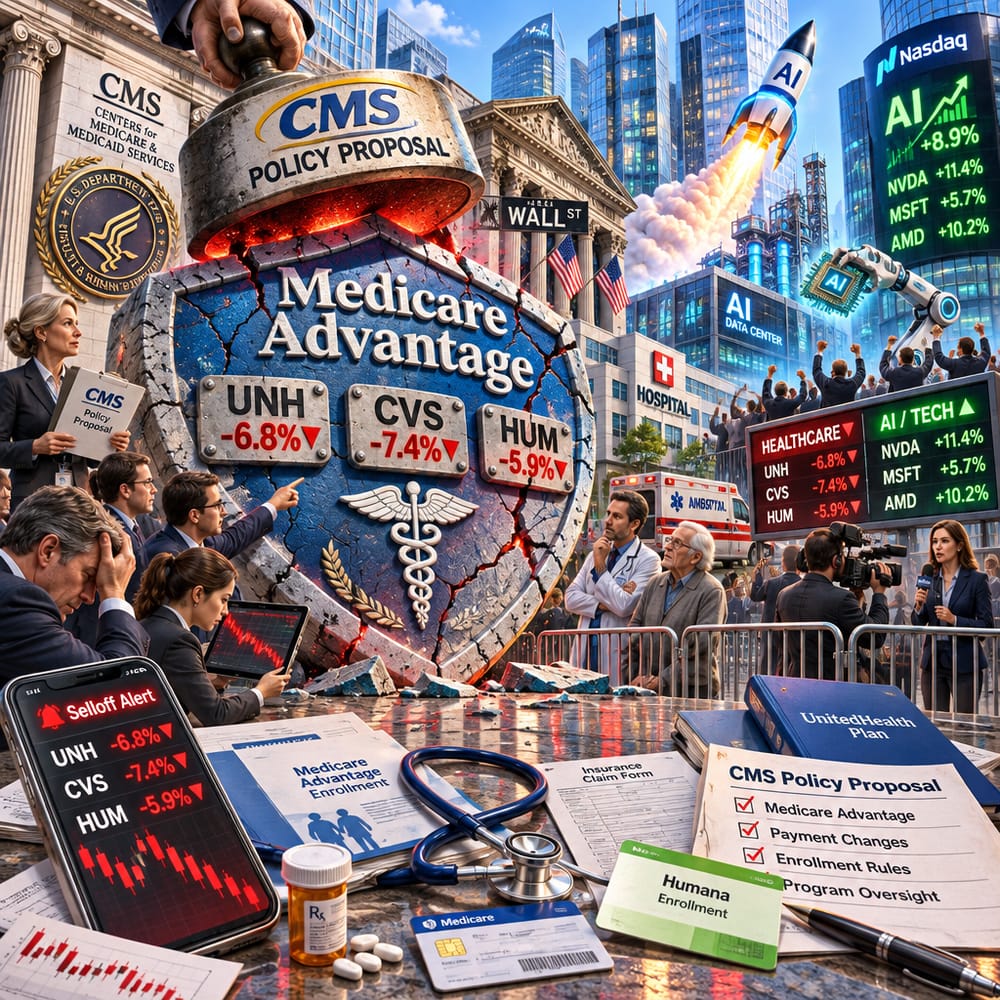
In a world where AI and tech stocks are throwing a party—and everyone's invited—managed-care stocks are the ones standing awkwardly in the corner, wondering what happened to their invite. While Nvidia's wild CEO rollercoaster ride and the subsequent tech rally have retail investors buzzing, managed-care titans like UnitedHealth, CVS Health, and Humana are left grappling with a party pooper: a new proposal from the Centers for Medicare & Medicaid Services (CMS) that's got Wall Street all jittery and nervous.
It's all fun and games until someone mentions policy risk, right? Just as the Nasdaq was doing its best impression of a rocket ship, rising by more than 6% thanks to Nvidia's bold boardroom moves, our healthcare bigwigs saw their stocks take a sharp nosedive. So, what's got these managed-care behemoths sweating bullets? It's the CMS's idea of potentially changing how much they're paying out for Medicare Advantage plans. Yes, a mere suggestion has put managed-care stocks in a spin.
Let's break it down: Medicare Advantage is a cash cow for companies like UnitedHealth, CVS Health, and Humana. These plans are essentially private insurance plans that are subsidized by the government, and they're big business. The proposed changes could mean less money flowing into these companies, directly hitting their earnings. Picture it like a sudden diet for a revenue stream that's been happily feasting for years.
The market's reaction was swift. UnitedHealth, CVS Health, and Humana stocks took a hit that left investors reaching for their Maalox. The uncertainty around the CMS proposal casts a shadow over future earnings forecasts and valuations. If you’re an investor looking for stability, this latest development is like discovering your supposedly unsinkable ship has sprung a leak. Managed-care stocks are now under scrutiny, with fears that future profits might not be as robust as previously thought.
But here's a twist: while some are running scared, others might see this as a perfect opportunity. Enter the concept of sector rotation. In simple terms, it's about moving investments from one industry to another to capitalize on expected economic conditions or market trends. With tech stocks currently on a tear thanks to AI fever, some investors are doing just that—shifting their focus to where the grass seems greener.
Yet, it’s crucial to ask: how much of this movement is based on real, sustainable growth versus a temporary hype-driven spike? Tech stocks are living their best life right now, true, but in the unpredictable world of investments, today's darling could be tomorrow's dud. The AI trade feels a bit like a rollercoaster—exhilarating highs, but always with the potential for a stomach-churning drop.
Meanwhile, managed-care stocks face the reality of regulatory risks that can affect their bottom line in the blink of an eye. But these companies are no strangers to navigating complex regulatory landscapes. They've been here before, and savvy investors might see their steep price drop as a buying opportunity, banking on their resilience and ability to adapt to new rules.
The question then becomes, are managed-care stocks being unfairly punished amidst the AI mania, or is this a wake-up call to assess the genuine risks they face? With the tech sector riding high on optimism, some might argue it's a great time to buy low on managed-care stocks and sell high on tech.
For those brave enough to make such moves, there’s potential to navigate the volatility to their advantage. After all, while one industry’s short-term pain could become another’s long-term gain, the dance between risk and reward in the stock market is as old as time itself.
As for the rest of us, watching these market moves play out could be more thrilling than a Netflix binge. If nothing else, it’s a reminder of the market’s mercurial nature. Today you’re in the tech crowd; tomorrow, you might find yourself back in the corner with healthcare, waiting for the next invitation to the dance floor.
This article is for informational purposes only and is not investment advice. Always do your own research or consult a licensed financial professional before making investment decisions.
© Copyright 2024. All Rights Reserved.
© Copyright 2024. All Rights Reserved.