

GSA's AI Procurement Rule Feedback Deadline Approaches
Friday, August 21, 2026
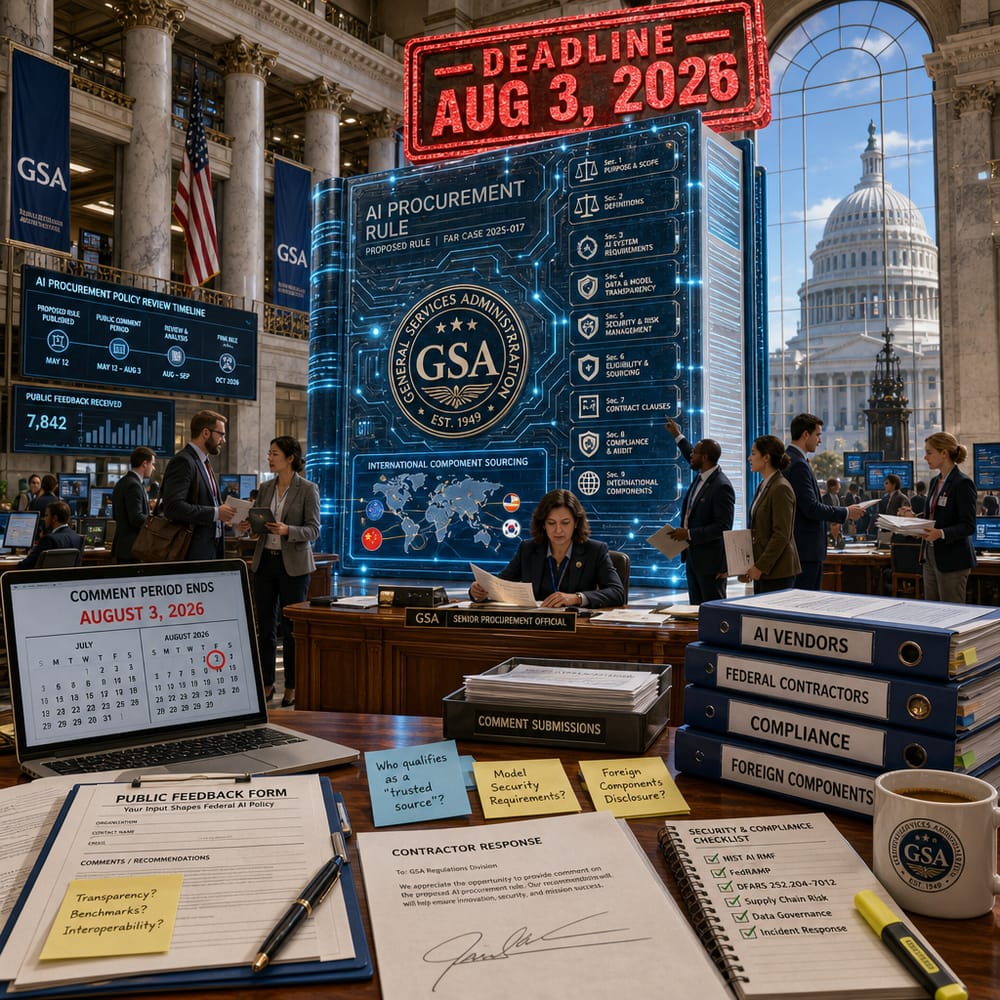
THE GSA'S AI PROCUREMENT OVERHAUL: A GAME-CHANGER FOR TECH GIANTS?
Picture this: You're a tech giant with a sleek AI solution that's ready to revolutionize the world. You've got it all — algorithms that could make Iron Man's JARVIS blush and a development team that could moonlight as a team of superheroes. But there's one catch — navigating the government's procurement labyrinth. Well, folks, hold on to your hats because the U.S. General Services Administration (GSA) is proposing a new set of rules that could change the game for AI procurement, and they're looking for your two cents before the clock strikes midnight on August 3, 2026.
THE RULES OF THE GAME
In an industry where speed and innovation can leave regulatory frameworks lagging behind like a 1990s modem, the GSA's move to solicit public feedback on its AI procurement rules is akin to unleashing a new expansion pack for an old game. And this one's packed with some fascinating changes. The biggest headline? The relaxation of restrictions on foreign AI components. Previously, the rules were as tight as a drum when it came to sourcing AI parts from abroad, especially with the geopolitical tensions that have been as electrifying as the final scenes of a blockbuster.
But the GSA's proposal loosens these restrictions, recognizing that innovation knows no borders. What does this mean for tech firms? Well, it could open the floodgates for collaboration with overseas partners, allowing companies to cherry-pick the best bits from the global tech smorgasbord. That's more than just good news—it could be a game-changer.
THE INDUSTRY RUMBLES
Naturally, the industry's been buzzing louder than a wasp in a jam jar since this announcement. Developers and contractors, who often feel like they're stuck in a never-ending episode of 'Survivor: Bureaucratic Edition', are cautiously optimistic. The rules also clarify roles in the AI industry, aiming to streamline who does what in this high-tech relay race. No more passing the buck or playing the blame game — at least that's the goal.
But the industry's feedback so far hasn't just been high-fives and handshakes. Concerns remain about how these changes might be implemented. Will the foreign component rule relaxations introduce new cybersecurity risks? Will the GSA's playbook have enough flexibility to adapt to the torrid pace of tech advancement? These are questions hanging in the air, like a cliffhanger ending that leaves you yelling at your screen.
FOR THE STOCKS AND SECTORS
If you're tracking stocks in AI development and federal contracting, these moves are the equivalent of spotting a shark fin in the surf—you're not sure exactly what’s coming, but you know it's going to be big. Companies like Palantir, IBM, and Microsoft, already entrenched in government work, could find themselves with more room to maneuver and innovate. It's like handing them a new set of tools in the middle of a marathon, which could spur stock movement if these companies position themselves as pioneers in this redefined landscape.
The federal space has traditionally been a tough nut to crack, and these changes might just be the nutcracker the tech industry has been waiting for. But remember, folks, with great procurement power comes great responsibility—and a mountain of paperwork, no doubt.
WHAT LIES AHEAD?
As August 3 approaches like a speeding freight train, the GSA's inbox is filling up faster than a Black Friday checkout line. The public feedback window is a rare chance for the industry’s voices to echo in the halls of power, shaping a framework that could dictate how AI tech integrates into federal operations.
But it's not just about meeting deadlines or ticking boxes. It's about navigating the future of federal tech collaboration, with the potential to boost innovation and efficiency across government services. Whether you're a starry-eyed startup or a seasoned tech titan, these changes could impact the very foundation of your business strategy.
In a world where AI developments are sprinting ahead faster than you can say "deep learning," GSA's proposal signals an exciting yet daunting shift in the federal contract game. Get your feedback in, and stay tuned — because when the dust settles post-August 3, the face of federal AI procurement might just have a brand-new look.
This article is for informational purposes only and is not investment advice. Always do your own research or consult a licensed financial professional before making investment decisions.
© Copyright 2024. All Rights Reserved.
© Copyright 2024. All Rights Reserved.