

Gritt’s $32M Raise Puts Spotlight on Renewable-Tech Robotics
Sunday, August 16, 2026
GRITT’S $32M RAISE PUTS SPOTLIGHT ON RENEWABLE-TECH ROBOTICS
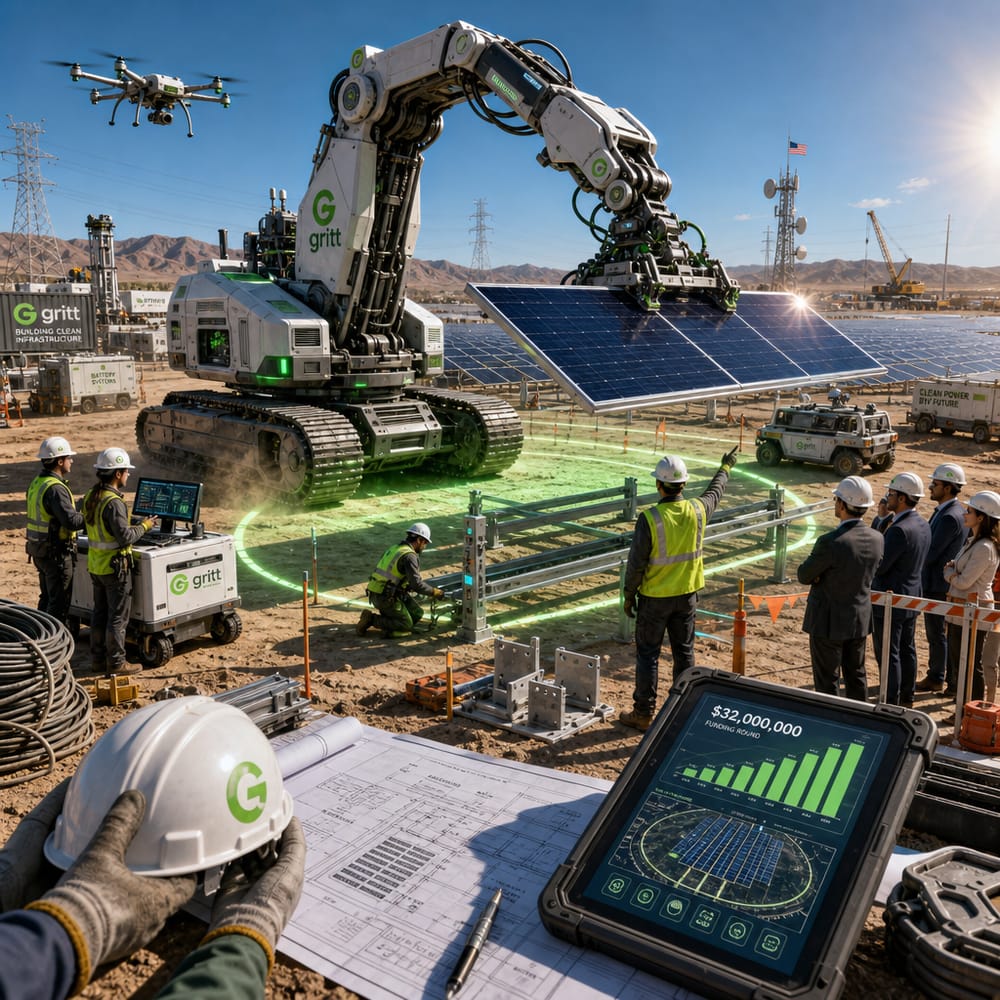
Money talks, but when it’s $32 million marching into a groundbreaking startup, it practically shouts. Enter Gritt, the stealth-mode sensation now making headlines for snagging a wallet-busting investment to shake up how we power our lives. They’re not just using robots—they’re unleashing them to build solar plants, promising to revolutionize renewable energy one robo-construct at a time.
So, what’s got investors singing “Hallelujah” and emptying their coffers into Gritt’s treasure chest? At the core of Gritt’s appeal is their secret sauce: techno-wizardry-infused robots specially designed to construct solar energy farms faster and (hopefully) cheaper than a traditional hard-hatted crew. Picture this: swarms of metallic minions, expertly assembling solar panels in a scene that looks like Iron Man crossed paths with a construction worker union.
But let’s not get ahead of ourselves. Gritt’s rise from the shadows is powered by some serious star-studded backing. A marquee investor list means this isn’t just a passing fad for VCs with a green thumb. The who’s who of investors are playing their cards with Gritt, all with eyes on the same prize—redefining solar energy’s efficiency and cost profile. These investors aren't just bringing money; they’re bringing strategic muscle, hoping to squeeze out inefficiencies and pump up the scale of solar projects worldwide.
At the heart of this gilded robo-revolution lies a bigger question: How exactly does Gritt plan to shake up the solar energy market? It’s simple—they’re banking on robots, the unsung heroes of precision and tirelessness. By harnessing cutting-edge robotics technology, Gritt aims to slice through the red tape and logistical hoops that plague traditional solar farm construction. And the idea isn’t just to speed things up; it’s to cut costs and make solar energy as ubiquitous as smartphones without the price tag making you wince.
Sure, it’s a bold vision, but if Gritt can pull it off, think of the ripple effect this could have in the energy sector. Renewables, particularly solar, have always struggled with the balance between cost and scalability. But with Gritt’s robots on the scene, this balance might just tip favorably towards renewables becoming the no-brainer energy choice.
Now, let’s talk strategy and the brains behind the bucks. Investors are eyeing Gritt with more than just financial returns in mind. They’re banking on Gritt’s potential to become a linchpin in the clean tech revolution. And as climate change climbs higher on global agendas, the demand for innovative solutions in renewable energy isn’t just growing—it’s sprinting.
With Gritt’s technology, solar plants could pop up faster than you can say “renewable energy,” turning once-complicated, drawn-out projects into streamlined deployments. The endgame here isn’t just about tomorrow’s energy solutions; it’s about changing the playbook entirely.
But it’s not all robot rainbows and unicorns. Hurdles remain, such as regulatory quagmires and market receptivity. Gritt will need to convince traditional players in the energy sector to embrace this robotic revolution. And while investors are hopeful, the proof will ultimately be in the (solar) pudding.
Gritt’s emergence marks a fascinating convergence of AI, robotics, and renewable energy. It’s bold, it’s daring, and it’s got the backing to make a real dent in how we harness the sun's power. For now, Gritt’s robots are poised at the starting line, ready to race towards a future where sustainability doesn’t just make sense—it makes cents.
Keep your eyes peeled and your portfolios ready. Gritt might just be the name to watch in the renewable sector, where the only limit to this solar surge might be the sun itself. In a world constantly searching for breakthroughs, Gritt’s robots might just be the overdue answer to energizing our future, one sunbeam at a time.
This article is for informational purposes only and is not investment advice. Always do your own research or consult a licensed financial professional before making investment decisions.
© Copyright 2024. All Rights Reserved.
© Copyright 2024. All Rights Reserved.