

GM Secures Up to $4.5B Parts Prepayment Facility to Shore Up Supply Chain
Tuesday, August 11, 2026
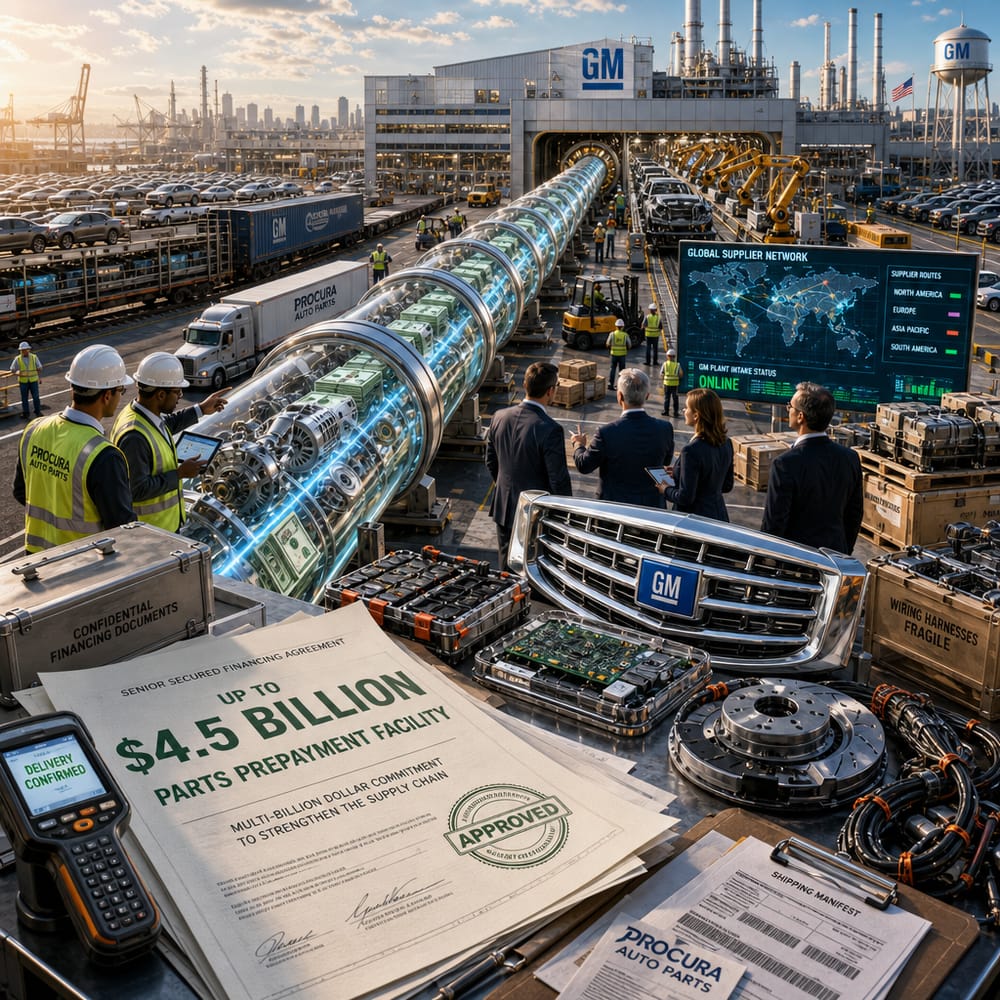
GM CUTS A $4.5 BILLION CHECK TO SECURE ITS SUPPLY CHAIN: HERE'S WHY THAT MATTERS
Imagine having the foresight to pre-order your favorite coffee before the world’s supply chains grind to a halt—sip in hand, while others stare into empty cups. This is exactly what General Motors is doing, but with car parts, not caffeine. In a move that would make any supply chain manager swoon, GM has penned a deal for a hefty $4.5 billion prepayment facility with Procura Auto Parts. The goal? To future-proof its assembly line against the chaotic whims of global supply disruptions.
At the heart of the automotive juggernaut’s strategy is a concept as simple as it is clever: paying upfront for parts and letting someone else manage the logistics headache. Enter Procura Auto Parts, the unsung hero of this narrative. They’ve been given the keys to source crucial, often elusive, parts for GM, while the heavyweight carmaker focuses on what it does best—rolling cars off the production line.
But let’s break down why this seemingly simple move is causing waves. First, it’s about agility. Think of GM as a nimble ninja, dodging the slow-moving boulder of global supply chaos. With this prepayment facility, GM keeps its inventory costs off its balance sheet, freeing up cash that would otherwise be tied up in warehouses piled high with parts. This isn’t just a financial ballet; it’s a full-on survival dance in today’s volatile market.
So, what’s the catch? Like all great deals, this one comes with strings attached. GM will issue irrevocable payment undertakings (IPUs)—essentially IOUs—to Procura, promising to pay for the parts they use by 2029. Meanwhile, they’ll fork over interest, a premium for the parts they use, and an annual fee on what remains untouched. Not exactly loose change, but for a company that knows the cost of halted production, it’s a price worth paying.
You might be wondering, why now? The auto industry is still shaking off the aftershocks of global disruptions that left carmakers scrambling for semiconductors and other vital components. GM’s strategy is a proactive measure to ensure that its production line doesn’t grind to a halt the next time the world’s supply chain catches a cold. In the world of carmaking, time lost is money burned, and GM isn’t in the business of pyrotechnics.
This strategic maneuver positions GM not just as a survivor, but a thriver. If successful, it could set a precedent for other automakers, prompting a reevaluation of how supply chains are managed in an unpredictable world. After all, in the art of car manufacturing, those who can predict—and prepay—often come out on top.
However, every silver lining has its cloud. The risks? This move could backfire if GM misjudges its parts needs, ending up with a stockpile of components that become obsolete as technology and designs evolve. It’s the automotive equivalent of stocking up on eight-track tapes right before the CD revolution. Timing and accuracy in anticipating demand will be critical.
Moreover, while GM is betting on better supply chain resilience, this financial arrangement adds complexity to its balance sheet. Keeping inventory costs off the books today could mean facing a hefty bill tomorrow. But if GM plays its cards right, the benefits could far outweigh these risks.
In essence, GM’s prepayment facility isn’t just a deal—it’s a statement. It signals a shift in how traditional industries are adapting old-school operations to new-age challenges. In a world where supply chain disruptions can snowball into financial disasters, GM is hedging its bets and reinforcing its production line’s backbone.
So, what should everyday investors take away from this? Keep an eye on how GM’s strategy unfolds. If they pull it off, this could be a blueprint for other industrial giants facing similar supply chain woes. And for GM, it could mean a more stable foothold in an otherwise shaky industry landscape.
In the end, whether GM’s $4.5 billion gamble pays off remains to be seen. But they’re not waiting for the storm to pass; they’re learning to dance in the rain. And for those who understand the high stakes of automotive production, that’s a tune worth listening to.
This article is for informational purposes only and is not investment advice. Always do your own research or consult a licensed financial professional before making investment decisions.
© Copyright 2024. All Rights Reserved.
© Copyright 2024. All Rights Reserved.