

Global Stablecoin Regulation Diverges
Monday, August 31, 2026
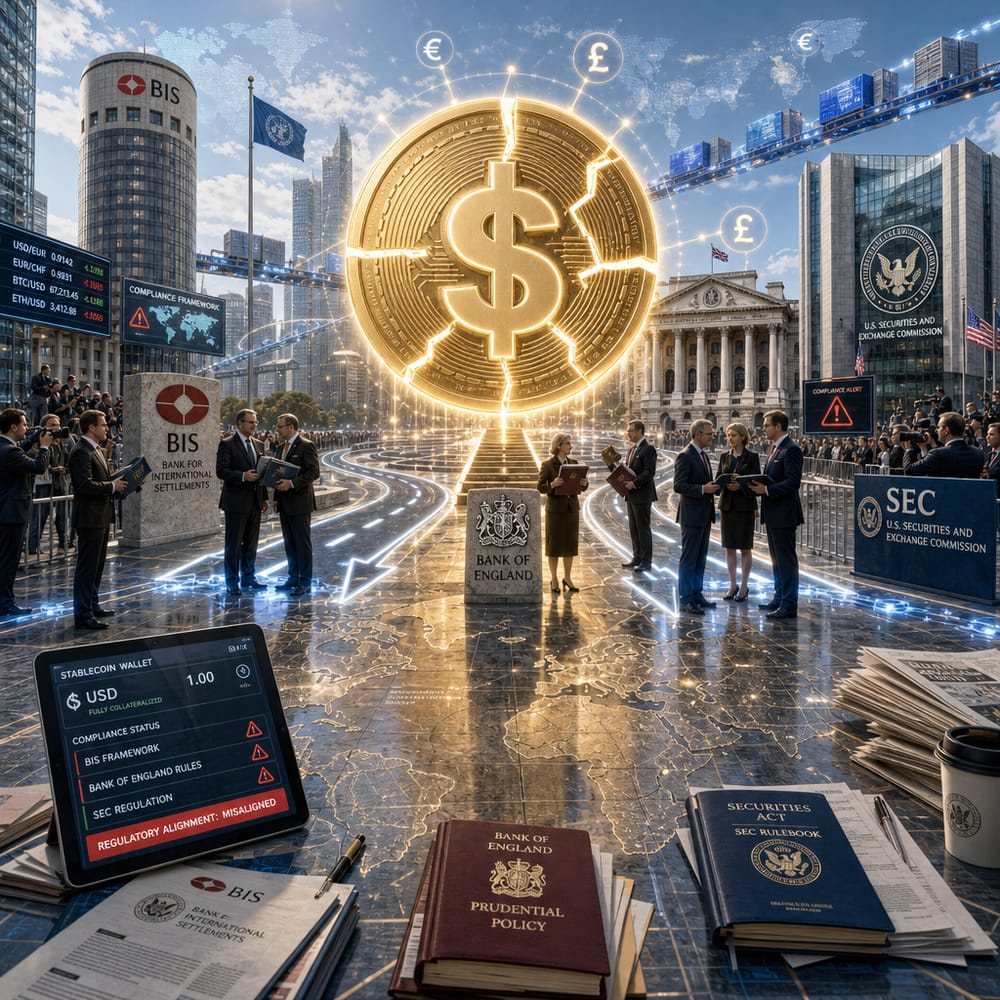
STABLECOINS AND GLOBAL REGULATION: A MIXED BAG OF RULES
If you're banking on a seamless, unified global economy as your next great investment opportunity, hold onto your hats—because stablecoins, the digital darlings of blockchain, are diving into regulatory waters that are anything but smooth. With the Bank for International Settlements (BIS), the UK, and the US each marching to the beat of their own drum, it's like trying to watch a symphony where each musician has decided to play their own solo. The result? A cacophony of regulatory confusion that could steer the global adoption of stablecoins right into the heart of fragmented market chaos.
THE BIS: ROUNDING UP THE STABLECOIN COWBOYS
First up, we have the BIS, which is trying to corral the stablecoin landscape by establishing rigorous oversight. Think of them as the stern school principal who’s seen one too many spitball fights and has decided it’s time to lay down the law. Their guidelines emphasize the need for strict controls on reserve assets and transparency. It’s all about ensuring that stablecoins are as stable as they claim—no sudden drops in value that could cause a global financial hiccup. If BIS had its way, every stablecoin would come with its own security blanket and a guarantee to never have a tantrum.
THE UK: AN OPEN FORUM
Meanwhile, across the pond, the UK’s approach is a bit more like a town hall meeting. They’re open to innovation and the conversations it brings. The UK’s regulators have welcomed stablecoins, seeing potential for these digital assets to sit comfortably within the financial ecosystem. But don’t mistake this for laissez-faire—UK regulators still want to ensure consumer protection and financial stability. They’re just more likely to invite stablecoin issuers for tea and a chat first, rather than sending them to detention.
THE US: STRAIGHT TO THE POINT
The US, however, has decided it's time for some tough love. Under the watchful eye of the Securities and Exchange Commission (SEC), stablecoins are feeling the regulatory heat. The SEC’s stance hinges on whether stablecoins should be classified as securities, which would subject them to strict regulations. Think of the US as the strict parent who’s been watching the neighbors’ kids run wild and decided it’s time for a few more house rules. Their approach could make the US a tough market for budding stablecoin startups unless they can comply with the regulatory hoops and hurdles.
IMPLICATIONS FOR STABLECOIN ISSUERS
So, what does this mean for the people creating these stablecoins? Picture it as setting up a lemonade stand on a hot summer’s day—only to be faced with a three-headed regulatory monster, each demanding a different permit. The varying regulations could mean more hoops to jump through, potentially slowing down the pace at which new coins can enter the market. For some issuers, it could be akin to walking a tightrope made of red tape.
AFFECTING GLOBAL ADOPTION
For investors, this tangled web of rules might make the idea of stablecoins seem less like a revolutionary currency and more like an investment in an exotic bird—exciting, but needing careful attention. The diverging regulations could create a world where stability is less about the coins themselves, and more about navigating the complex patchwork of rules from one country to another.
Investors who thrive in uniform environments may find themselves hesitant, while those who relish a challenge might jump in, hoping to capitalize on the disparities. However, the real risk lies in whether each country’s approach will create barriers that ultimately slow down the adoption process.
FINAL THOUGHTS
In a perfect world, global stablecoin regulation would resemble a meticulously choreographed dance. Instead, we’ve got a dance floor where everyone’s doing their own routine. While the BIS, UK, and US all aim to keep the financial peace, their divergent approaches could drive stablecoin markets into a fragmented chaos—a potential roadblock on what might otherwise be a superhighway to a new era of digital finance.
For retail investors, the takeaway is simple: before you dive into the stablecoin pool, be sure to check not just the temperature of the water, but who's lifeguarding it. With each major player setting their own rules, diving into the world of stablecoins might require more than just financial savvy—it might demand a map and a compass to navigate the regulatory maze.
This article is for informational purposes only and is not investment advice. Always do your own research or consult a licensed financial professional before making investment decisions.
© Copyright 2024. All Rights Reserved.
© Copyright 2024. All Rights Reserved.