

Global Memory Chip Stocks Slump on Chinese Rival’s Breakthrough
Tuesday, October 13, 2026
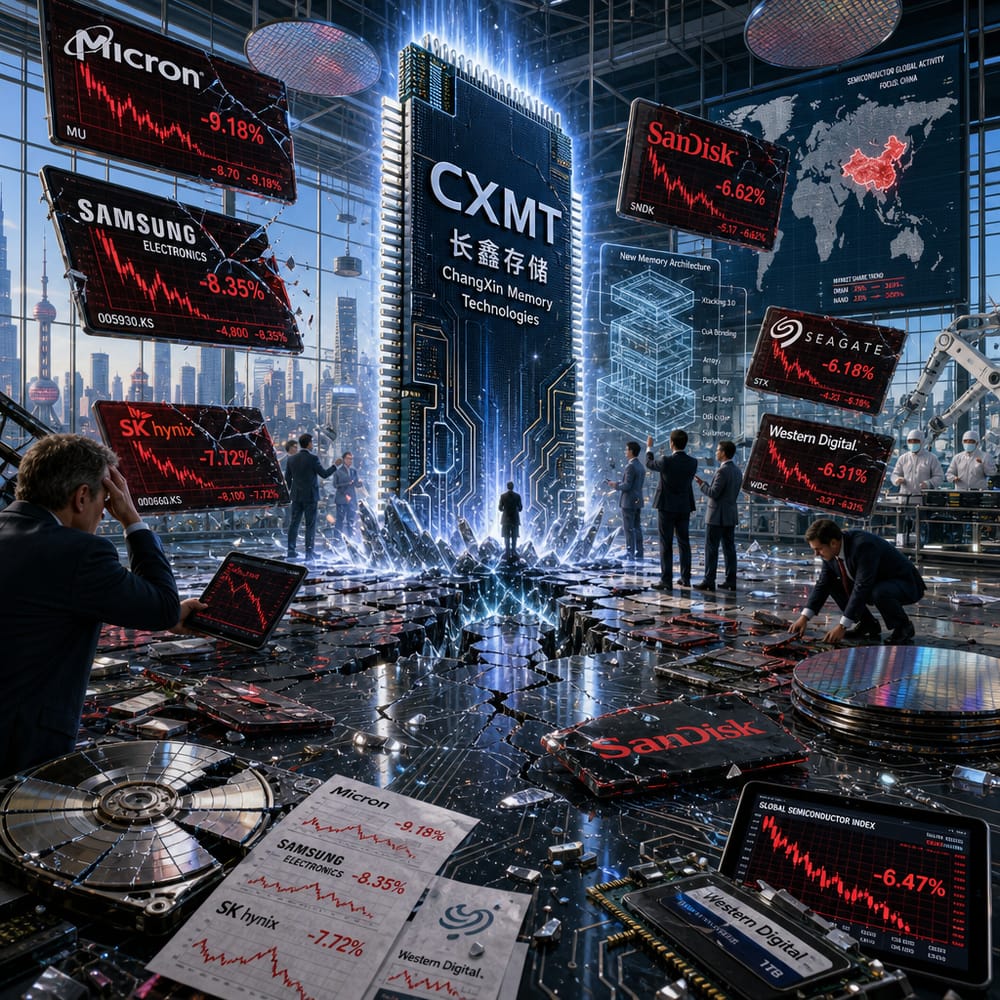
CHIP WARS: CHINA’S CXMT CRASHES GLOBAL MEMORY STOCKS
When your portfolio takes a nosedive because a Chinese company you've never heard of throws a tech curveball, you know the market gods have been up to some shenanigans. Enter ChangXin Memory Technologies, or CXMT. This upstart from the East has just spooked the global tech elite, and it’s not just a ripple — it’s a full-on tidal wave.
Over the weekend, CXMT announced a breakthrough in memory chip architecture that could make their competition sweat bullets. The magic sauce? They’ve found a way to cram more data into smaller spaces, a holy grail in the memory chip industry. It’s akin to squeezing your overstuffed suitcase into the overhead compartment with room to spare. This news sent shockwaves through the memory chip sector, dropping stocks like Micron, Samsung Electronics, and SK Hynix faster than a hot potato.
But let’s pause here. What exactly did CXMT crack open? In simple terms, memory density. By improving how memory chips are structured, CXMT can increase how much data these tiny chips can hold without upsizing their physical size. It’s not rocket science, but in the tech world, it’s close enough. More memory in smaller chips is like finding out your smartphone can fold your laundry — revolutionary, cost-saving, and enough to make competitors shiver.
Here’s why this matters: Memory chips are the backbone of all things digital, from your smartphone to supercomputers. If CXMT's technology pans out, they could produce smaller, cheaper, and more efficient chips than their U.S. and South Korean rivals, reshaping the competitive landscape. And when the earth shakes in tech land, everyone feels it.
For U.S. and South Korean chipmakers who have been the top dogs for years, this is a wake-up call that hits harder than your Monday morning alarm. Companies like Micron and Samsung have long dominated this sector, but CXMT’s breakthrough means they could lose market share faster than you can say "Silicon Valley." If CXMT can mass-produce these chips, it might lead to a price war, driving down global memory chip prices. Lower prices sound like a win for consumers, but for chipmakers, it’s a slippery slope that could erode profit margins.
In the stock market, fear of the new kid on the block has already triggered a sell-off. Micron's stock slid around 5%, while Samsung saw a similar fall. SK Hynix didn’t escape the storm either. Investors are not just worried; they’re recalculating the future, and for good reason. If CXMT’s chips deliver as promised, the cost advantage could shift significantly eastward.
But before we get carried away, it’s important to remember this: breaking new ground in tech is not always a straight path to domination. CXMT needs to prove they can deliver this innovation at scale, maintain quality, and meet global demand, which is easier said than done. Furthermore, there are geopolitical factors at play. The U.S. has been trying to curtail China’s tech ascent through various sanctions, and this development might just intensify the tech cold war.
Nonetheless, this new development highlights an inevitable truth in the tech industry: innovation never sleeps. For investors, the message is clear. The memory chip sector is set to become a battleground, and volatility could become the norm. It might be wise to buckle up for the ride. While the dust settles, it’s a good time to revisit your tech investments and brace for potential industry shifts.
As it stands, the memory chip giants must decide their next move. Will they ramp up R&D to keep pace, forge new alliances, or perhaps, engage in good old-fashioned price wars? For now, the ball is in CXMT’s court, and everyone is watching to see if the newcomer can keep up the pace after this explosive debut. Meanwhile, don’t be surprised if the headlines in the coming weeks continue to feature this David versus Goliath story — though in the tech world, such battles are rarely straightforward.
This article is for informational purposes only and is not investment advice. Always do your own research or consult a licensed financial professional before making investment decisions.
© Copyright 2024. All Rights Reserved.
© Copyright 2024. All Rights Reserved.