

GENIUS Act Rulemaking: Agencies Miss Deadline, First Treasury NPRM Triggers Comment Window
Monday, August 31, 2026
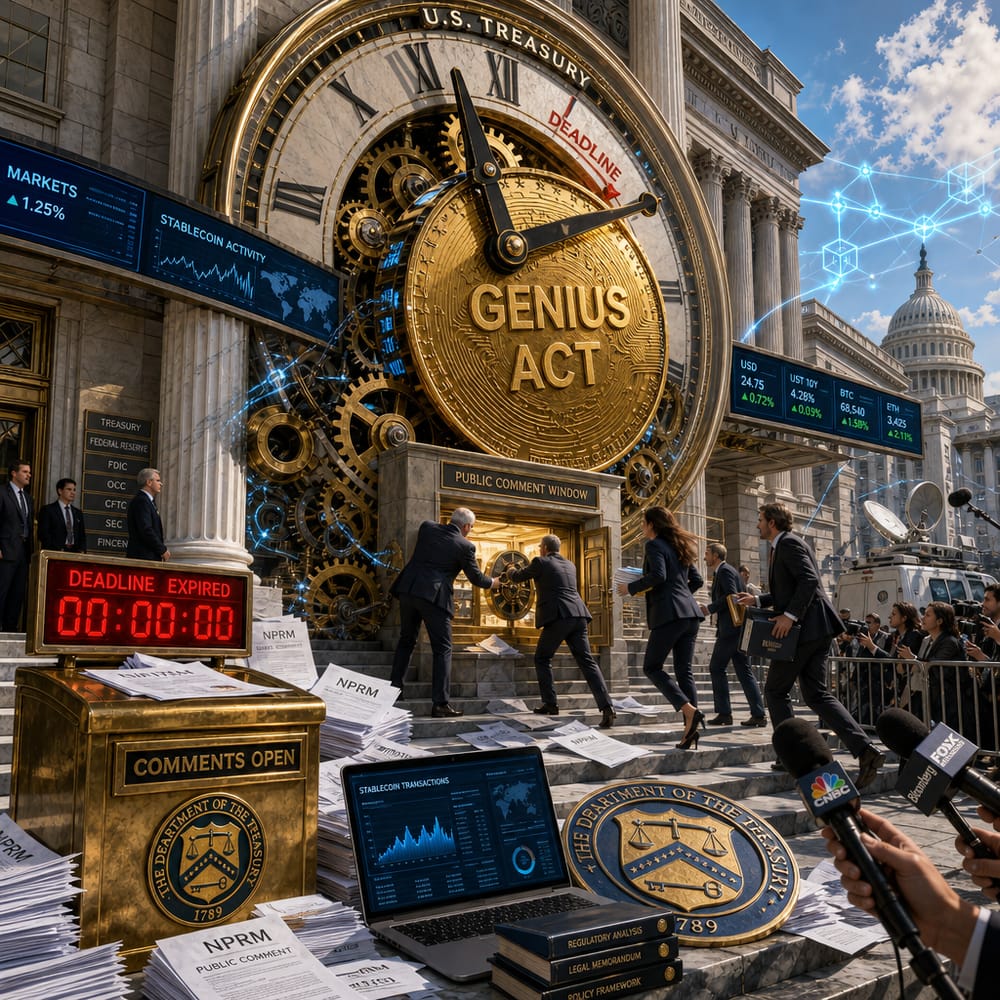
GENIUS ACT RULEMAKING: A DEADLINE MISSED AND THE FALL-OUT FOR STABLECOINS
In the high-stakes world of cryptocurrencies, deadlines are like the fourth rail—you just don’t mess with them. Yet, that's exactly what happened with the GENIUS Act's rulemaking process. Federal agencies, with all the urgency of a snail on a Sunday stroll, have missed a crucial deadline, leaving stablecoin issuers and investors to sweat it out in regulatory uncertainty. As if the crypto market wasn’t already thrilling enough.
RISKY BUSINESS: THE TREASURY'S NPRM
Now let’s talk about the Treasury's Notice of Proposed Rulemaking (NPRM), which has finally opened its doors to public comment. Think of this as a suggestion box for stakeholders, but one that’s situated on the edge of a cliff. It's a shot at shaping the regulatory landscape for stablecoins, those digital darlings pegged to less volatile assets, usually fiat currencies like the dollar. The key provisions here look to tackle the perennial concerns: risks of money laundering, consumer protection, and the ever-charming concept of "systemic risk." For stablecoin issuers, the NPRM might feel like a to-do list written by someone who hates fun.
THE IMPACT ON STABLECOIN ISSUERS
Stablecoin issuers are now stuck playing a game of Freeze Tag with regulators. The missed deadline means there’s no clear rulebook, and that spells chaos—or at the very least, a lot of nervous Zoom calls. Without clear regulatory guidelines, issuers face the risk of stepping on the wrong side of the law without even knowing it. Imagine trying to bake a cake without a recipe while the kitchen's on fire. That’s what it feels like to run a stablecoin operation in today's climate.
THE INVESTOR ANGLE: RISKS GALORE
For investors, the rulemaking delay is the equivalent of showing up to a concert to find the band hasn’t decided what genre they’re playing. Without knowing the rules, assessing risk becomes as easy as juggling jelly. Sure, stablecoins are supposed to be, well, stable. But with potential regulatory shifts looming like storm clouds, investors have to consider the prospect of their digital dollars facing unforeseen devaluation or even delisting from exchanges.
WHAT COMES NEXT?
The good news is that the NPRM is a chance for everyone to pull up a chair and have their say. The bad news? The comment window doesn’t close the regulatory black hole—instead, it just broadens the dialogue. With every Tom, Dick, and Harry weighing in, the final rules could range from rigid as a drill sergeant to laid-back as a cat in a sunbeam. Analysts are already predicting anything from zero impact to catastrophic overhaul. Quite the spectrum.
THE BIG PICTURE
The ripple effects of this missed deadline and the NPRM’s outcome are likely to extend beyond stablecoins. It’s set to influence the broader cryptocurrency market, which is already a cocktail of hype, hope, and hair-trigger price swings. As stablecoins serve as a crucial bridge between fiat and crypto worlds, any regulation—or lack thereof—can send shockwaves through the entire ecosystem.
THE BOTTOM LINE
What’s the takeaway here? Investors and issuers are left in a limbo of regulatory anticipation. The missed deadline adds an extra layer of intrigue and uncertainty, making an already volatile market even more unpredictable. For those with skin in the game, it’s a time to stay sharp, stay informed, and maybe even voice your opinions at that NPRM comment window. Just remember, in the crypto game, fortune favors not just the brave, but the well-informed.
In the quirky, rollercoaster world of cryptocurrencies, one thing remains clear—there’s never a dull moment. Whether that’s a blessing or a curse, well, only time will tell. Keep your eyes peeled and your digital wallets ready; we’re in for a ride.
This article is for informational purposes only and is not investment advice. Always do your own research or consult a licensed financial professional before making investment decisions.
© Copyright 2024. All Rights Reserved.
© Copyright 2024. All Rights Reserved.