

G10 Carry Trade Repricing Hits USD/CHF Hard While EUR, GBP Edge Higher
Tuesday, August 25, 2026
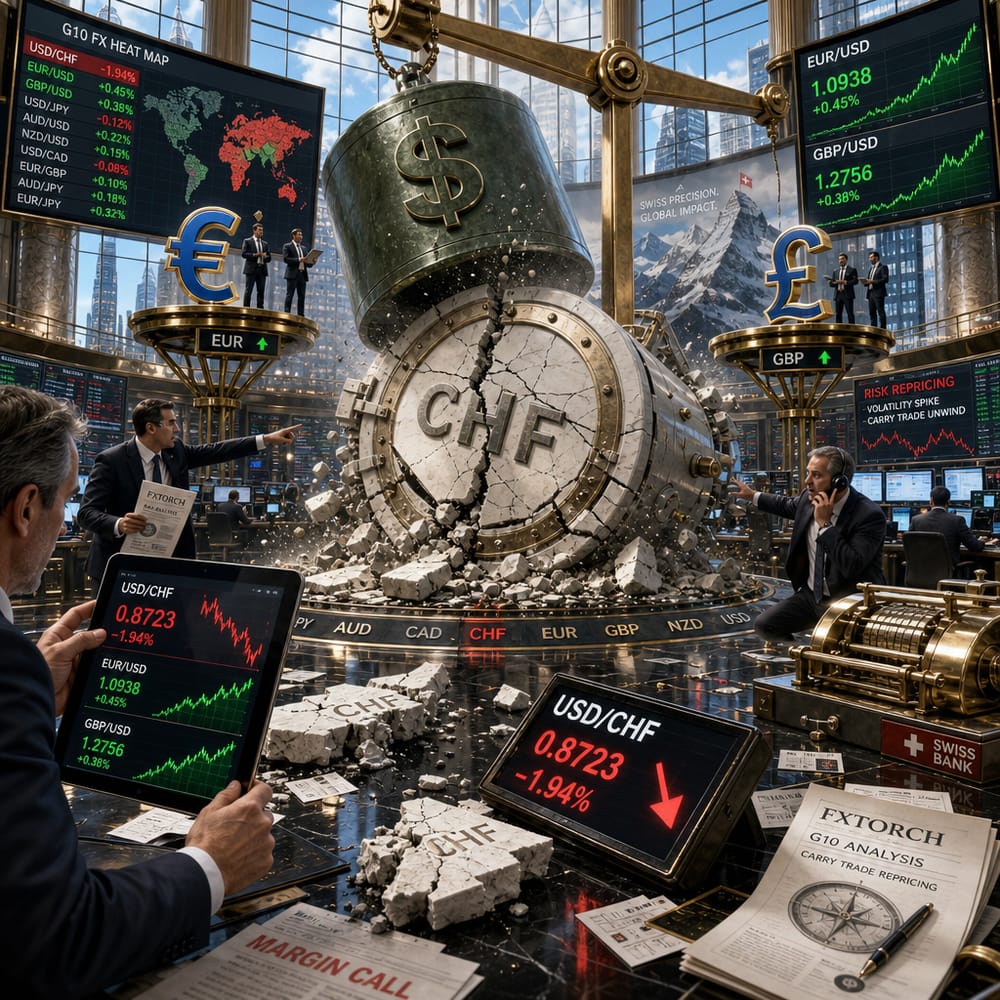
Currency markets are a bit like dance floors at a wedding: crowded, dynamic, and sometimes wildly unpredictable—especially when someone’s had too much punch. Right now, the G10 FX ballroom is buzzing over some fancy footwork known as the carry trade, and it’s causing all sorts of ripple effects, particularly for the USD/CHF pair. So, what exactly is this carry trade and why is it leaving USD/CHF gasping on the sidelines while the EUR and GBP are strutting their stuff with confidence?
First, let's untangle the mystery of the carry trade. Imagine borrowing money in a country where interest rates are as low as the limbo bar, like Japan or Switzerland. Then, you invest that cash in a country where rates are doing the high jump, like Brazil or South Africa. The goal? Pocket the interest rate difference. It’s financial arbitrage at its best—like borrowing from your rich aunt to invest in a lemonade stand that’s offering a sizzling return.
But here’s the twist: carry trades can lead to currency shifts, especially when traders decide to adjust—or in financial lingo, reprice—the associated risks and rewards. Recently, FXTORCH, the currency clairvoyant, highlighted a notable reshuffling in the G10 foreign exchange markets—our major players in the global currency arena. This reshuffling has put the USD/CHF pair at the losing end of the dance-off, while the Euro and the British pound are waltzing to new tunes.
So, what’s got the USD/CHF slipping on the dance floor? The Swiss franc is considered a safe haven—like that friend who never says no to a responsible night in with a cup of tea. During times of uncertainty, like economic turbulence or geopolitical tensions, investors flock to the Swiss franc, pushing its value up. Meanwhile, the US dollar is feeling the heat from concerns over fiscal policies and budget deficits, not to mention the increasing debt buybacks announced by the Treasury. These factors have combined to make borrowing in dollars less attractive, resulting in a sell-off relative to the steady-as-she-goes Swiss franc.
Pivoting to the Euro and British pound, these currencies are taking advantage of market dynamics with their own twist. The Eurozone, despite its own set of challenges, is experiencing a bit of a renaissance thanks to better-than-expected economic data and a more stable interest rate environment. Similarly, the GBP is gaining ground as the UK navigates its post-Brexit reality with a stiff upper lip and a focus on strategic trade partnerships.
Now, how can the everyday investor leverage these currency gymnastics? Understanding carry trade dynamics could be akin to holding the remote to a complex market movie. If you know which way the winds are blowing, you can adjust your sails—or, in this case, your portfolio. Watch for interest rate changes and geopolitical cues that might shake up currency valuations. When the winds of repricing blow, some currencies are bound to rise, and others to fall.
For instance, if you spot a carry trade opportunity where a currency is undervalued but interest rates in another region are due for a hike, you might consider investments that would benefit from such a shift. It's not about timing the market perfectly—no one can predict every move on the dance floor—but being aware of the beat and rhythm changes can inform your broader strategy.
At the end of the day, the currency market remains a place of intrigue and opportunity, where savvy investors can find ways to capitalize on the ever-changing landscape. Whether it's the USD/CHF taking a tumble or the Euro and GBP finding their groove, understanding the mechanics of carry trades could just be the ticket to dancing along with the market rather than getting stepped on by it. So keep an eye on those interest rates and global events—because in the dance of currencies, staying on your toes is everything.
This article is for informational purposes only and is not investment advice. Always do your own research or consult a licensed financial professional before making investment decisions.
© Copyright 2024. All Rights Reserved.
© Copyright 2024. All Rights Reserved.