

Futures Sell-Off Signals Risk-Off Sentiment Amid Oil Spike
Sunday, August 23, 2026
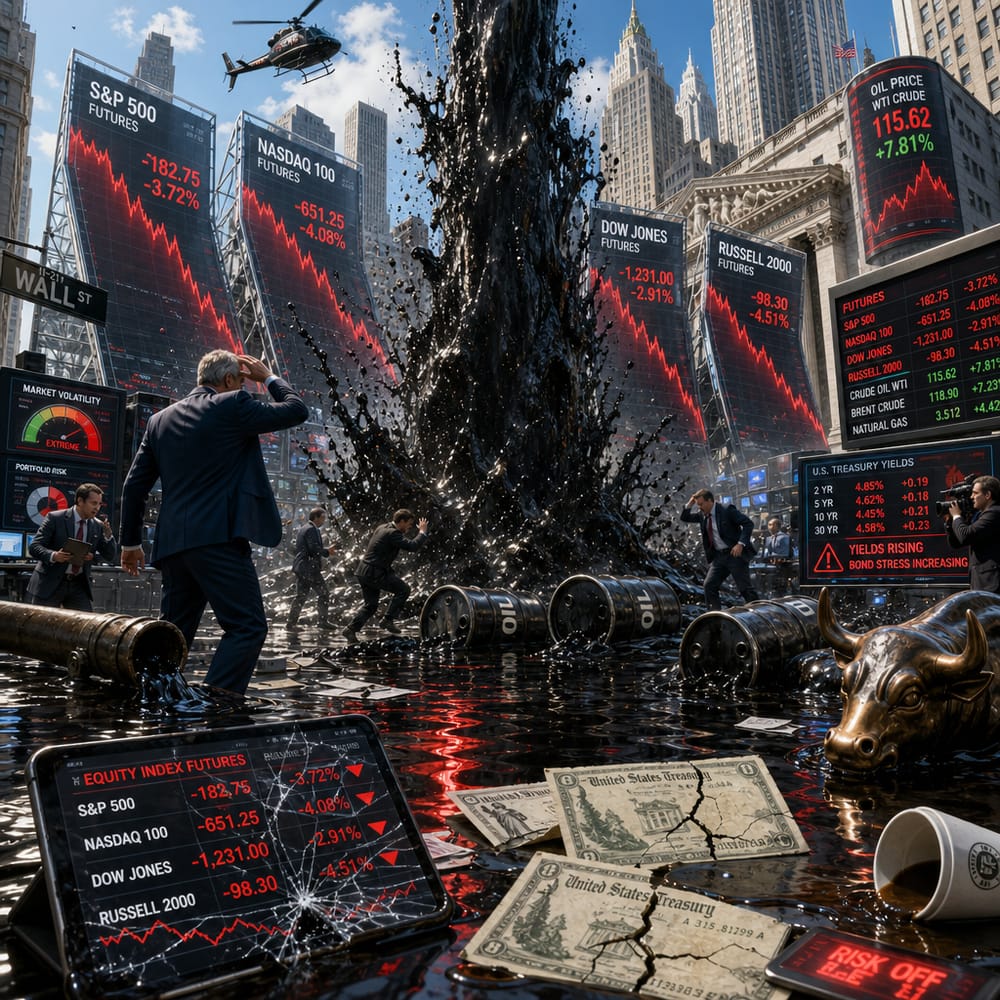
FUTURES SELL-OFF SIGNALS RISK-OFF SENTIMENT AMID OIL SPIKE
If you thought the markets were going to sleepwalk gently into the weekend, think again. Like an alarm going off at 4 a.m., U.S. equity futures just jolted everyone awake with a sharp sell-off. And no, this isn’t about some celebrity mishap or a political figure putting their foot in their mouth again. This time, the culprits are the usual suspects of economic tension: soaring oil prices and bond market turbulence.
Let’s break it down. You see, the price of oil has been playing a dangerous game of "how high can you go," and it's beginning to feel a lot like 2008 around here. As oil prices spike, so does the cost of just about everything else, from your morning latte to that plane ticket you promised your grandparents you'd buy for the holidays. It’s inflation déjà vu, and it’s making investors worry about profit margins getting squeezed tighter than a tube of toothpaste.
Now, if you’re thinking this is just a blip, hold onto your hats. The bond market is throwing its own party, and it’s not the fun kind with cake and balloons. Imagine trying to dance at a party where every song is out of tune—that’s the chaos bond investors are feeling. With recent Treasury yield fluctuations and whispers of financial repression (fancy term for governments messing around with the market), the bond market is sending a message: risk-off sentiment is in the air.
For those of you without a financial crystal ball, "risk-off" means investors are looking to batten down the hatches and avoid risky assets like stocks. When bond yields rise, investors tend to shift from stocks (like those in the S&P 500 or Nasdaq) to the relative safety of bonds. It’s the equivalent of going from betting it all on red in Vegas to stashing cash under your mattress.
So, what's the deal with these rising oil prices and bond market jitters? Why do they matter? Well, let’s paint the picture. Rising oil prices act like a tax on consumers and businesses, inflaming inflation fears and putting central banks like the Federal Reserve in a tough spot. Raise interest rates to curb inflation, and you risk slowing down the economy. Ignore it, and inflation might spiral like a rogue rollercoaster.
As for the bond market stress, it’s a double whammy. Higher yields mean higher borrowing costs for everyone from Uncle Sam to your neighbor looking to refinance their mortgage. And with the U.S. national debt ballooning to an eye-watering $40 trillion, the stakes are higher than ever. Rising yields can also signal decreased confidence in economic stability, which naturally sends equity markets into a tailspin.
But let’s not forget the broader implications. When investors get nervous, they tend to pull back and save, reducing consumption and slowing economic growth. The phrase "risk-off sentiment" is essentially the market equivalent of a teenager sulking in their room, and the reason we're seeing equity futures drop.
So, what now? Investors are bracing for a bumpy ride. In the short term, we might see a flight to quality—think gold, defensive stocks, and of course, cash (the king in uncertain times). But for those with nerves of steel and a long-term view, moments like these can also be an opportunity. Remember, the stock market is a long game of patience and nerves, not a sprint.
As the dust settles, keep an eye on how the Federal Reserve responds, how geopolitical tensions might impact oil supply, and whether bond yields stabilize or continue their acrobatics.
And remember, as with any rollercoaster, sometimes the best course of action is to hold on tight and wait for the ride to even out. Just maybe skip ordering that extra cup of oil—sorry, coffee—in the meantime.
This article is for informational purposes only and is not investment advice. Always do your own research or consult a licensed financial professional before making investment decisions.
© Copyright 2024. All Rights Reserved.
© Copyright 2024. All Rights Reserved.