

Forex Implications of Broad Dollar-Gold Divergence Amid Jackson Hole
Thursday, August 27, 2026
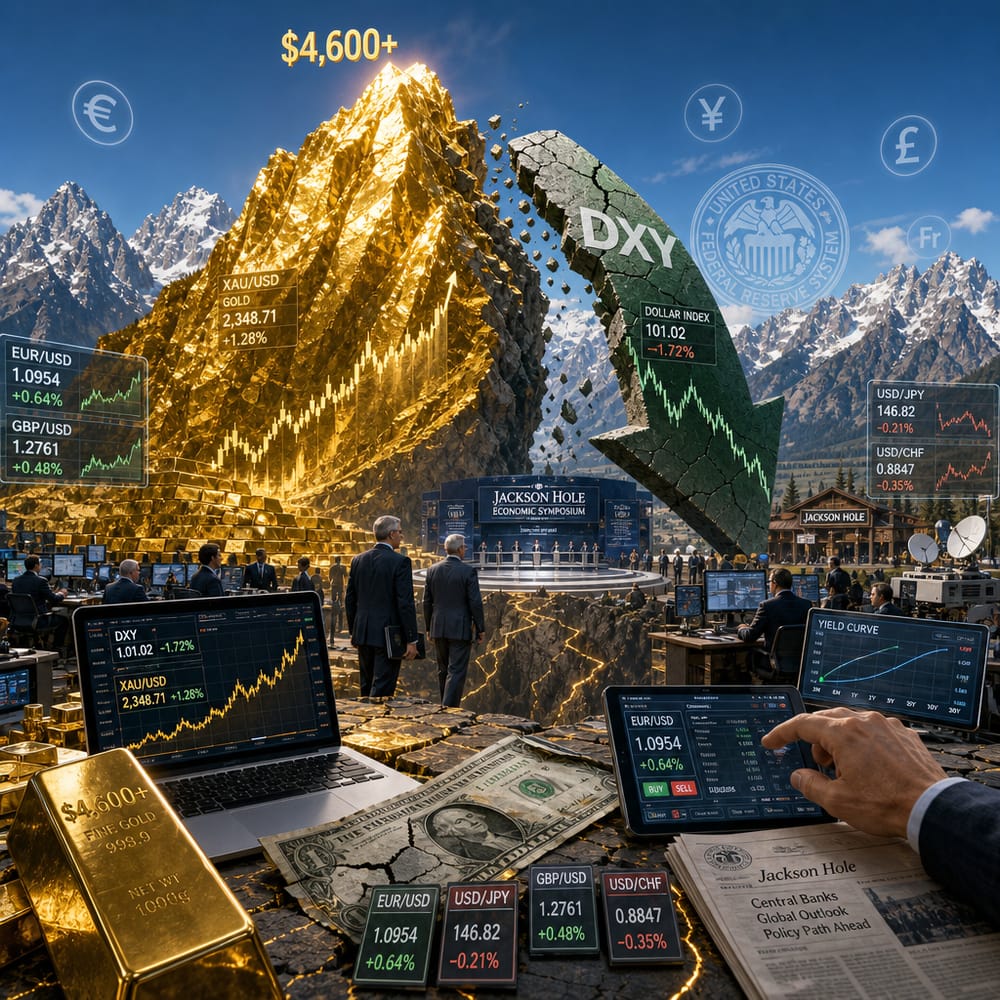
GOLD AND DOLLAR AT ODDS: WHAT IT MEANS FOR YOUR WALLET
Ever been to a party where two loudmouths vie for attention, and you just want to escape to the snack table? Welcome to the financial world’s latest soiree, starring the U.S. dollar and gold. As of late, these two heavyweights are sparring in opposite corners, and investors are left wondering where to place their bets.
Gold is flashing its shiny credentials, holding steady above $4,600 an ounce—a high not seen since the ‘bling era’ of the 80s. Meanwhile, the U.S. dollar seems to be the wallflower of this monetary gala. It’s not quite tanking, but it's definitely not leading the cha-cha against other currencies either. This face-off comes just as the biggest economic symposium in Jackson Hole is set to unfold. Picture global financial bigwigs gathered in a scenic hamlet, discussing the fate of your wallet over coffee and croissants.
So, why should you care? Because when gold and the dollar start dancing to different tunes, it often signals broader market sentiment shifts. Investors generally flock to gold when they're worried about inflation or economic upheaval—think of it as a shiny financial security blanket. The USD, on the other hand, tends to be the global currency of choice when people want stability and predictability. When these two aren’t in sync, it might hint at an underlying tension or transition in the market.
IS THE USD SHOWING SIGNS OF WEAKNESS?
Right now, the dollar’s swagger seems to be more of a shuffle. Against the euro and the pound, it’s holding its own, but just barely. The Japanese yen, however, is experiencing a bit of a comeback, trimming some of the dollar’s gains. As the Dollar Index (DXY)—a measure of the dollar's strength against a basket of major currencies—reveals, the greenback isn’t exactly flexing its muscles.
But why the hesitation? Investors are adopting a wait-and-see approach ahead of the Fed's powwow at Jackson Hole. Will they maintain high interest rates to squash inflation, or is a rate cut on the horizon if the economy starts to shiver? This uncertainty is causing investors to pause and reevaluate their strategies.
HOW ARE INVESTORS POSITIONING THEMSELVES AHEAD OF JACKSON HOLE?
If investing were a poker game, gold bugs would be going all in while dollar bulls cautiously look at their hand, considering whether to fold or play. Some investors are hedging their bets by diversifying into currencies like the Swiss franc and the euro. The franc, in particular, often emerges as a safe haven when geopolitical tensions rise—think of it as the financial world's cozy chalet.
Meanwhile, the Jackson Hole discussions promise to be a cliffhanger. Should the Fed signal a dovish shift—meaning they’re ready to cut rates—the dollar could lose more ground. In that scenario, gold might shine brighter than a Vegas marquee.
WHAT DOES THE GOLD PRICE MOVEMENT INDICATE ABOUT MARKET SENTIMENT?
Gold’s glittering heights above $4,600 are blinking like a neon warning sign. This surge typically suggests investors are hedging against potential inflation spikes or geopolitical hiccups—hello, ongoing tensions with Iran. It also reflects skepticism about the dollar maintaining its current course if economic growth shows signs of losing steam.
In short, market sentiment isn’t exactly singing “Don’t Worry, Be Happy.” Instead, it’s more akin to biting nails during a suspense thriller. Investors are bracing for potential turbulence, and gold is their parachute.
THE BOTTOM LINE
As the dollar and gold continue their awkward dance, retail investors need to stay nimble. Keep an eye on the Jackson Hole proceedings like your financial future depends on it—because it just might. Whether the Fed plays dove or hawk could tip the scales, affecting everything from your next vacation abroad to that e-commerce impulse buy.
In the meantime, consider spreading your investment wings. A little gold, some foreign currency exposure, and maybe an eye on what’s happening with tech stocks (hello, Nvidia!) might just see you through this dance-off with your portfolio intact and your financial nerves a tad more settled.
This article is for informational purposes only and is not investment advice. Always do your own research or consult a licensed financial professional before making investment decisions.
© Copyright 2024. All Rights Reserved.
© Copyright 2024. All Rights Reserved.