

Forced Liquidation Hits AI & Tech Sectors
Saturday, November 07, 2026
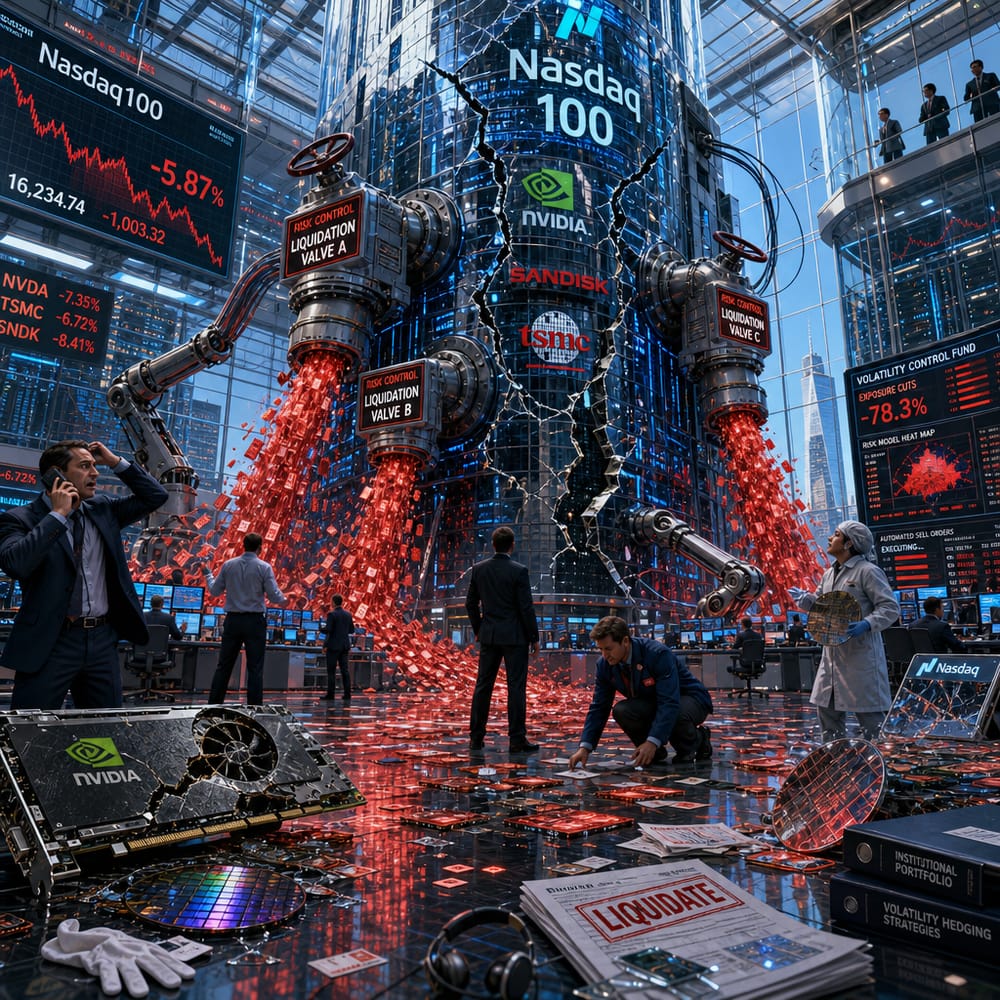
FORCED LIQUIDATION HITS AI & TECH SECTORS
If you were peacefully savoring your morning coffee when tech stocks took a swan dive, welcome to the world of forced liquidation — the financial equivalent of a high-stakes poker game where everyone suddenly folds, and the chips go flying. The tech sector, starring the usual suspects like Nasdaq 100, Nvidia, and TSMC, just received a rude awakening, courtesy of some trigger-happy volatility-control funds.
First things first: What the heck are volatility-control funds? Imagine these funds as nervous drivers who slam the brakes at the first sign of a squirrel crossing the road. When markets get shaky, they start pulling out of equities faster than you can say "sell-off." And boy, did they slam those brakes last week, causing a ripple effect that wiped out trillions in market value.
So, what sparked this financial fire drill? The market was already jittery with talk of an AI slowdown, and when volatility-control funds decided it was time to bail, things careened from shaky to downright chaotic. Picture the scene: Nvidia stumbling like it's been hit by a virtual pie, and Sandisk wondering what just happened to its memory (pun fully intended).
The result? A market downturn that left retail investors clutching their portfolios and wondering if they should start hoarding canned goods. It seemed like the AI party was over, with a monstrous $2.5 trillion wiped out. Investors went into panic mode, rushing for the exits and leaving tech stocks scattered like confetti after a parade.
But it wasn't just the AI sector that took a hit. The tech-heavy Nasdaq 100 felt the heat, sending retail investors into a frenzy. Social media feeds were ablaze with DIY financial gurus offering advice that ranged from "hold tight" to "buy the dip," accompanied by quirky memes of stonks and rocket ships.
On the flip side, the market did show signs of life—albeit modest—by the week's end. Like a superhero emerging from the rubble, the Nasdaq and S&P 500 rose slightly, with AI stocks making a surprisingly swift comeback. Nvidia, for example, rebounded by nearly 3% on Friday. It's the kind of resilience that made investors breathe a collective sigh of relief, at least for now.
But let's not break out the champagne just yet. The volatility illustrates the dark side of quant-driven trading strategies—those high-octane, algorithmic maneuvers that can flip the market faster than a blackjack dealer in Vegas. While these strategies often work like a well-oiled machine, they can also spark sudden sell-offs, leaving the average Joe to pick up the pieces.
Now, investors are left to ponder the future. Will this forced liquidation become another cautionary tale, or is it just a blip on the tech sector's radar? With the chatter around AI still buzzing, companies like TSMC are under pressure to show they're not just shiny tech darlings but have the chops for a long-term game.
In the short term, savvy investors will likely keep a close eye on these funds, ready to pivot at the first sign of turbulence. As we've seen, markets tend to bounce back, at least partially, after such dramatic drops. Some are already eyeing the dip as a buying opportunity, while others are sitting tight, waiting for more stability.
In this volatile world, one thing is clear: the tech sector is not for the faint-hearted. Whether you're in it for the long haul or just along for the ride, understanding the mechanics behind these forced liquidations can be the difference between navigating the storm and getting swept away by it. So, buckle up, keep your wits about you, and remember: in finance, as in poker, sometimes it's not just about the cards you're dealt, but how you play them.
This article is for informational purposes only and is not investment advice. Always do your own research or consult a licensed financial professional before making investment decisions.
© Copyright 2024. All Rights Reserved.
© Copyright 2024. All Rights Reserved.