

Fed’s Beige Book Signals Mixed Momentum Just Ahead of December FOMC Meeting
Saturday, November 28, 2026
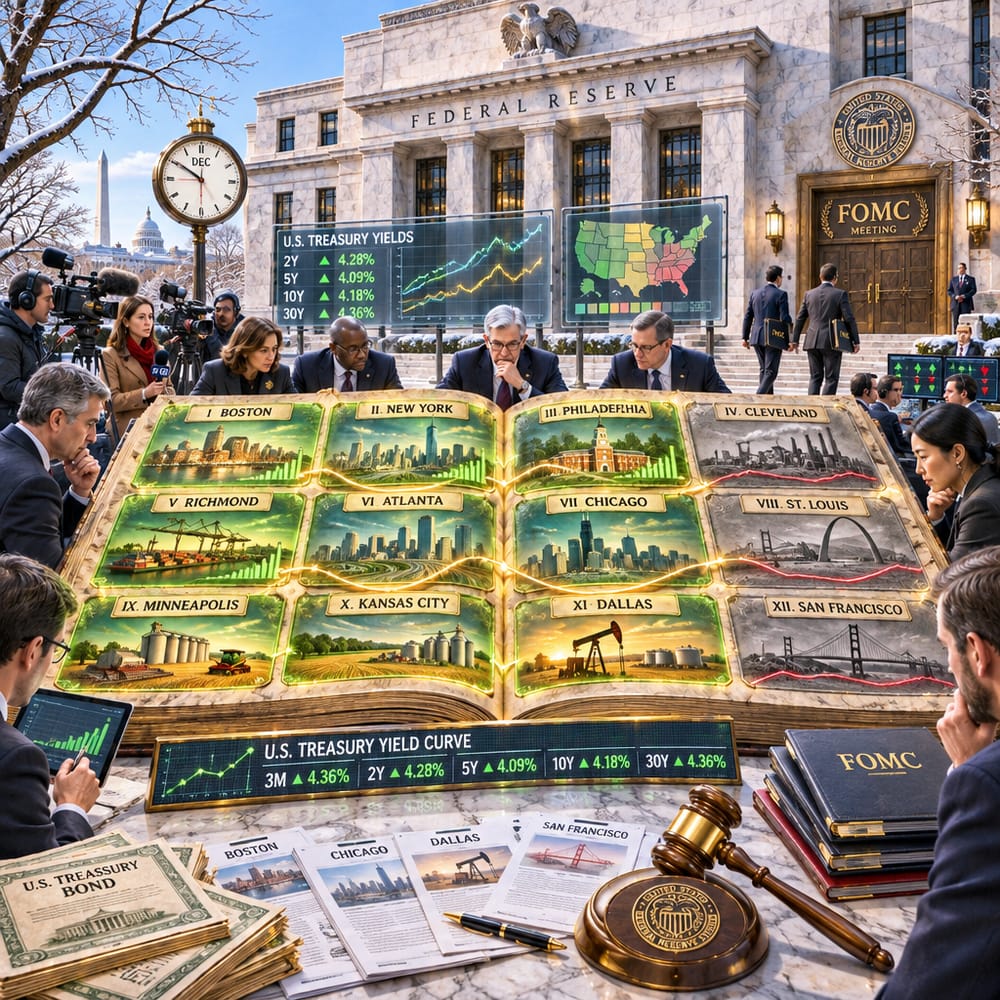
FED’S BEIGE BOOK SIGNALS MIXED MOMENTUM JUST AHEAD OF DECEMBER FOMC MEETING
If the Federal Reserve’s Beige Book were a novel, it would be one of those page-turners with a plot twist you never see coming. Just when you think you’ve got the Federal Reserve’s next move figured out, along comes the Beige Book with a surprise to keep everyone guessing. This latest edition reveals a mixed bag of economic growth across the United States’ regions, setting the stage for a nail-biter of a Federal Open Market Committee (FOMC) meeting in December.
WHAT’S THE BEEF WITH THE BEIGE BOOK?
For those of you who don’t spend your free time reading Fed reports (and honestly, who does?), the Beige Book is like a regional gossip column for the U.S. economy. It’s a collection of economic anecdotes from 12 Federal Reserve Districts, shedding light on everything from retail sales to employment trends. And just like any good gossip, it reveals who's thriving, who's struggling, and who’s just plain stuck in the mud.
In this latest edition, eight of the twelve districts report a slight to moderate uptick in economic activity. That’s right – some good news for a change. But before you pop the champagne, the remaining four districts report little to no change. Picture a high school reunion where half the class is showing off their flashy new jobs while the other half is still trying to figure out what they want to be when they grow up.
THE REGIONAL ROLLERCOASTER
So what’s causing these regional disparities? It turns out, like in real estate, it’s all about location, location, location. Some areas are benefiting from strong consumer demand and robust job markets—think of them as the star quarterbacks of the economic team. Others, however, are grappling with labor shortages and supply chain snafus, the underdogs trying to score a touchdown with one hand tied behind their back.
Take the Midwest, for instance. Its agriculture-heavy economy is seeing growth thanks to rising commodity prices. Meanwhile, parts of the South are bogged down by sluggish tourism and hospitality sectors still limping from COVID's nasty scars.
WHAT DOES THIS MEAN FOR THE FOMC?
Now, you might be wondering, what kind of curveball is this going to throw at the Fed’s December meeting? Here’s the thing: the Fed’s main tool for steering the economy is adjusting interest rates. And these regional discrepancies complicate the matter like trying to solve a Rubik’s Cube blindfolded.
The Fed wants to avoid being too trigger-happy with rate hikes that could stifle growth where it’s finally picking up. Yet, they also don’t want to be too passive, letting inflation run wild like a toddler hopped up on Halloween candy. The challenge is to find that Goldilocks “just right” interest rate policy.
THE MARKET’S NEXT MOVE
So how might these economic tales influence the Fed’s decision-making process? If growth continues to be uneven, the Fed could adopt a more cautious, wait-and-see approach—more like a chess player plotting several moves ahead rather than swinging for a checkmate right away.
For investors, this means keeping an eye on U.S. Treasury yields, which could fluctuate based on rate expectations. A cautious Fed might mean lower yields, as markets adjust to fewer rate hikes on the horizon. This could, in turn, give a little boost to sectors like housing and tech, which tend to thrive on lower borrowing costs.
Then there’s the wildcard of market sentiment. If investors smell uncertainty, they tend to get skittish faster than a cat in a room full of rocking chairs. Expect volatility to remain a faithful companion as markets try to read the Fed’s poker face.
BOTTOM LINE
The Federal Reserve’s Beige Book has turned up the suspense on the upcoming FOMC meeting. With regional economies pulling in different directions, the Fed faces a complex balancing act that could shape interest rates and market expectations.
For everyday investors, now’s a good time to keep those investment seat belts fastened. While the Fed decides whether to throttle up or ease off, it’s crucial to stay informed and be prepared for any plot twists that could come our way. After all, in the world of finance, truth is often stranger than fiction.
This article is for informational purposes only and is not investment advice. Always do your own research or consult a licensed financial professional before making investment decisions.
© Copyright 2024. All Rights Reserved.
© Copyright 2024. All Rights Reserved.