

Fed Rate-Hike Odds Slashed: Markets Price a Dovish Fed, Pressuring the Dollar
Sunday, August 23, 2026
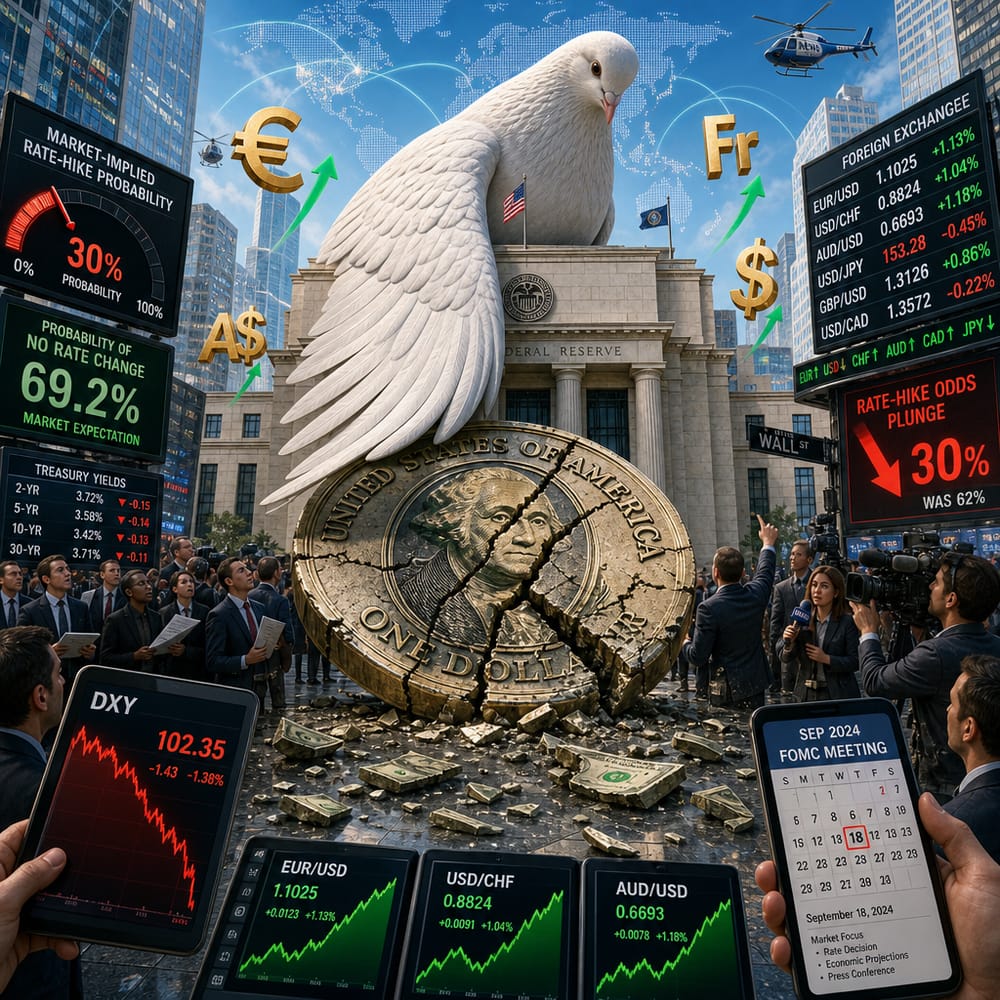
FED RATE-HIKE ODDS SLASHED: MARKETS PRICE A DOVISH FED, PRESSURING THE DOLLAR
Alright, folks, grab your popcorn because the Federal Reserve's rollercoaster ride just took another wild twist. If you’ve been following the whispers in the financial corridors—and boy, they’re getting loud—there’s a nearly 70% market expectation that the Fed will play nice and keep interest rates untouched in September. That’s right, friends: the mighty dollar is feeling a little less invincible these days. The markets are betting on a dovish Fed, and it's creating a shakedown in the global currency arena.
But what’s behind this softening Fed stance? Let’s dive into the tea leaves, or in this case, economic indicators. First up, inflation seems to be finally loosening its grip. Prices aren’t skyrocketing like they used to, and that has the Fed cautiously optimistic. Combine that with a job market that's still strutting its stuff—though with a bit less swagger—and you've got a Fed that can afford to take a breather.
Yet, it's the U.S. national debt that’s really making the Fed sweat bullets. At a jaw-dropping $40 trillion, the debt has become the financial equivalent of Godzilla stomping through Tokyo. It’s no wonder the Fed is hesitant to hike rates, which could make borrowing even more costly and exacerbate the already monstrous debt burden.
Now, let’s talk about our old friend, the U.S. dollar. When the Fed adopts a dovish stance, it's like throwing a wet blanket over the dollar’s usual bravado. The Dollar Index (DXY), a measure of the dollar against a basket of other currencies, has been feeling the heat. As the dollar loses its mojo, global investors are paying close attention to how other currency pairs are responding. The EUR/USD and AUD/USD are particularly in the limelight. A weaker dollar typically means these currencies get a boost, making European and Australian goods more attractive on the global stage.
But it’s not all roses and sunshine. For example, if you’re holding USD/CHF (that’s the U.S. dollar against the Swiss franc, for those keeping score at home), you might be biting your nails a bit. The franc is often seen as a safe haven currency, and with a softer dollar, it could strengthen, potentially complicating things for dollar-denominated Swiss assets.
The global ripple effects of a dovish Fed can be profound. Emerging markets, which often rely heavily on dollar-denominated borrowing, might breathe a sigh of relief. Lower U.S. interest rates make it cheaper for these economies to service their debts. However, this also means their own currencies could appreciate, which isn’t necessarily great for exports.
The ever-dynamic world of forex (foreign exchange) is primed for some seismic shifts. As the dollar eases back, central banks everywhere are recalibrating their strategies. The Bank of Japan, for example, has been itching to see the yen strengthen as the dollar weakens. And let’s not forget our pals at the European Central Bank, who have been juggling their own inflation challenges while watching the euro gain ground.
So, what’s the bottom line here? A dovish Fed is like a balancing act on a tightrope—one gust of wind, and the whole thing could wobble. Investors are keeping a hawkish eye on the Fed’s next move, which, for now, seems to be a cautious shuffle rather than a bold stride.
For retail investors, this is the time to review your portfolio. Currency markets are notoriously fickle, and a dovish Fed could open up new opportunities—or risks, depending on how the chips fall. Whether you’re trading forex pairs or holding onto stocks that are sensitive to exchange rates, now’s the moment to stay sharp. Keep an eye on the Fed’s signals and prepare for what could be a tumultuous ride ahead. After all, in the world of finance, the only constant is change.
This article is for informational purposes only and is not investment advice. Always do your own research or consult a licensed financial professional before making investment decisions.
© Copyright 2024. All Rights Reserved.
© Copyright 2024. All Rights Reserved.