

Fed Rate-Hike Odds Collapse Pushes DXY Below 200-Day EMA
Saturday, August 22, 2026
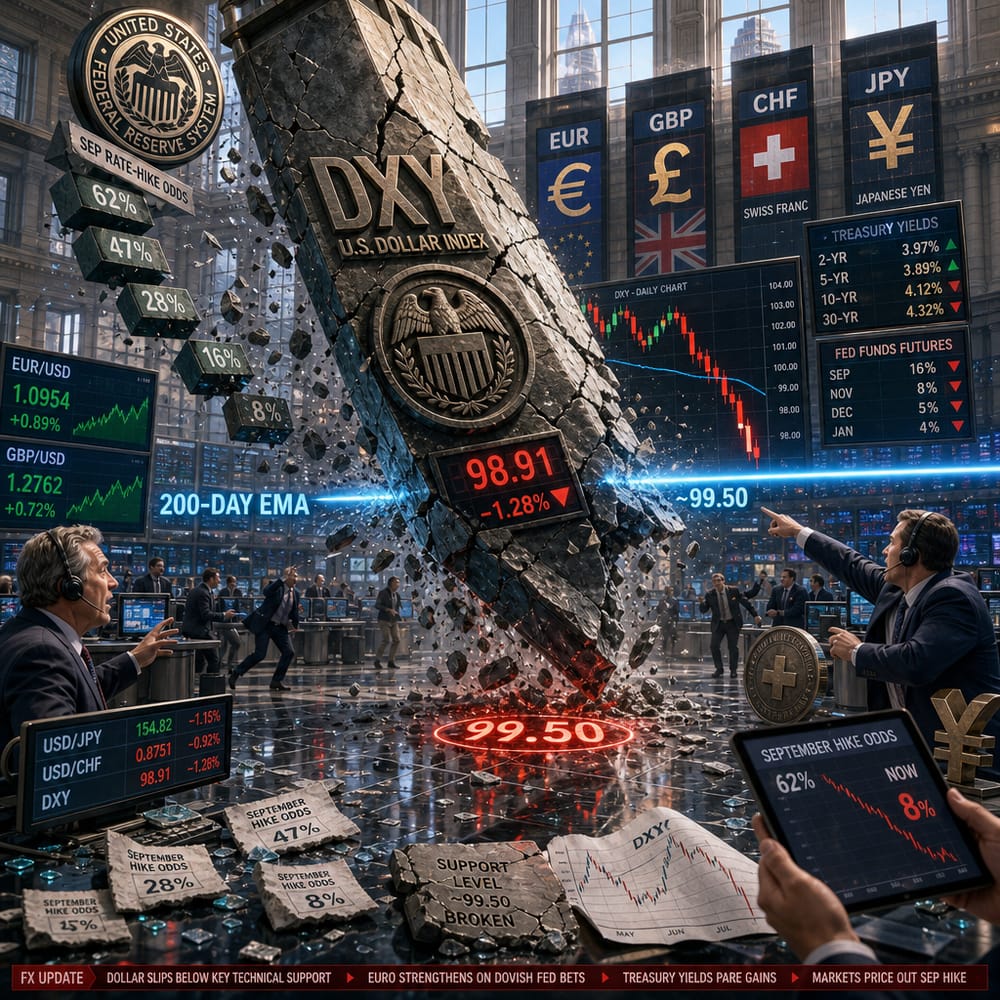
DISASTER STRIKES AS FED RATE-HIKE ODDS CRATER, DRAGGING DXY INTO THE DOLDRUMS
If you’re still waiting for your invite to the Federal Reserve’s next rate hike party, you might want to stop holding your breath. The odds of a September rate hike have plummeted like a lead balloon, and the mighty U.S. dollar index, or DXY, has taken a nose dive right alongside it, slipping below its 200-day exponential moving average threshold of around 99.50. Now, if you’re scratching your head wondering why a moving average matters, think of it as the financial markets’ equivalent of a trusty weather forecast — and right now, it's predicting a stormy outlook for the dollar.
WHAT'S BEHIND THE RATE-HIKE RUCKUS?
Wall Street's favorite pastime might be predicting Fed moves, but lately, everyone's crystal ball seems to be on the fritz. So, what's really stirring the pot? For starters, a tangled web of economic data, from mixed employment reports to inflation figures that just can't pick a direction. The Fed’s previous rate hikes were an effort to tame inflation, but with recent data hinting at cooler inflation and a job market that’s showing signs of fatigue, the Fed’s hawkish stance is starting to look more like a scared bird than a fierce predator.
And it's not just domestic woes throwing a wrench in the works. Overseas chaos, such as the U.S.-Canada trade tiff where tariffs have been slapped on like they’re going out of style, also contributes to the uncertainty. A potential trade war can upset the delicate balance of economic factors the Fed uses to make its decisions, which may explain why they’re pumping the brakes.
THE FALLEN DOLLAR: A RIPPLE EFFECT
As the DXY dips below its 200-day EMA, it’s sending shockwaves well beyond the land of stars and stripes. The weaker dollar is music to the ears of major European currencies like the euro and pound, which have been dancing in delight at their newfound strength. Meanwhile, haven currencies such as the Swiss franc and Japanese yen are also getting a boost, with investors flocking to safety like moths to a flame.
But before you start celebrating a European vacation on the cheap, remember that a weakening dollar can have some sticky consequences. For one, it can make imports pricier, potentially stoking inflation when we're already trying to keep that beast at bay. Plus, it's a bit of a double-edged sword for American exports: while they become more attractive price-wise abroad, a full-blown trade spat could negate that advantage faster than you can say "tariff."
LONG-TERM PROSPECTS: A FUTURE FOR THE GREENBACK
So, what lies ahead for the almighty buck? The current slide certainly casts a long shadow over its future prospects. If the Fed remains dovish and refrains from further hikes, the greenback may continue its slippery slope. However, it’s not all doom and gloom — a weaker dollar could actually be the shot in the arm that U.S. exports need, boosting competitiveness overseas. But before you break out the confetti, bear in mind that this comes amid a complex global backdrop where geopolitical tensions and shifting trade policies could easily upend any textbook outcomes.
TRADING PLACES: PAYING THE CURRENCY GAME
How should savvy investors navigate these murky waters? With cautious optimism and a keen eye on global developments. Currency markets are nothing if not tempestuous, and what goes down often finds its way back up. Diversification remains your best friend — think beyond just the dollar, perhaps eyeing the potential gains in foreign stocks and assets if the dollar continues to stumble.
In the end, while the Fed’s rate-hike uncertainty has turned the DXY’s world upside down for now, remember that financial markets are like your favorite roller coaster: full of ups and downs that many find exhilarating. So buckle up, stay informed, and don’t be afraid to enjoy the ride. After all, as any seasoned investor will tell you, volatility is just another word for opportunity.
This article is for informational purposes only and is not investment advice. Always do your own research or consult a licensed financial professional before making investment decisions.
© Copyright 2024. All Rights Reserved.
© Copyright 2024. All Rights Reserved.