

Fed Policy Outlook Shifts After Weak Jobs Data
Monday, August 10, 2026
FED POLICY OUTLOOK SHIFTS AFTER WEAK JOBS DATA
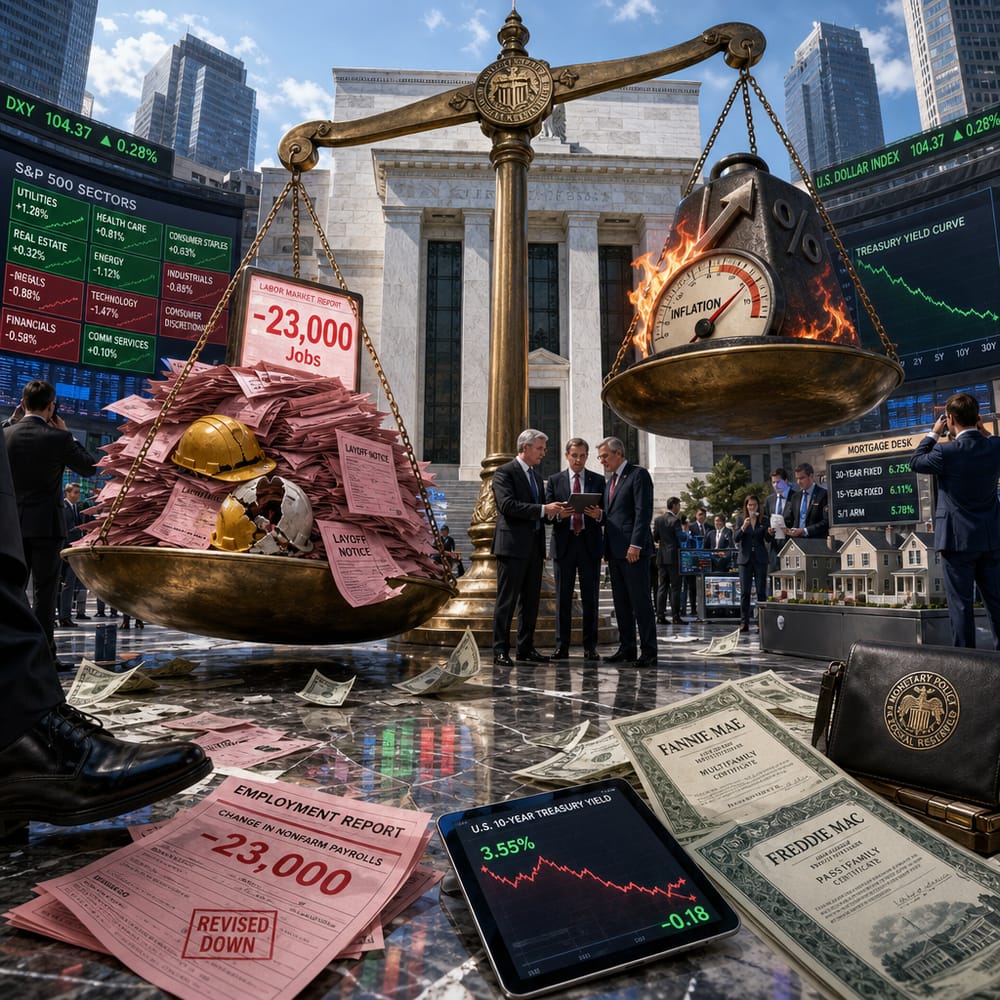
In the financial world, news is often greeted with a mixture of shrugs and eyebrows raised so high they might need zip codes. The latest jobs report has sparked more than a few elevated brows—and not in a good way. The U.S. economy just dropped a surprise: 23,000 jobs lost in July. For those keeping score, that’s about 118,000 jobs shy of what economists had penciled in. Talk about missing the mark.
Now, you might ask, “Does this mean we're barreling towards economic doom?” Not exactly. But the Federal Reserve is certainly re-evaluating its game plan, and that matters for everyone from Wall Street tycoons to folks wondering why their mortgage rates are still climbing.
RATE-HIKE ODDS: FROM "WHEN" TO "IF"
Hiking interest rates has been the Fed’s go-to move for taming inflation, much like how your grandma uses a trusty pressure cooker to tenderize tough meat. But the prospect of another rate hike now feels as exciting as reheated leftovers. Fed funds futures—a sort of betting pool among finance pros about where rates are headed—have adjusted their odds. Pre-report, another rate hike seemed like a sure bet. Now, it's more like placing your chips on red at a roulette table and crossing your fingers.
WHAT COULD HAPPEN NEXT?
If rate hikes are shelved, some sectors may be ready to party. Tech and growth stocks often perform well when borrowing costs remain low, offering them a cheap runway to fund innovation. On the flip side, if the Fed pulls a surprise hike from its hat, financial stocks, which benefit from higher interest rates, could come out ahead.
But let’s not ignore the elephant in the room—AI, or artificial intelligence. If companies decide they don’t need to hire because robots and algorithms do it better, what does that mean for inflation? Nobody’s quite sure yet, least of all the Fed, whose crystal ball is still on backorder.
DATA TO WATCH: CPI, PCE, AND THE ART OF READING TEA LEAVES
Attention now turns to upcoming data—the Consumer Price Index (CPI) and Personal Consumption Expenditures (PCE). These alphabet soups of economic metrics could tip the scales on whether the Fed slams the rate-hike brakes or revs up again. CPI will show us if prices for things like groceries and gas are still climbing faster than a SpaceX rocket, while PCE will tell us how much we’re actually spending despite those high prices.
EMERGING TRENDS AND THE INVESTOR'S DILEMMA
The jobs report has thrown a wrench in the works, but consumer spending remains a rockstar in this economy’s ensemble cast. Retailers are still seeing sales, even as prices pinch pockets like tight jeans after Thanksgiving.
However, with economic indicators sending mixed signals like a car with a broken GPS, retail investors could be left scratching their heads. Do you hedge your bets and stay in the market, or do you cash out and wait for clearer skies?
THE BOTTOM LINE
Only time—and a few more data releases—will reveal whether the Fed decides to hike, hold, or fold. But for now, keep your eyes on the numbers and your ear to the ground. The market is a living, breathing beast that can turn on a dime—or a jobs report. So, stay informed, stay flexible, and don’t let the financial headlines send you running for the hills. After all, the economy is nothing if not a roller-coaster ride, and the best investors are always ready for the next twist or turn.
This article is for informational purposes only and is not investment advice. Always do your own research or consult a licensed financial professional before making investment decisions.
© Copyright 2024. All Rights Reserved.
© Copyright 2024. All Rights Reserved.