

Fed Chair Warsh’s Shift Away from Forward Guidance Adds Uncertainty
Monday, August 10, 2026
FED CHAIR WARSH'S SHIFT AWAY FROM FORWARD GUIDANCE ADDS UNCERTAINTY
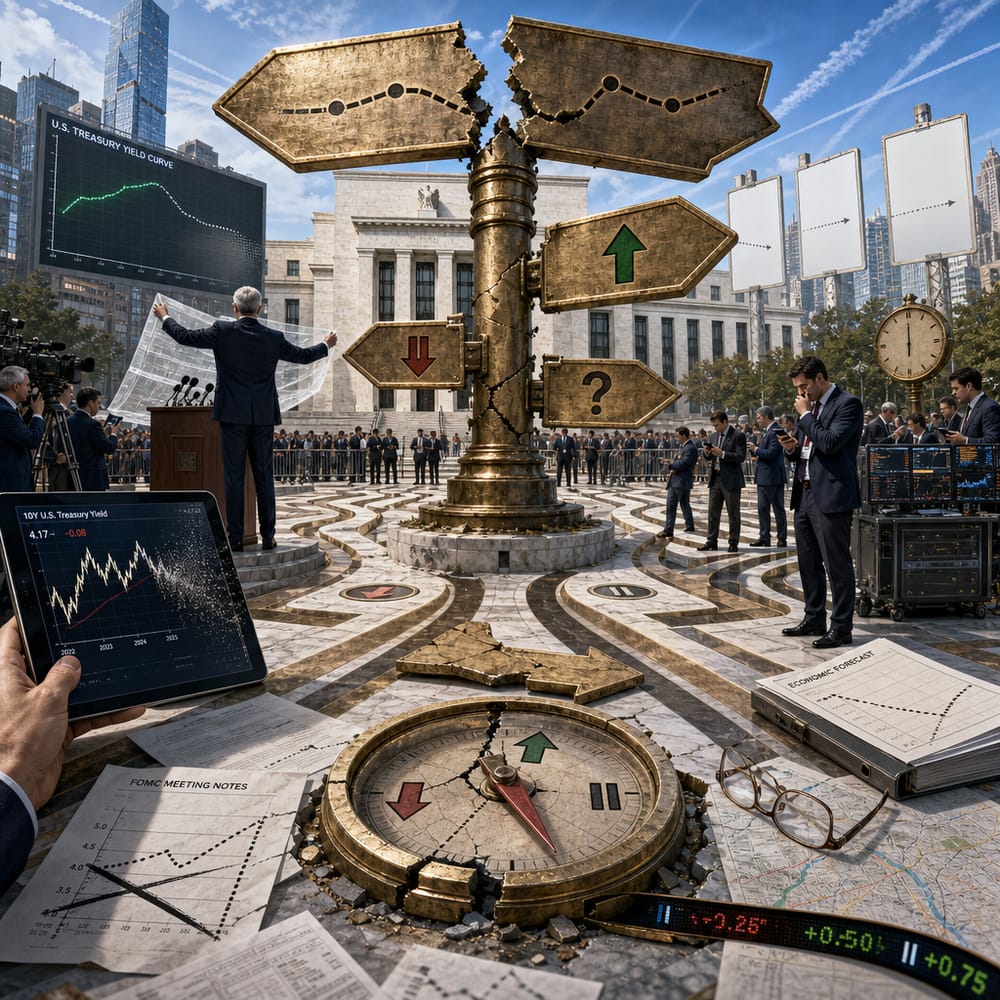
Imagine you're on a road trip, cruising down the highway with your GPS guiding you every step of the way. Suddenly, the GPS goes silent. You're left to your own devices, squinting at road signs and second-guessing every turn. That's exactly how investors feel right now with the Federal Reserve's latest move under its new captain, Kevin Warsh. He's hit the mute button on forward guidance, leaving Wall Street flying blind in the middle of an economic storm.
Forward guidance, in plain English, is the Fed's way of telling the world what's happening with interest rates. It’s the market’s cheat sheet, a little nudge that says, “Hey, we're going to do X or Y with rates in the coming months.” It helps investors, businesses, and economists plan for the future, like knowing when to swap out your summer tires for snow tires. But now, Warsh has tossed that script out the window, leaving investors to read between the lines of cryptic Fed statements.
The big question buzzing around Wall Street is, “Why?” Warsh argues that forward guidance has outlived its usefulness. He wants the Fed to be unpredictable, to keep inflation and unemployment on their toes. In his view, the economy is like a game of poker, and Warsh doesn't want to show his hand.
However, the market doesn't play well with uncertainty. It's like trying to guess how much milk you need for a recipe, without ever being told what you're making. Investors are left jittery, constantly on edge as they try to anticipate the Fed's next move. Some say it's like trying to drive through a fog with your headlights off.
The implications of this shift are massive. For one, it makes it harder to predict interest rate changes. If you're a company thinking about borrowing money to expand, you’re now left wondering whether the cost of that loan will skyrocket next month. It also leaves bond markets in a tizzy, as traders scramble to adjust their portfolios to align with whatever they think the Fed might do next.
Without forward guidance anchoring expectations, market volatility is likely to increase. This is the financial equivalent of riding a rollercoaster blindfolded. Traders thrive on predictability, and with uncertainty, comes the potential for wild market swings, which can spook investors and lead to knee-jerk reactions that aren't always rational.
And let's talk about the long-term effects. If the Fed doesn’t lay the groundwork for its moves, the market might lose trust in its ability to manage the economy. Investors could start seeing the central bank as more of a wild card than a stabilizing force. And when trust in the Fed erodes, it can send shockwaves through all aspects of economic life, from how businesses plan their strategies to how everyday people decide to save or spend their money.
So how exactly are investors reacting to Warsh's poker face? With a mix of skepticism and caution, frankly. Some are holding their breath, hoping Warsh's gamble pays off, while others are diversifying their portfolios, trying to hedge against the unexpected. It's a scene straight out of a financial thriller, with traders glued to their screens, waiting for any hint of a rate hike—or cut—buried in the Fed's cryptic communications.
But can this uncertainty ever translate into market stability? If investors learn to adapt to this new normal, maybe. But for now, expect plenty of hand-wringing and a lot of guessing games on Wall Street. The Fed's shift away from forward guidance might just be the shake-up the economy needs—or it could be a gamble that leaves markets more unstable than ever before.
In the meantime, as investors, we’re all left humming Bob Dylan's “The Times They Are a-Changin’” and hoping that Warsh's bet on unpredictability doesn't come back to bite us. So grab your popcorn, because it looks like the market’s unpredictability show is just getting started. Keep your wits about you, and maybe, just maybe, this wild ride will be worth the uncertainty.
This article is for informational purposes only and is not investment advice. Always do your own research or consult a licensed financial professional before making investment decisions.
© Copyright 2024. All Rights Reserved.
© Copyright 2024. All Rights Reserved.