

Fed Chair Warsh’s Dual Strategy: Standard Toolkit and Macro Reassessment
Tuesday, August 11, 2026
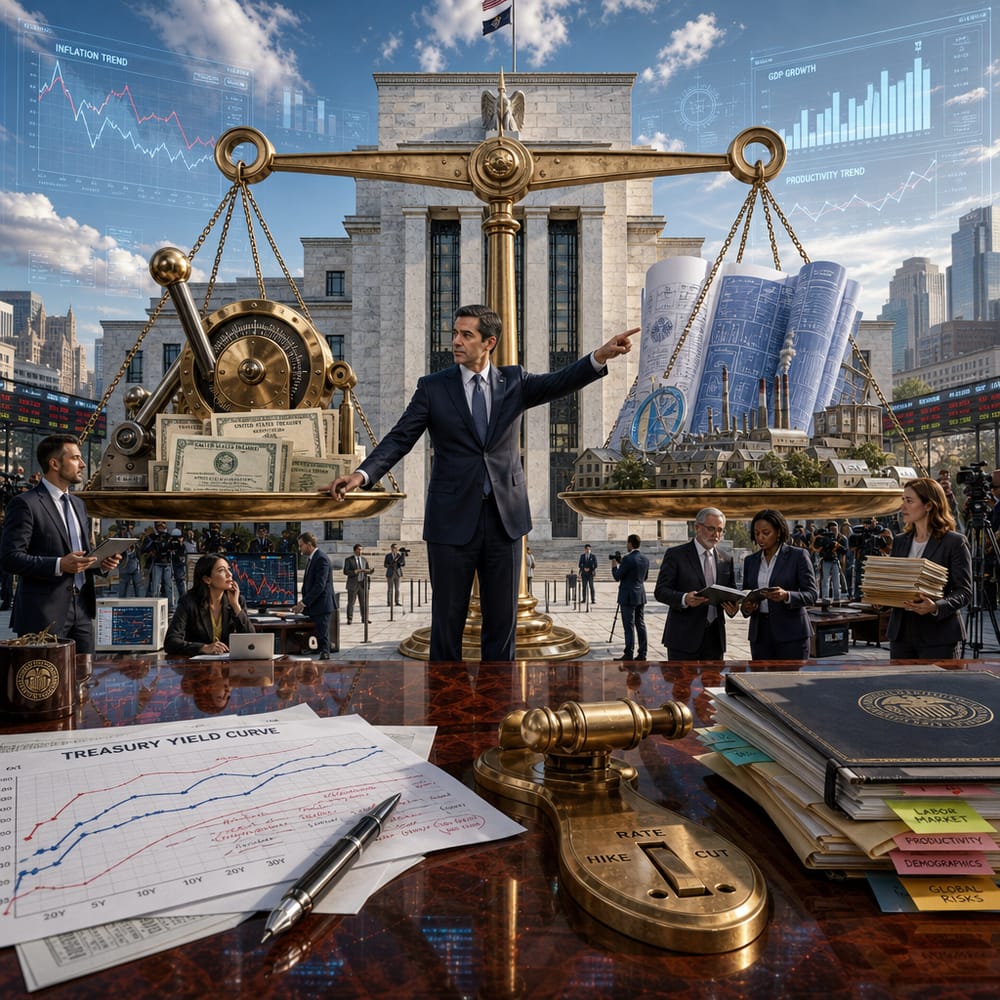
Kevin Warsh isn't your typical Federal Reserve Chair, and his approach to steering the economic ship is far from the usual monotony of rate adjustments and perplexing jargon. Instead, Warsh is playing dual roles—like an economic Dr. Jekyll and Mr. Hyde—by both leveraging traditional monetary tools and giving the entire policy framework a much-needed reality check. It's all about balance, my friends, and Warsh is determined to ensure that the Federal Reserve doesn't trip over its own feet like a teenager on prom night.
Warsh's game plan involves a two-pronged strategy. On one hand, he's employing the age-old tool of interest rate manipulation. It’s as reliable as your grandma's secret cookie recipe—tried and true. But here’s the twist: Warsh is also out to explore new horizons. He’s asking those big existential questions about long-term policies that others have been too polite—or too afraid—to tackle. Basically, he’s the Sherlock Holmes of central banking, minus the pipe and questionable hygiene habits.
At the heart of Warsh's strategy is the balance between adjusting those interest rates to keep inflation in check and diving deep into a re-evaluation of macroeconomic assumptions that have long governed the Fed's moves. It's like he's trying to keep both Moby Dick and the Pequod afloat—no easy task. But Warsh seems to think that both can thrive together, reimagining what's possible for economic policy as we know it.
Now, why does all this matter to you, the savvy retail investor scrolling through this on your phone while juggling a latte in the other hand? Because Warsh's approach is shaking things up in a way that could hit you squarely in the portfolio. A Fed that’s more sensitive to new data and willing to rethink its policy underpinnings means we could see more rapid shifts in market expectations. Less predictability equals more volatility—so buckle up!
Warsh’s reevaluation isn’t just a theoretical exercise. He’s looking at real-world indicators, like the recent tech sell-off that dragged the S&P 500 down, or the geopolitical jitters over Iran that's got oil prices playing the hokey-pokey. These are not just news blips; they are the very kind of data blips that could influence how Warsh shapes future Fed policies.
Picture this: a Fed that not only adjusts rates based on what inflation looks like today but also based on a broader reevaluation of what growth and employment should mean for tomorrow's economy. It's a paradigm shift, a bit like going from measuring your morning jog in miles to understanding it in terms of the number of donuts it burns off.
Warsh's approach could lead to a more responsive Fed, potentially making the classical indicators like bond yields and mortgage rates a bit more fluid and less predictable. For instance, while Treasury yields held steady as the market waited for new inflation data, any shift in Fed policy direction could send those yields on a roller coaster ride, impacting everything from your mortgage rate to your favorite tech stock’s value.
And let's not forget the wider implications for sectors like real estate and energy. As mortgage rates climb and home sales slow—crunching aspiring homeowners' budgets—Warsh's flexible approach could either ease the pressure or reinforce the hurdles, depending on how the economic winds blow.
So, what's next? Well, keep your investing antennae tuned. Warsh's dual strategy signals a Fed that’s poised to act with agility, grounded but not rooted in tradition. It’s like watching a tightrope walker with a trusty safety net below—but that net is now made of futuristic, dynamic material.
The takeaway here is that under Warsh’s leadership, the Fed might just move from being a lumbering behemoth to a nimble operator capable of navigating the unforeseen complexities of today's economic landscape. Whether this keeps Wall Street quaking in its boots or sighing in relief—only time will tell. But isn’t the thrill of the unknown what makes this financial ride so exhilarating?
This article is for informational purposes only and is not investment advice. Always do your own research or consult a licensed financial professional before making investment decisions.
© Copyright 2024. All Rights Reserved.
© Copyright 2024. All Rights Reserved.