

Fed and Treasury Divergence Adds Uncertainty to Economic Outlook
Tuesday, August 25, 2026
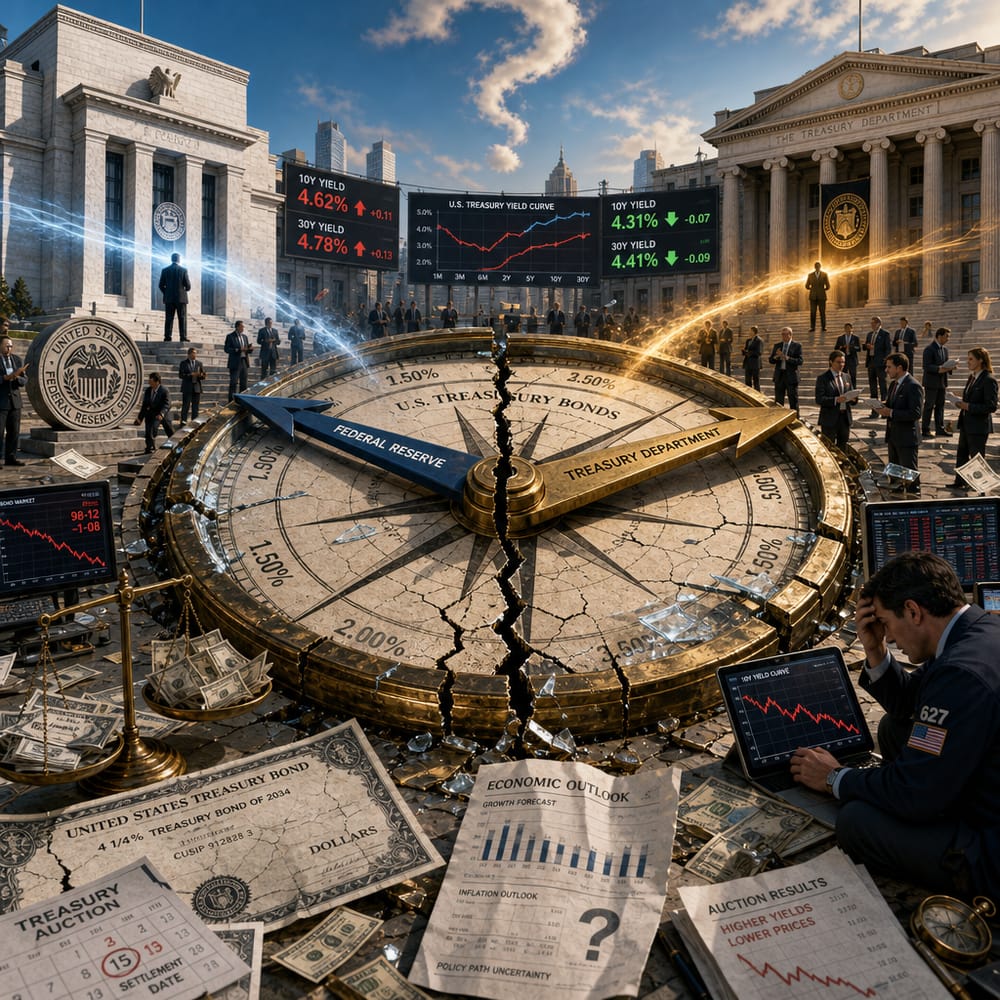
Yields are like teenagers—volatile, unpredictable, and perpetually in flux. In the world of finance, interest rates can tell you a whole lot about what’s coming. And right now, there’s a bit of a family feud unfolding between the Federal Reserve and the U.S. Treasury Department. If you're wondering what this odd couple's spat might mean for your investment portfolio, buckle up. It could be a bumpy ride.
THE GREAT DIVERGENCE
Imagine you’ve got two cooks in the economic kitchen, each with their own recipe to whip up a stable U.S. economy. On one side, we have the Federal Reserve, the stalwart of steady monetary policy, tirelessly adjusting interest rates to keep inflation in check while trying not to throw the economy into a tailspin. On the other, there's the Treasury Department, recently pulling a wild card move by announcing plans to buy back bonds. This could lower long-term interest rates, theoretically giving a boost to government borrowing and, hopefully, to economic growth.
But here’s the rub: these two approaches are about as aligned as oil and water. The Fed's focus on controlling inflation through rate hikes doesn’t exactly gel with the Treasury’s bond buyback plan that could nudge rates down. It’s like watching a tug-of-war with no clear winner, leaving investors scratching their heads and scrambling to make sense of it all.
THE RISKS OF MIXED SIGNALS
You might be asking, why does any of this matter? Well, this divergence could stir up more drama than your favorite reality TV show, with consequences for everything from consumer lending to corporate profits. If the markets perceive these policies as sending mixed signals, the biggest risk is uncertainty — and uncertainty is kryptonite for investors.
The bond market, for instance, could start behaving erratically, making it difficult to forecast returns. And let's face it, in the financial market, stability is the star of the show. With both entities pulling in different directions, we might see a seesaw effect on yields and lending rates, which could lead to volatility in stock prices. Think of it as the financial equivalent of a caffeine-fueled toddler: unpredictable and prone to sudden tantrums.
INVESTOR SENTIMENT IN THE CROSSHAIRS
Let’s talk about investor sentiment, the mood ring of the financial world. When investors are confident, money flows freely, and stock markets tend to thrive. But uncertainty? That’s when the jittery nerves kick in, and people start hoarding cash under their mattresses.
If the divergence between the Fed and Treasury creates enough confusion, it could weigh heavily on investor sentiment. When no one knows what’s coming next, investors might pivot towards safer assets, like gold, or park their money in bonds despite the chaos. And while safe, these moves generally don't spur economic growth or boost portfolios the way riskier investments might.
WHAT'S AT STAKE FOR MARKETS?
So, what’s the worst-case scenario? Well, if this policy divergence gets out of hand, we could see a drop in market stability. We’re talking about increased volatility as traders try to interpret the mismatched signals, leading to a bumpy ride for equity markets. The bond market could experience a bit of turbulence too, as it struggles with conflicting cues on interest rate direction.
The sectors most sensitive to interest rates—like housing, utilities, and financials—might feel the heat first. These industries rely heavily on predictable interest rates to plan investments and manage debt. A misaligned economic policy could complicate their financial strategies, and you might see this reflected in their stock valuations.
KEEPING AN EYE ON THE BALL
For now, investors would do well to keep a close watch on the moves of both the Fed and the Treasury. Understanding these maneuvers could provide crucial insights into the broader economic trajectory. Stay informed, keep your portfolio diversified, and maybe skip buying that extra cup of artisanal coffee if you’re feeling particularly risk-averse.
In the end, this fascinating dance between the Fed and Treasury might not be the catastrophe some fear, but it’s definitely a plot twist worth watching closely. Just remember, in the world of finance, as in life, the only constant is change—expect the unexpected, and you might just come out ahead.
This article is for informational purposes only and is not investment advice. Always do your own research or consult a licensed financial professional before making investment decisions.
© Copyright 2024. All Rights Reserved.
© Copyright 2024. All Rights Reserved.