

Fed and Treasury At Odds: Central Bank Prefers Market-Driven Adjustments, Treasury Prefers Intervention
Friday, August 21, 2026
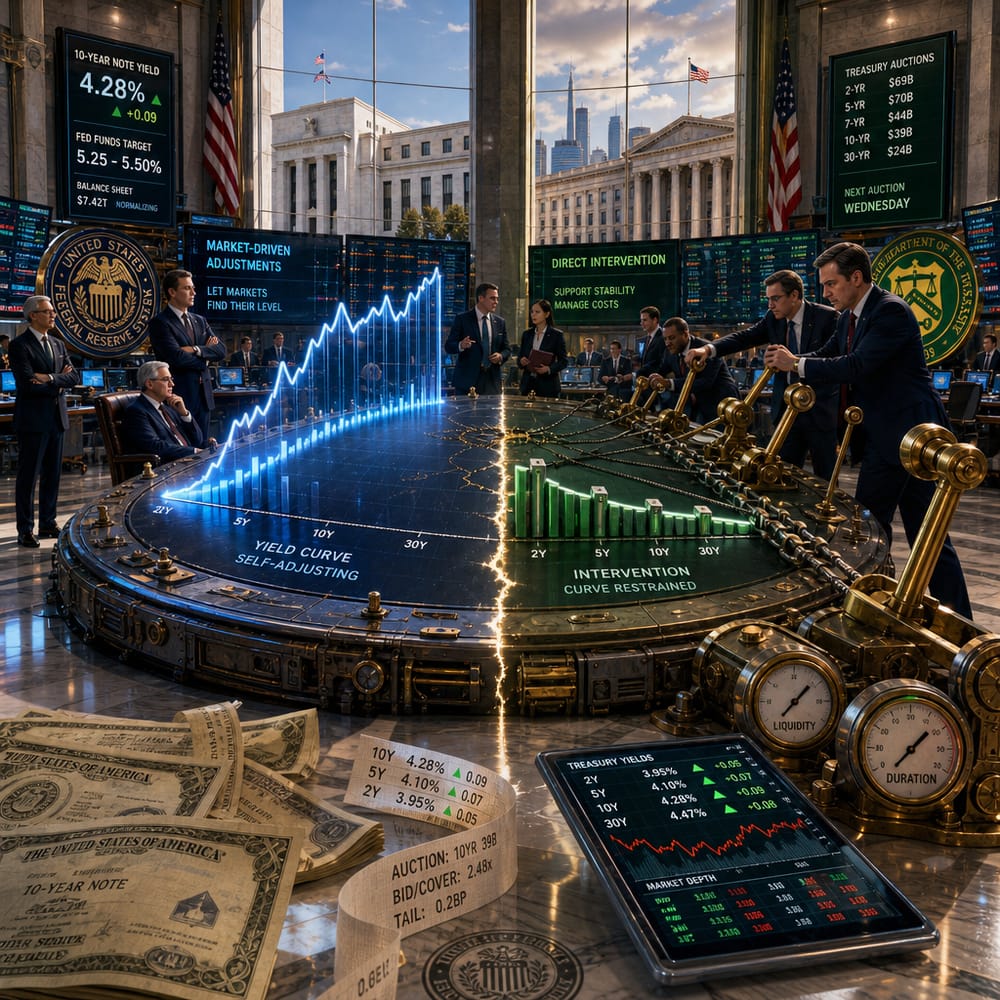
THE GREAT ECONOMIC TANGO: WHY THE FED AND TREASURY CAN'T FIND THE RHYTHM
You know that awkward dance moment when one person wants to foxtrot and the other insists on tangoing? Right now, that's the Federal Reserve and the Treasury Department on the economic dance floor, leaving everyone from Wall Street to Main Street scratching their heads and wondering who will step on whose toes next.
At the heart of this ballroom blitz is a fundamental clash. The Federal Reserve, the grand maestro of monetary policy, is all about letting the markets do their thing, trusting the invisible hand to guide bond yields to their "natural" level. Meanwhile, across the room, the Treasury Department is cha-cha-cha-ing with intervention, buying back long-term debt in a bid to put a lid on those rising yields. It’s a textbook case of "I love you, but we need to talk."
WHY DOES THIS MATTER?
Picture yourself trading stocks, blissfully humming along with a cup of coffee in hand. Now imagine if the two major players guiding economic policy can't agree on a playlist. For investors, this policy divergence is more than just philosophical—it’s the kind of thing that can make or break portfolios. Mixed signals from two massive economic institutions can translate to market instability, making the already capricious bond market even more unpredictable.
LET'S TALK DISAGREEMENT
So, what exactly are we dealing with here? The Federal Reserve’s approach is essentially laissez-faire. They're confident that market-driven adjustments will naturally balance the scales. On the other hand, the Treasury, led by Secretary Scott Bessent, is taking a more hands-on approach, actively buying back debt to manage yields. This is like the Fed saying, "Let it go with the breeze," while the Treasury insists on weatherproofing the house.
While the Treasury's actions might soothe short-term fears of runaway yields, it also raises the specter of debt accumulation, a point billionaire investor Ray Dalio was quick to underline. Dalio’s not one to mince words, describing the move as a potential harbinger of a debt crisis. His advice? Consider stashing some gold and Bitcoin as a hedge. In other words, batten down the hatches, folks.
THE RIPPLE EFFECTS
So, what does this policy spat mean for the rest of us? Well, if you're holding bonds, you’ve probably already felt the burn as yields have soared, driven by investor concerns over inflation and debt levels. As the Treasury fights to keep a lid on borrowing costs, the bond market has been a rollercoaster of volatility. Meanwhile, rising yields are capturing the attention of equity markets, too, as seen in the recent gyrations of the Dow and S&P 500.
But it's not all doom and gloom. Some sectors are cashing in on the chaos. Cryptocurrencies, for instance, have seen a resurgence as investors flee traditional assets. Bitcoin's recent 22% weekly gain is a testament to renewed optimism—or perhaps paranoia—about traditional markets. Still, this policy divergence has some investors wondering whether they need to rethink their strategies altogether.
LONG-TERM IMPLICATIONS
This Fed-Treasury tension isn’t just a juicy policy drama; it's a potential game-changer for monetary and fiscal policy coordination. If these two can't find common ground, we could see fragmented policy responses to future economic challenges, undermining their effectiveness. The lack of coordination could make it harder to combat inflation or manage economic growth, affecting everything from interest rates to government spending.
Moreover, this dance-off could signal to foreign investors that the U.S. doesn't have its economic house in order, potentially impacting the attractiveness of U.S. assets. If the world starts betting against U.S. bonds, well, let's just say, the ripple effects won't be pretty.
So what’s next in this economic tango? Will the Fed and Treasury find a common rhythm, or are we in for a season of economic two-stepping? As retail investors, it's more important than ever to keep an eye on these moves. Because when the giants waltz—or trip—they can leave a trail of market chaos in their wake, and you don’t want to be caught flat-footed.
This article is for informational purposes only and is not investment advice. Always do your own research or consult a licensed financial professional before making investment decisions.
© Copyright 2024. All Rights Reserved.
© Copyright 2024. All Rights Reserved.