

Expanding Breadth and Risk-On Indicators Suggest Stabilizing Market
Tuesday, August 25, 2026
EXPANDING BREADTH AND RISK-ON INDICATORS SUGGEST STABILIZING MARKET
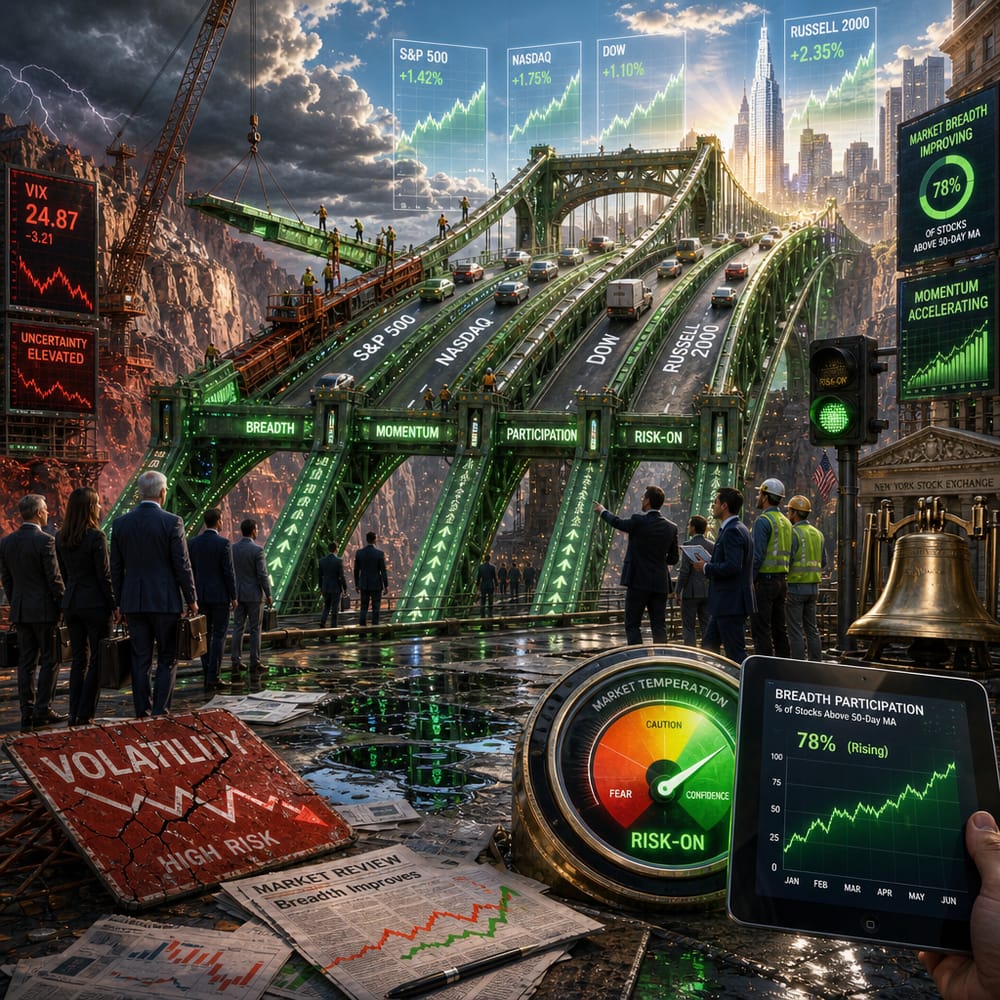
In a market full of twists and turns, a little stability is like a sip of water in the desert—refreshing, vital, and quite possibly a mirage. But, folks, it seems like the U.S. market might just be finding its footing. Recent indicators point to a shift in the market's mood from hesitant to daring, with improving breadth and a risk-on regime suggesting we might be in for smoother sailing, despite choppy headlines.
Let’s dive into what this all means. Market breadth, in plain English, refers to the number of stocks participating in a market move. When breadth improves, it means more stocks are getting in on the action. It’s like when everyone at the party finally hits the dance floor instead of standing around awkwardly pretending to enjoy the punch.
The significance of this? Well, when just a handful of stocks are pulling the market along, savvy investors tend to keep one eye open at night. It’s like balancing a pyramid on a single block—tippy. But broad participation? That’s a foundation you can build on, suggesting stability that can hold up to a few more wobbly news cycles.
In the recent past, we've seen the S&P 500, Nasdaq, and Dow dancing to the beat of just a few tech megastars while many other stocks sat out. But now, it seems like more members of the S&P 500 and the smaller-cap Russell 2000 are busting a move. And this, dear reader, is a promising sign.
Risk-on indicators are flashing, too. These are like those flashing lights at a concert—a little guidance that excitement is spreading. Essentially, a risk-on environment means that investors are feeling gutsy enough to bet on more volatile stocks—think the high-flyers of tech or emerging markets. It suggests a growing confidence in market conditions and potential returns.
But what’s sparking this courage? A few things are in play. For starters, we've watched U.S. Treasury yields start to walk back from their lofty heights. Lower yields make bonds less attractive, pushing investors to seek higher returns in stocks. Combine that with a Fed that’s been dropping hints of a pause on further rate hikes, and suddenly equities are looking like the belle of the ball.
And let's not forget our old buddy, momentum. It’s that glorious force that can propel stocks higher just because they’re already on the climb. It’s the market equivalent of a pop song that gets catchier the more you hear it. As more stocks catch this wave, it's easier for the indices to continue their upward trend.
Investors are taking note and adjusting their portfolios accordingly. With the Nasdaq climbing on the back of a semiconductor rally—shout-out to Nvidia's pre-earnings bounce—there’s optimism in the air. Even as chip analysts warn of potential valuations hiccups, the sector's revival fuels the risk-on fire.
As for sectors, it appears some investors are betting on growth areas that could thrive amidst volatility, such as tech and energy. This shift could be an attempt to diversify beyond the tried-and-true safe havens, looking to catch a ride on sectors with high potential for upside.
Of course, the macroeconomic landscape isn’t without its quirks. Trade tensions continue to simmer with Canada’s retaliatory tariffs and a bond market skeptically eyeing Treasury strategies. Yet, despite these headwinds, investor sentiment seems to be aligning with the idea that the worst may be behind us.
For the everyday investor, this is a fascinating moment. It’s the market equivalent of a dare—do you lean into the optimism or keep your guard up? While no one’s breaking out the crystal ball just yet, the broadening market participation and risk-on indicators are compelling reasons to stay engaged.
So, as we step into this new chapter, keep a watchful eye and a steady hand. After all, in the world of investing, the only certainty is change. That, and the fact that there’s always another twist just around the corner.
This article is for informational purposes only and is not investment advice. Always do your own research or consult a licensed financial professional before making investment decisions.
© Copyright 2024. All Rights Reserved.
© Copyright 2024. All Rights Reserved.