

Euro Struggles Against Dollar Amid Fed-ECB Policy Divergence
Thursday, August 13, 2026
EURO STRUGGLES AGAINST DOLLAR AMID FED-ECB POLICY DIVERGENCE
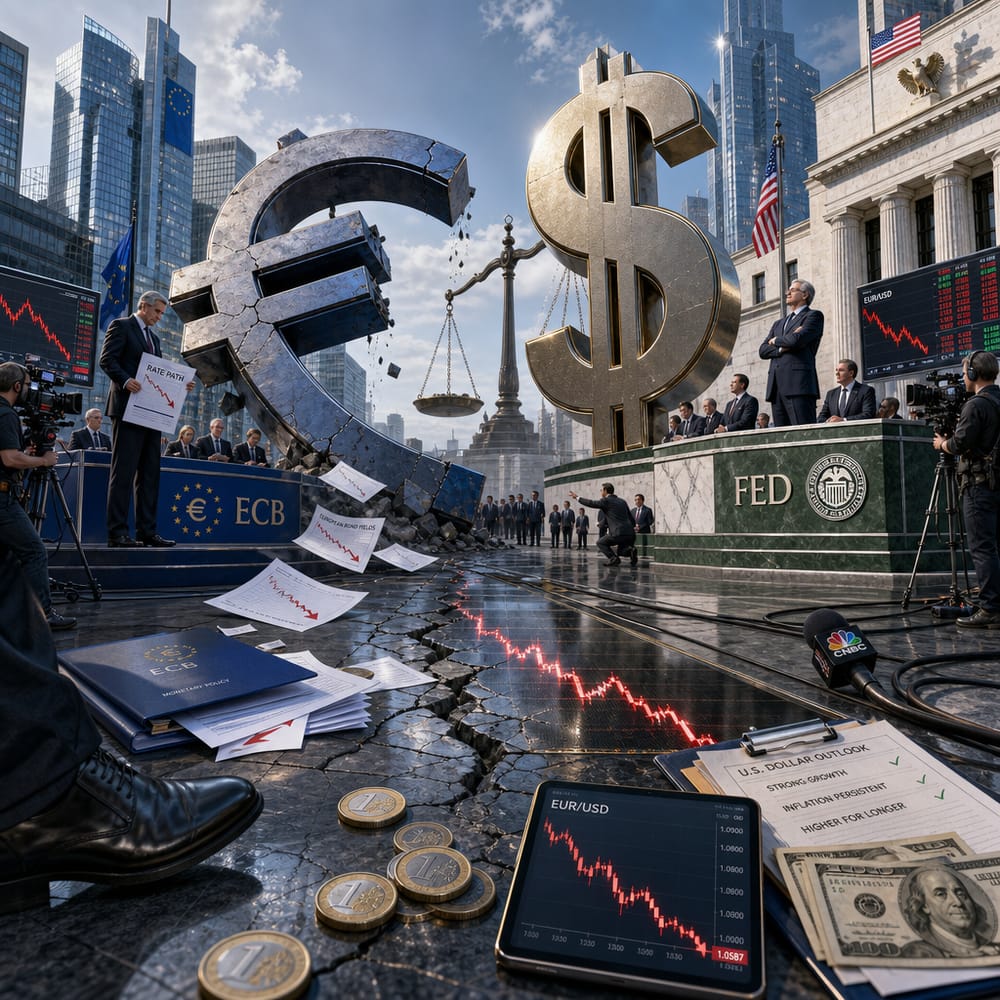
Picture this: the euro and the U.S. dollar in a wrestling ring, duking it out for dominance. The euro is battered and bruised, while the dollar stands tall and mighty. This isn’t just your average market match-up—it's about diverging monetary policies tugging at the heartstrings of currency traders everywhere.
Why should you care? Because these battles affect not just your vacation plans to Paris but also the broader economic landscape, shaping trade, investment, and even the cost of your next espresso.
THE FEDERAL RESERVE’S DOUBLE-EDGED SWORD
Let’s start with Uncle Sam’s Federal Reserve, the heavyweight in this contest. After a series of rate hikes aimed at cooling down the inflation party, Jerome Powell and his league of banking superheroes haven't ruled out further tightening. Unlike a casual summer fling, they're in it for the long haul, ready to hike rates if inflation refuses to play nice and cozy.
Here’s a fun fact for context: higher interest rates make a currency more attractive to investors. It's like moths to a flame. Why? Because investors can expect better returns on their investments denominated in that currency. So, as the Fed keeps its finger on the trigger, the dollar flexes its muscles, attracting global capital like bees to honey.
THE EUROPEAN CENTRAL BANK’S DOVISH WALTZ
Now, let’s salsa over to the European side, where the European Central Bank (ECB) is doing a different dance. Picture a slow waltz instead of a high-energy tango. The ECB has adopted a bit of a ‘dovish’ stance, which, in financial lingo, means they’re not in a rush to hike interest rates. Why? Europe's economic recovery isn’t out of the woods yet, and the ECB doesn't want to accidentally send it back into the wilderness.
By keeping rates low, the ECB aims to encourage borrowing and spending, hoping to inject some much-needed pep into the eurozone’s step. But there's a snag—the euro becomes less attractive for investors compared to the dollar. With lower returns on the table, why would anyone park their cash in euros when greener pastures beckon across the Atlantic?
RISKS LOOMING OVER THE EUROZONE
Now, let’s talk risks. With the euro underperforming, the eurozone faces some tricky situations. First, a weaker euro means imports become pricier, which isn’t great news when inflation is already a worry. Plus, the eurozone is heavily reliant on energy imports, so any dip in the euro's value can sting.
There’s also the looming specter of trade imbalances. If European products become cheaper on the global market thanks to a weaker euro, exports might get a temporary boost. But let’s not pop the champagne just yet—this imbalance can lead to protectionist sentiments from trading partners, a not-so-friendly reminder that global trade isn’t a one-way street.
WHAT’S NEXT FOR THE EURO?
Now, the million-euro question: what happens next? Will the ECB change its tune, or will the Fed’s hawkish ways prevail?
Much depends on inflation data, employment numbers, and other economic indicators that central bankers treat like gospel. If the ECB decides to tighten its belt and raise interest rates, it could level the playing field—but that’s a big ‘if.’
So, keep your eyes peeled and ears open for any signals from the ECB. Until then, the euro will likely continue its rollercoaster ride, holding on tight as the dollar speeds along the track.
THE TAKEAWAY
As we watch this monetary tug-of-war, remember that currency markets are like a game of chess on steroids—complex, fast-paced, and influenced by multiple moves. For retail investors, understanding the ebb and flow of these market dynamics can be as valuable as knowing when to hold 'em and when to fold 'em.
In the end, whether you’re trading forex, planning a European getaway, or merely sipping your morning cappuccino, the dollar-euro clash will ripple through the financial world, reminding us all that in the global economy, no currency is an island.
This article is for informational purposes only and is not investment advice. Always do your own research or consult a licensed financial professional before making investment decisions.
© Copyright 2024. All Rights Reserved.
© Copyright 2024. All Rights Reserved.