

ETF Inflows vs. Derivatives Liquidations: A Market Tug-of-War
Sunday, August 23, 2026
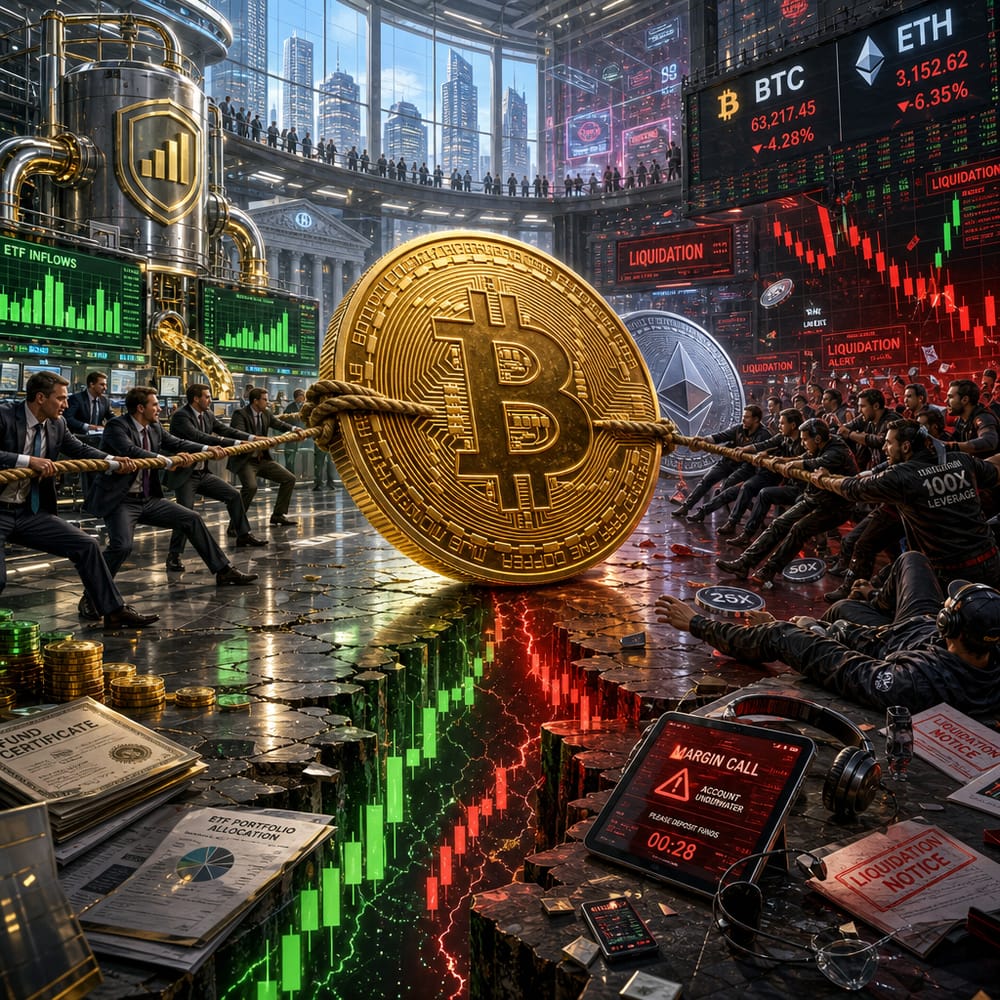
ETF Inflows vs. Derivatives Liquidations: A Market Tug-of-War
In the world of finance, it's usually a good thing when money flows into an investment vehicle. But what happens when your shiny new investments keep getting knocked around by some overzealous traders with a penchant for the dramatic? Answer: you get a market tug-of-war that would make even the most seasoned investor sweat a little.
Welcome to the world of crypto, where the influx of ETF investments and the chaos of derivatives liquidations are currently arm-wrestling for dominance. On one side, we have ETFs (Exchange Traded Funds) attracting more capital than a Black Friday sale at Best Buy. This is generally a sign that institutional investors are pouring in, bringing a sense of legitimacy and stability. On the other side, the crypto circus is lit up by risk-loving traders whose leveraged bets are causing liquidation fireworks.
So, what's the story here? Let's break it down, minus the Wall Street mumbo-jumbo.
ETFs: THE COOL, CALM COLLECTOR
Picture ETFs as the mature adult in a room full of teenagers hyped up on energy drinks. They are investment vehicles that follow the value of a group of assets, and in the case of crypto ETFs, they track cryptocurrencies like Bitcoin and Ethereum. These ETFs have been raking in cash, suggesting that big players want a piece of the digital currency pie. Think of it as Wall Street finally catching up with Silicon Valley's latest tech fad.
The money pouring into crypto ETFs might be seen as a stabilizing force. It's like adding more anchors to a ship in stormy seas — the hope is to keep the ride a little less turbulent. But as you might expect, crypto doesn't do "calm" very well.
DERIVATIVES: THE VOLATILE PARTY CRASHERS
Enter derivatives, the rebellious teenager of the financial world. These are contracts that derive their value from an underlying asset, like cryptocurrencies. Traders use them to bet on price movements, hoping to profit wildly. But unlike the slow and steady ETF investors, these traders are in it for a quick thrill. They often use leverage, meaning they borrow money to amplify their bets.
When their bets go south, the market sees what's called a "liquidation." It's a fancy way of saying these traders are forced to sell off their positions, often at a loss, to cover the borrowed money. This can cause prices to spiral downwards quickly, creating a ripple effect across the market.
THE RIPPLE EFFECT
So, how does this all play out for market stability? If ETFs are the brakes, derivatives liquidations are the gas pedal glued to the floor. The influx of ETF money tries to slow down the wild price swings, but every time there's a mass liquidation in the derivatives market, it sends the market skidding out of control.
For future price movements, this dynamic suggests an ongoing battle. Institutional money might bring some semblance of order, yet as long as derivatives traders keep pushing their luck, volatility will remain a hallmark of the crypto market.
WHAT DOES THIS MEAN FOR YOU, DEAR RETAIL INVESTOR?
As a retail investor, you might feel like a spectator at a gladiator match, eyes darting between the ETF warriors and the derivatives gladiators. On the one hand, ETFs offer a more stable and regulated way to participate in the crypto craze without diving into the pandemonium directly. On the other, the potential for massive gains through derivatives is tempting, but with that comes massive risk.
For those eyeing the long haul, leaning towards ETFs might make sense, especially if you're looking to avoid the anxiety of daily price swings. However, if you've got the appetite for high risk and even higher reward, derivatives might still have a spot in your portfolio — just make sure it's the kind of money you can afford to lose.
In the end, whether you're in it for the calm or the chaos, understanding the dance between these two market forces is key to navigating the crypto landscape. So buckle up, because this tug-of-war isn't ending anytime soon. Who knows? You might just enjoy the ride.
This article is for informational purposes only and is not investment advice. Always do your own research or consult a licensed financial professional before making investment decisions.
© Copyright 2024. All Rights Reserved.
© Copyright 2024. All Rights Reserved.